

THE DEEP-SEA FLOOR: AN OVERVIEW
29
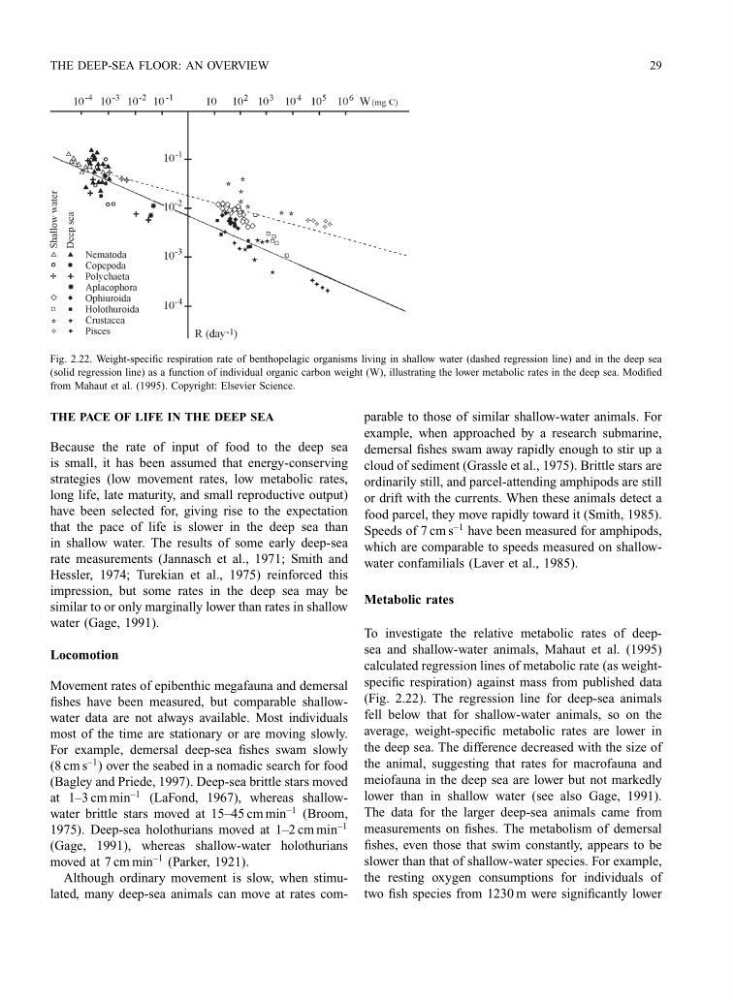
Fig. 2.22. Weight-specific respiration rate of benthopelagic organisms living in shallow water (dashed regression line) and in the deep sea
(solid regression line) as a function of individual organic carbon weight (W), illustrating the lower metabolic rates in the deep sea. Modified
from Mahaut et al. (1995). Copyright: Elsevier Science.
THE PACE OF LIFE IN THE DEEP SEA
Because the rate of input of food to the deep sea
is small, it has been assumed that energy-conserving
strategies (low movement rates, low metabolic rates,
long life, late maturity, and small reproductive output)
have been selected for, giving rise to the expectation
that the pace of life is slower in the deep sea than
in shallow water. The results of some early deep-sea
rate measurements (Jannasch et al., 1971; Smith and
Hessler, 1974; Turekian et al., 1975) reinforced this
impression, but some rates in the deep sea may be
similar to or only marginally lower than rates in shallow
water (Gage, 1991).
Locomotion
Movement rates of epibenthic megafauna and demersal
fishes have been measured, but comparable shallowwater data are not always available. Most individuals
most of the time are stationary or are moving slowly.
For example, demersal deep-sea fishes swam slowly
(8 cm s
−1 ) over the seabed in a nomadic search for food
(Bagley and Priede, 1997). Deep-sea brittle stars moved
at 1–3 cm min
−1 (LaFond, 1967), whereas shallowwater brittle stars moved at 15–45 cm min
−1 (Broom,
1975). Deep-sea holothurians moved at 1–2 cm min
−1
(Gage, 1991), whereas shallow-water holothurians
moved at 7 cm min
−1 (Parker, 1921).
Although ordinary movement is slow, when stimulated, many deep-sea animals can move at rates comparable to those of similar shallow-water animals. For
example, when approached by a research submarine,
demersal fishes swam away rapidly enough to stir up a
cloud of sediment (Grassle et al., 1975). Brittle stars are
ordinarily still, and parcel-attending amphipods are still
or drift with the currents. When these animals detect a
food parcel, they move rapidly toward it (Smith, 1985).
Speeds of 7 cm s
−1 have been measured for amphipods,
which are comparable to speeds measured on shallowwater confamilials (Laver et al., 1985).
Metabolic rates
To investigate the relative metabolic rates of deepsea and shallow-water animals, Mahaut et al. (1995)
calculated regression lines of metabolic rate (as weightspecific respiration) against mass from published data
(Fig. 2.22). The regression line for deep-sea animals
fell below that for shallow-water animals, so on the
average, weight-specific metabolic rates are lower in
the deep sea. The difference decreased with the size of
the animal, suggesting that rates for macrofauna and
meiofauna in the deep sea are lower but not markedly
lower than in shallow water (see also Gage, 1991).
The data for the larger deep-sea animals came from
measurements on fishes. The metabolism of demersal
fishes, even those that swim constantly, appears to be
slower than that of shallow-water species. For example,
the resting oxygen consumptions for individuals of
two fish species from 1230 m were significantly lower
29
Fig. 2.22. Weight-specific respiration rate of benthopelagic organisms living in shallow water (dashed regression line) and in the deep sea
(solid regression line) as a function of individual organic carbon weight (W), illustrating the lower metabolic rates in the deep sea. Modified
from Mahaut et al. (1995). Copyright: Elsevier Science.
THE PACE OF LIFE IN THE DEEP SEA
Because the rate of input of food to the deep sea
is small, it has been assumed that energy-conserving
strategies (low movement rates, low metabolic rates,
long life, late maturity, and small reproductive output)
have been selected for, giving rise to the expectation
that the pace of life is slower in the deep sea than
in shallow water. The results of some early deep-sea
rate measurements (Jannasch et al., 1971; Smith and
Hessler, 1974; Turekian et al., 1975) reinforced this
impression, but some rates in the deep sea may be
similar to or only marginally lower than rates in shallow
water (Gage, 1991).
Locomotion
Movement rates of epibenthic megafauna and demersal
fishes have been measured, but comparable shallowwater data are not always available. Most individuals
most of the time are stationary or are moving slowly.
For example, demersal deep-sea fishes swam slowly
(8 cm s
−1 ) over the seabed in a nomadic search for food
(Bagley and Priede, 1997). Deep-sea brittle stars moved
at 1–3 cm min
−1 (LaFond, 1967), whereas shallowwater brittle stars moved at 15–45 cm min
−1 (Broom,
1975). Deep-sea holothurians moved at 1–2 cm min
−1
(Gage, 1991), whereas shallow-water holothurians
moved at 7 cm min
−1 (Parker, 1921).
Although ordinary movement is slow, when stimulated, many deep-sea animals can move at rates comparable to those of similar shallow-water animals. For
example, when approached by a research submarine,
demersal fishes swam away rapidly enough to stir up a
cloud of sediment (Grassle et al., 1975). Brittle stars are
ordinarily still, and parcel-attending amphipods are still
or drift with the currents. When these animals detect a
food parcel, they move rapidly toward it (Smith, 1985).
Speeds of 7 cm s
−1 have been measured for amphipods,
which are comparable to speeds measured on shallowwater confamilials (Laver et al., 1985).
Metabolic rates
To investigate the relative metabolic rates of deepsea and shallow-water animals, Mahaut et al. (1995)
calculated regression lines of metabolic rate (as weightspecific respiration) against mass from published data
(Fig. 2.22). The regression line for deep-sea animals
fell below that for shallow-water animals, so on the
average, weight-specific metabolic rates are lower in
the deep sea. The difference decreased with the size of
the animal, suggesting that rates for macrofauna and
meiofauna in the deep sea are lower but not markedly
lower than in shallow water (see also Gage, 1991).
The data for the larger deep-sea animals came from
measurements on fishes. The metabolism of demersal
fishes, even those that swim constantly, appears to be
slower than that of shallow-water species. For example,
the resting oxygen consumptions for individuals of
two fish species from 1230 m were significantly lower