

384
Craig M. YOUNG
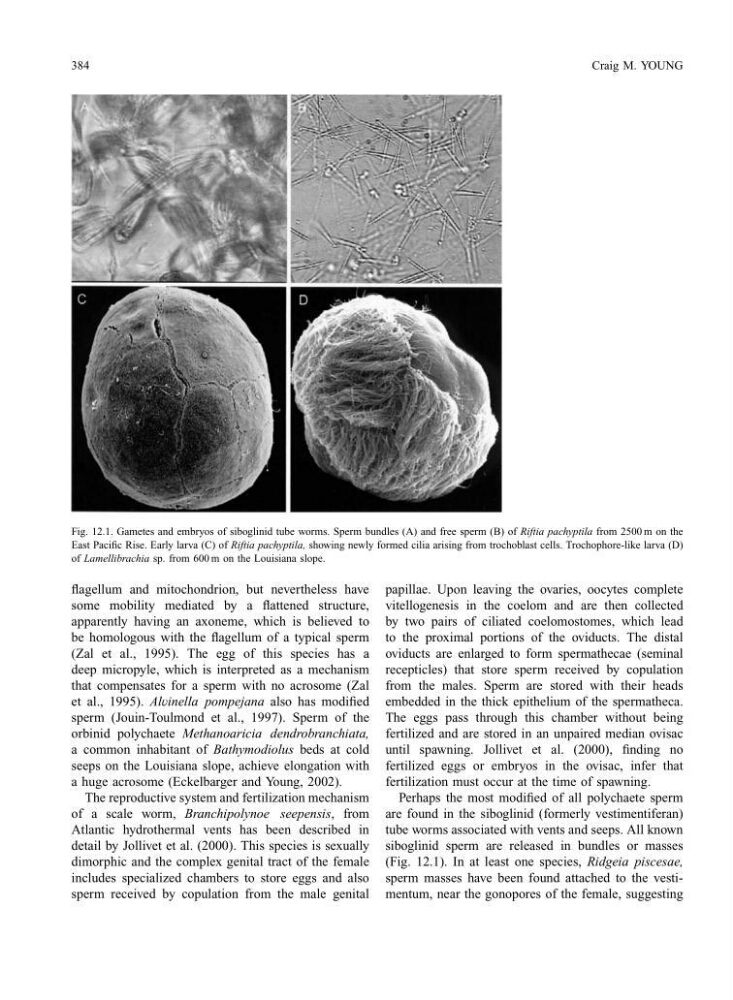
Fig. 12.1. Gametes and embryos of siboglinid tube worms. Sperm bundles (A) and free sperm (B) of Riftia pachyptila from 2500 m on the
East Pacific Rise. Early larva (C) of Riftia pachyptila, showing newly formed cilia arising from trochoblast cells. Trochophore-like larva (D)
of Lamellibrachia sp. from 600 m on the Louisiana slope.
flagellum and mitochondrion, but nevertheless have
some mobility mediated by a flattened structure,
apparently having an axoneme, which is believed to
be homologous with the flagellum of a typical sperm
(Zal et al., 1995). The egg of this species has a
deep micropyle, which is interpreted as a mechanism
that compensates for a sperm with no acrosome (Zal
et al., 1995). Alvinella pompejana also has modified
sperm (Jouin-Toulmond et al., 1997). Sperm of the
orbinid polychaete Methanoaricia dendrobranchiata,
a common inhabitant of Bathymodiolus beds at cold
seeps on the Louisiana slope, achieve elongation with
a huge acrosome (Eckelbarger and Young, 2002).
The reproductive system and fertilization mechanism
of a scale worm, Branchipolynoe seepensis, from
Atlantic hydrothermal vents has been described in
detail by Jollivet et al. (2000). This species is sexually
dimorphic and the complex genital tract of the female
includes specialized chambers to store eggs and also
sperm received by copulation from the male genital
papillae. Upon leaving the ovaries, oocytes complete
vitellogenesis in the coelom and are then collected
by two pairs of ciliated coelomostomes, which lead
to the proximal portions of the oviducts. The distal
oviducts are enlarged to form spermathecae (seminal
recepticles) that store sperm received by copulation
from the males. Sperm are stored with their heads
embedded in the thick epithelium of the spermatheca.
The eggs pass through this chamber without being
fertilized and are stored in an unpaired median ovisac
until spawning. Jollivet et al. (2000), finding no
fertilized eggs or embryos in the ovisac, infer that
fertilization must occur at the time of spawning.
Perhaps the most modified of all polychaete sperm
are found in the siboglinid (formerly vestimentiferan)
tube worms associated with vents and seeps. All known
siboglinid sperm are released in bundles or masses
(Fig. 12.1). In at least one species, Ridgeia piscesae,
sperm masses have been found attached to the vestimentum, near the gonopores of the female, suggesting
Craig M. YOUNG
Fig. 12.1. Gametes and embryos of siboglinid tube worms. Sperm bundles (A) and free sperm (B) of Riftia pachyptila from 2500 m on the
East Pacific Rise. Early larva (C) of Riftia pachyptila, showing newly formed cilia arising from trochoblast cells. Trochophore-like larva (D)
of Lamellibrachia sp. from 600 m on the Louisiana slope.
flagellum and mitochondrion, but nevertheless have
some mobility mediated by a flattened structure,
apparently having an axoneme, which is believed to
be homologous with the flagellum of a typical sperm
(Zal et al., 1995). The egg of this species has a
deep micropyle, which is interpreted as a mechanism
that compensates for a sperm with no acrosome (Zal
et al., 1995). Alvinella pompejana also has modified
sperm (Jouin-Toulmond et al., 1997). Sperm of the
orbinid polychaete Methanoaricia dendrobranchiata,
a common inhabitant of Bathymodiolus beds at cold
seeps on the Louisiana slope, achieve elongation with
a huge acrosome (Eckelbarger and Young, 2002).
The reproductive system and fertilization mechanism
of a scale worm, Branchipolynoe seepensis, from
Atlantic hydrothermal vents has been described in
detail by Jollivet et al. (2000). This species is sexually
dimorphic and the complex genital tract of the female
includes specialized chambers to store eggs and also
sperm received by copulation from the male genital
papillae. Upon leaving the ovaries, oocytes complete
vitellogenesis in the coelom and are then collected
by two pairs of ciliated coelomostomes, which lead
to the proximal portions of the oviducts. The distal
oviducts are enlarged to form spermathecae (seminal
recepticles) that store sperm received by copulation
from the males. Sperm are stored with their heads
embedded in the thick epithelium of the spermatheca.
The eggs pass through this chamber without being
fertilized and are stored in an unpaired median ovisac
until spawning. Jollivet et al. (2000), finding no
fertilized eggs or embryos in the ovisac, infer that
fertilization must occur at the time of spawning.
Perhaps the most modified of all polychaete sperm
are found in the siboglinid (formerly vestimentiferan)
tube worms associated with vents and seeps. All known
siboglinid sperm are released in bundles or masses
(Fig. 12.1). In at least one species, Ridgeia piscesae,
sperm masses have been found attached to the vestimentum, near the gonopores of the female, suggesting