

FOOD INPUTS, UTILIZATION, CARBON FLOW AND ENERGETICS
365
to account for the deficiency observed in sediment
traps (Thomsen, 1999). However, these studies have
also shown the importance of the resuspension loop in
modifying the distribution and composition of organic
carbon. Thomsen and Gust (2000) have suggested that
an energy cascade occurs for benthic boundary layer
aggregates. This begins with the most labile and nutritious particles freshly arrived from the euphotic zone,
and ends with primary sediment particles containing
very old refractory carbon of extremely low nutritive
value to the sediment community, which accumulate in
deep water.
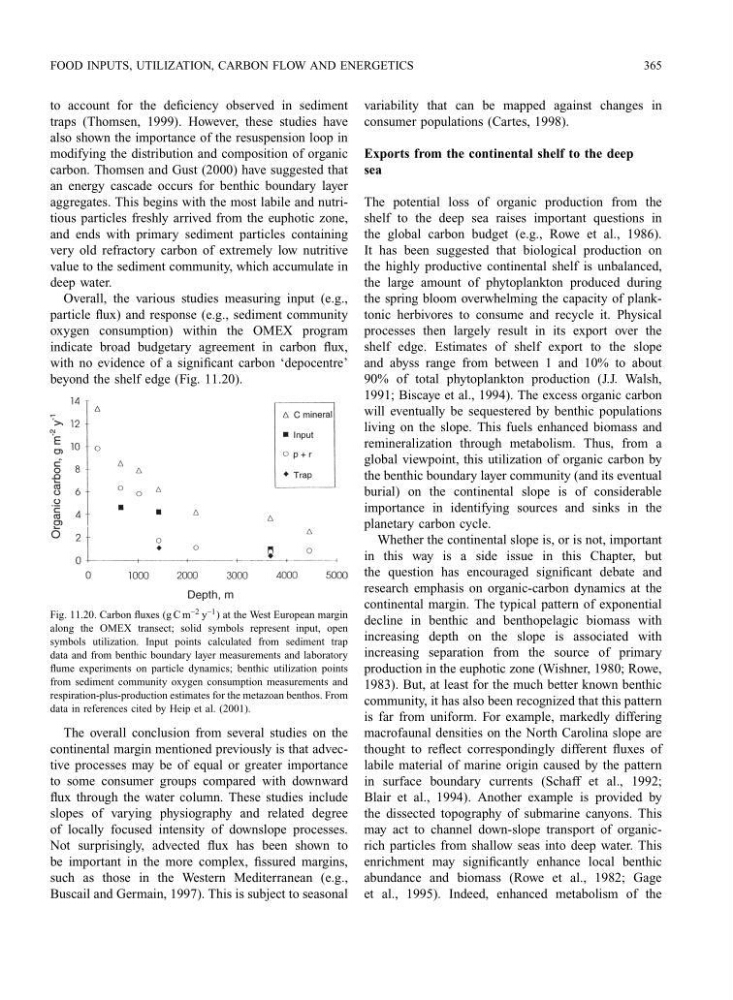
Overall, the various studies measuring input (e.g.,
particle flux) and response (e.g., sediment community
oxygen consumption) within the OMEX program
indicate broad budgetary agreement in carbon flux,
with no evidence of a significant carbon ‘depocentre’
beyond the shelf edge (Fig. 11.20).
Fig. 11.20. Carbon fluxes (g C m −2 y −1 ) at the West European margin
along the OMEX transect; solid symbols represent input, open
symbols utilization. Input points calculated from sediment trap
data and from benthic boundary layer measurements and laboratory
flume experiments on particle dynamics; benthic utilization points
from sediment community oxygen consumption measurements and
respiration-plus-production estimates for the metazoan benthos. From
data in references cited by Heip et al. (2001).
The overall conclusion from several studies on the
continental margin mentioned previously is that advective processes may be of equal or greater importance
to some consumer groups compared with downward
flux through the water column. These studies include
slopes of varying physiography and related degree
of locally focused intensity of downslope processes.
Not surprisingly, advected flux has been shown to
be important in the more complex, fissured margins,
such as those in the Western Mediterranean (e.g.,
Buscail and Germain, 1997). This is subject to seasonal
variability that can be mapped against changes in
consumer populations (Cartes, 1998).
Exports from the continental shelf to the deep
sea
The potential loss of organic production from the
shelf to the deep sea raises important questions in
the global carbon budget (e.g., Rowe et al., 1986).
It has been suggested that biological production on
the highly productive continental shelf is unbalanced,
the large amount of phytoplankton produced during
the spring bloom overwhelming the capacity of planktonic herbivores to consume and recycle it. Physical
processes then largely result in its export over the
shelf edge. Estimates of shelf export to the slope
and abyss range from between 1 and 10% to about
90% of total phytoplankton production (J.J. Walsh,
1991; Biscaye et al., 1994). The excess organic carbon
will eventually be sequestered by benthic populations
living on the slope. This fuels enhanced biomass and
remineralization through metabolism. Thus, from a
global viewpoint, this utilization of organic carbon by
the benthic boundary layer community (and its eventual
burial) on the continental slope is of considerable
importance in identifying sources and sinks in the
planetary carbon cycle.
Whether the continental slope is, or is not, important
in this way is a side issue in this Chapter, but
the question has encouraged significant debate and
research emphasis on organic-carbon dynamics at the
continental margin. The typical pattern of exponential
decline in benthic and benthopelagic biomass with
increasing depth on the slope is associated with
increasing separation from the source of primary
production in the euphotic zone (Wishner, 1980; Rowe,
1983). But, at least for the much better known benthic
community, it has also been recognized that this pattern
is far from uniform. For example, markedly differing
macrofaunal densities on the North Carolina slope are
thought to reflect correspondingly different fluxes of
labile material of marine origin caused by the pattern
in surface boundary currents (Schaff et al., 1992;
Blair et al., 1994). Another example is provided by
the dissected topography of submarine canyons. This
may act to channel down-slope transport of organicrich particles from shallow seas into deep water. This
enrichment may significantly enhance local benthic
abundance and biomass (Rowe et al., 1982; Gage
et al., 1995). Indeed, enhanced metabolism of the
365
to account for the deficiency observed in sediment
traps (Thomsen, 1999). However, these studies have
also shown the importance of the resuspension loop in
modifying the distribution and composition of organic
carbon. Thomsen and Gust (2000) have suggested that
an energy cascade occurs for benthic boundary layer
aggregates. This begins with the most labile and nutritious particles freshly arrived from the euphotic zone,
and ends with primary sediment particles containing
very old refractory carbon of extremely low nutritive
value to the sediment community, which accumulate in
deep water.
Overall, the various studies measuring input (e.g.,
particle flux) and response (e.g., sediment community
oxygen consumption) within the OMEX program
indicate broad budgetary agreement in carbon flux,
with no evidence of a significant carbon ‘depocentre’
beyond the shelf edge (Fig. 11.20).
Fig. 11.20. Carbon fluxes (g C m −2 y −1 ) at the West European margin
along the OMEX transect; solid symbols represent input, open
symbols utilization. Input points calculated from sediment trap
data and from benthic boundary layer measurements and laboratory
flume experiments on particle dynamics; benthic utilization points
from sediment community oxygen consumption measurements and
respiration-plus-production estimates for the metazoan benthos. From
data in references cited by Heip et al. (2001).
The overall conclusion from several studies on the
continental margin mentioned previously is that advective processes may be of equal or greater importance
to some consumer groups compared with downward
flux through the water column. These studies include
slopes of varying physiography and related degree
of locally focused intensity of downslope processes.
Not surprisingly, advected flux has been shown to
be important in the more complex, fissured margins,
such as those in the Western Mediterranean (e.g.,
Buscail and Germain, 1997). This is subject to seasonal
variability that can be mapped against changes in
consumer populations (Cartes, 1998).
Exports from the continental shelf to the deep
sea
The potential loss of organic production from the
shelf to the deep sea raises important questions in
the global carbon budget (e.g., Rowe et al., 1986).
It has been suggested that biological production on
the highly productive continental shelf is unbalanced,
the large amount of phytoplankton produced during
the spring bloom overwhelming the capacity of planktonic herbivores to consume and recycle it. Physical
processes then largely result in its export over the
shelf edge. Estimates of shelf export to the slope
and abyss range from between 1 and 10% to about
90% of total phytoplankton production (J.J. Walsh,
1991; Biscaye et al., 1994). The excess organic carbon
will eventually be sequestered by benthic populations
living on the slope. This fuels enhanced biomass and
remineralization through metabolism. Thus, from a
global viewpoint, this utilization of organic carbon by
the benthic boundary layer community (and its eventual
burial) on the continental slope is of considerable
importance in identifying sources and sinks in the
planetary carbon cycle.
Whether the continental slope is, or is not, important
in this way is a side issue in this Chapter, but
the question has encouraged significant debate and
research emphasis on organic-carbon dynamics at the
continental margin. The typical pattern of exponential
decline in benthic and benthopelagic biomass with
increasing depth on the slope is associated with
increasing separation from the source of primary
production in the euphotic zone (Wishner, 1980; Rowe,
1983). But, at least for the much better known benthic
community, it has also been recognized that this pattern
is far from uniform. For example, markedly differing
macrofaunal densities on the North Carolina slope are
thought to reflect correspondingly different fluxes of
labile material of marine origin caused by the pattern
in surface boundary currents (Schaff et al., 1992;
Blair et al., 1994). Another example is provided by
the dissected topography of submarine canyons. This
may act to channel down-slope transport of organicrich particles from shallow seas into deep water. This
enrichment may significantly enhance local benthic
abundance and biomass (Rowe et al., 1982; Gage
et al., 1995). Indeed, enhanced metabolism of the