

358
John D. GAGE
increasing depth (Stockton and DeLaca, 1982) is at
least partly because of the declining flux of small
particles arriving at the bottom, so that quantitatively
detrivory becomes relatively less important.
Recent studies using stable-isotope analysis combined with gut-contents analysis in the European
BENGAL study site on the Porcupine Abyssal Plain
support this view of facultative scavenging combined
with predation on living prey. Iken et al. (2001)
found that highly motile organisms – large amphipods,
decapod crustaceans and benthopelagic fish, such as
Coryphaenoides (Nematonurus) armatus – show levels
of
13 N enrichment below those of known predators.
This was interpreted as reflecting dependency on both
abyssopelagic prey and large food-falls.
Effect of food falls on the ‘background’ sediment
community
It has been thought that relatively large carcasses
might attract small benthic trophic opportunists, such
as capitellid and dorvilleid polychaetes, cumaceans and
leptostracans, as well as the more specialized scavenging fauna such as lysiannasid amphipods. Observations
suggest that fish visiting carcasses prey on smaller
animals such as the scavenging amphipods always
attracted to such falls (e.g., Jones et al., 1998), so that
such links form part of the wider deep-sea food chain.
These, and more recent observations on the sediment
macrofaunal response to a whale skeleton on the seabed
off California (C.R. Smith et al., 1998), however,
seem to confirm earlier suppositions (e.g., Dayton and
Hessler, 1972; Rowe et al., 1974) that the ‘background’
sediment fauna is little affected. They certainly do not
support the hypothetical enrichment by consumption of
scavenger faeces suggested by Stockton and DeLaca
(1982). Fish and epifaunal invertebrate scavengers
consume and disperse the package so efficiently that
little remains for direct utilization by the infaunal
sediment community. Any local sediment enrichment
perhaps resulting from scavenger faeces might be
counterbalanced by direct effects through smothering
by the carcass, or by secondary smothering caused
by debris from megafauna colonizing whale skeletons
(C.R. Smith et al., 1998).
Significance of large animal food-falls and the
biomass of the scavenging community
It is immensely difficult to estimate the total amount of
organic matter entering the deep-sea ecosystem as large
food falls. Bait experiments on the deep-sea bed (see
below) show that scavenging animals are an integral
part of deep-sea food webs through the ingestion and
redistribution of organic matter. Quantification of these
scavenger populations is a good way to understand
the importance of such large food falls, but this
has proved difficult. Although a large biomass of
sharks and chimaeras has been observed from baited
cameras and manned submersibles, quantification of
their importance as scavengers is problematic. Mahaut
et al. (1990) concluded that carcasses falling to the
bottom, at a depth of 2100 m on the Meriadzek
Terrace (Northeast Atlantic), are exploited exclusively
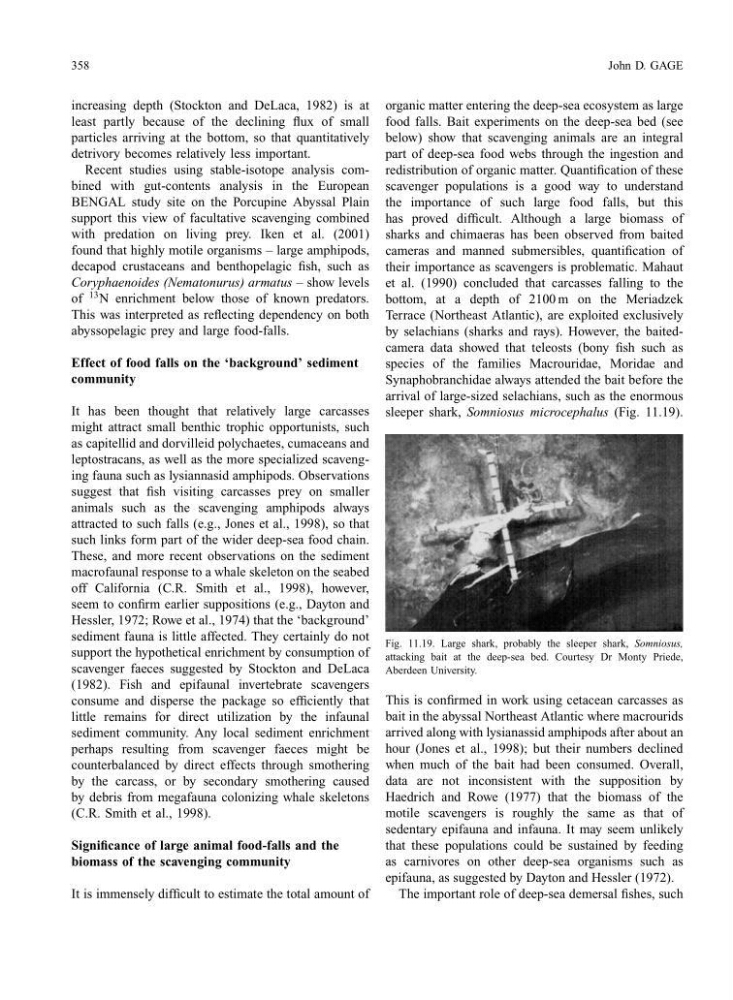
by selachians (sharks and rays). However, the baitedcamera data showed that teleosts (bony fish such as
species of the families Macrouridae, Moridae and
Synaphobranchidae always attended the bait before the
arrival of large-sized selachians, such as the enormous
sleeper shark, Somniosus microcephalus (Fig. 11.19).
Fig. 11.19. Large shark, probably the sleeper shark, Somniosus,
attacking bait at the deep-sea bed. Courtesy Dr Monty Priede,
Aberdeen University.
This is confirmed in work using cetacean carcasses as
bait in the abyssal Northeast Atlantic where macrourids
arrived along with lysianassid amphipods after about an
hour (Jones et al., 1998); but their numbers declined
when much of the bait had been consumed. Overall,
data are not inconsistent with the supposition by
Haedrich and Rowe (1977) that the biomass of the
motile scavengers is roughly the same as that of
sedentary epifauna and infauna. It may seem unlikely
that these populations could be sustained by feeding
as carnivores on other deep-sea organisms such as
epifauna, as suggested by Dayton and Hessler (1972).
The important role of deep-sea demersal fishes, such
John D. GAGE
increasing depth (Stockton and DeLaca, 1982) is at
least partly because of the declining flux of small
particles arriving at the bottom, so that quantitatively
detrivory becomes relatively less important.
Recent studies using stable-isotope analysis combined with gut-contents analysis in the European
BENGAL study site on the Porcupine Abyssal Plain
support this view of facultative scavenging combined
with predation on living prey. Iken et al. (2001)
found that highly motile organisms – large amphipods,
decapod crustaceans and benthopelagic fish, such as
Coryphaenoides (Nematonurus) armatus – show levels
of
13 N enrichment below those of known predators.
This was interpreted as reflecting dependency on both
abyssopelagic prey and large food-falls.
Effect of food falls on the ‘background’ sediment
community
It has been thought that relatively large carcasses
might attract small benthic trophic opportunists, such
as capitellid and dorvilleid polychaetes, cumaceans and
leptostracans, as well as the more specialized scavenging fauna such as lysiannasid amphipods. Observations
suggest that fish visiting carcasses prey on smaller
animals such as the scavenging amphipods always
attracted to such falls (e.g., Jones et al., 1998), so that
such links form part of the wider deep-sea food chain.
These, and more recent observations on the sediment
macrofaunal response to a whale skeleton on the seabed
off California (C.R. Smith et al., 1998), however,
seem to confirm earlier suppositions (e.g., Dayton and
Hessler, 1972; Rowe et al., 1974) that the ‘background’
sediment fauna is little affected. They certainly do not
support the hypothetical enrichment by consumption of
scavenger faeces suggested by Stockton and DeLaca
(1982). Fish and epifaunal invertebrate scavengers
consume and disperse the package so efficiently that
little remains for direct utilization by the infaunal
sediment community. Any local sediment enrichment
perhaps resulting from scavenger faeces might be
counterbalanced by direct effects through smothering
by the carcass, or by secondary smothering caused
by debris from megafauna colonizing whale skeletons
(C.R. Smith et al., 1998).
Significance of large animal food-falls and the
biomass of the scavenging community
It is immensely difficult to estimate the total amount of
organic matter entering the deep-sea ecosystem as large
food falls. Bait experiments on the deep-sea bed (see
below) show that scavenging animals are an integral
part of deep-sea food webs through the ingestion and
redistribution of organic matter. Quantification of these
scavenger populations is a good way to understand
the importance of such large food falls, but this
has proved difficult. Although a large biomass of
sharks and chimaeras has been observed from baited
cameras and manned submersibles, quantification of
their importance as scavengers is problematic. Mahaut
et al. (1990) concluded that carcasses falling to the
bottom, at a depth of 2100 m on the Meriadzek
Terrace (Northeast Atlantic), are exploited exclusively
by selachians (sharks and rays). However, the baitedcamera data showed that teleosts (bony fish such as
species of the families Macrouridae, Moridae and
Synaphobranchidae always attended the bait before the
arrival of large-sized selachians, such as the enormous
sleeper shark, Somniosus microcephalus (Fig. 11.19).
Fig. 11.19. Large shark, probably the sleeper shark, Somniosus,
attacking bait at the deep-sea bed. Courtesy Dr Monty Priede,
Aberdeen University.
This is confirmed in work using cetacean carcasses as
bait in the abyssal Northeast Atlantic where macrourids
arrived along with lysianassid amphipods after about an
hour (Jones et al., 1998); but their numbers declined
when much of the bait had been consumed. Overall,
data are not inconsistent with the supposition by
Haedrich and Rowe (1977) that the biomass of the
motile scavengers is roughly the same as that of
sedentary epifauna and infauna. It may seem unlikely
that these populations could be sustained by feeding
as carnivores on other deep-sea organisms such as
epifauna, as suggested by Dayton and Hessler (1972).
The important role of deep-sea demersal fishes, such