

FOOD INPUTS, UTILIZATION, CARBON FLOW AND ENERGETICS
335
et al. (1995). Although varying in detail, the different
systems consist of an inverted box or cylinder that is
pushed into an area of sediment rarely exceeding 0.1 m
2
and usually much less. Another approach employs
oxygen electrodes to provide microprofiles of dissolved
oxygen in pore water, the gradient in cohesive sediment
providing the basis for an estimate of diffusive flux
and the depth distribution of oxygen consumption
rates. Values measured by Glud et al. (1994) using a
benthic chamber were 1.2 to 4.2 times the diffusive
uptake measured by microprofiling at the same stations,
the difference being correlated with the abundance of
macrofauna in the sediment. However, when relating
values to real seabed fluxes, effects of uneven stirring
and bottom water oxygen concentration, should be
taken into account (Archer and Devol, 1992). Another
source of variability may occur at the local scale (Rowe
et al., 1994). This can be addressed by mounting more
than one chamber on the lander, and by recovering
the chamber sediment to investigate the presence of
larger organisms and other parameters (e.g., K.L. Smith
and White, 1982; Pfannkuche and Lochte, 1990). At
a slightly larger spatial scale this may be done by
replication of deployments, or by using a manned
submersible (see below). A new approach to this
problem uses an autonomous tracked vehicle which is
able to move, repeating measurements, over the abyssal
bottom. This ‘crawler’ vehicle has already measured
spatial and temporal variability over several months and
sites at a depth of 4100 m off California (K.L. Smith
et al., 1997).
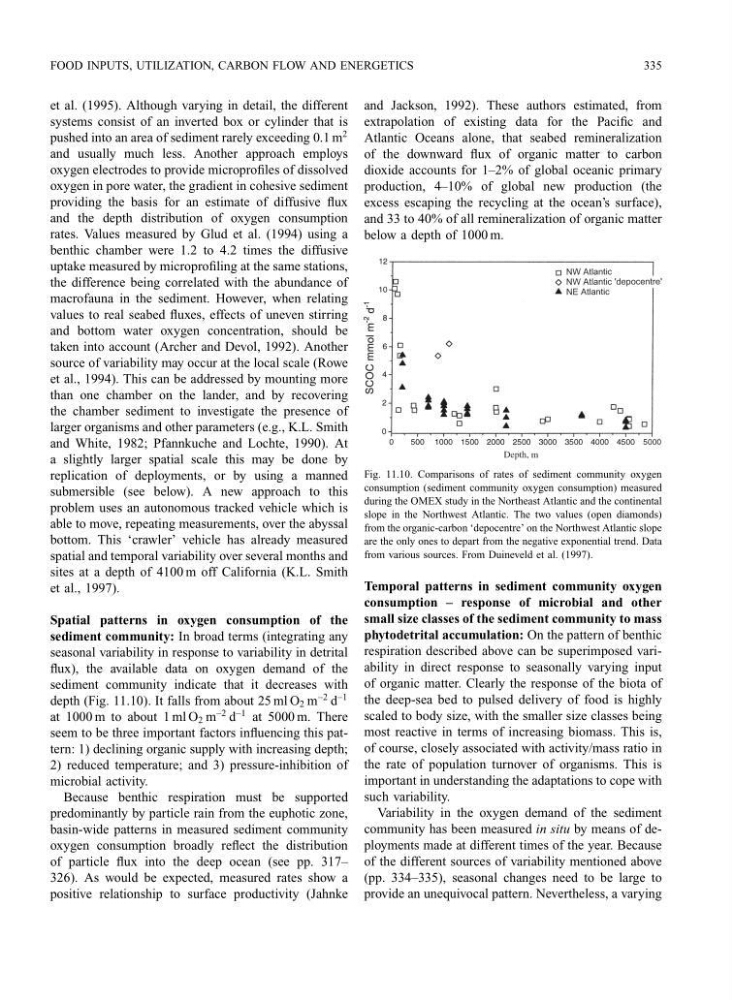
Spatial patterns in oxygen consumption of the
sediment community: In broad terms (integrating any
seasonal variability in response to variability in detrital
flux), the available data on oxygen demand of the
sediment community indicate that it decreases with
depth (Fig. 11.10). It falls from about 25 ml O 2 m
−2 d
−1
at 1000 m to about 1 ml O 2 m
−2 d
−1 at 5000 m. There
seem to be three important factors influencing this pattern: 1) declining organic supply with increasing depth;
2) reduced temperature; and 3) pressure-inhibition of
microbial activity.
Because benthic respiration must be supported
predominantly by particle rain from the euphotic zone,
basin-wide patterns in measured sediment community
oxygen consumption broadly reflect the distribution
of particle flux into the deep ocean (see pp. 317–
326). As would be expected, measured rates show a
positive relationship to surface productivity (Jahnke
and Jackson, 1992). These authors estimated, from
extrapolation of existing data for the Pacific and
Atlantic Oceans alone, that seabed remineralization
of the downward flux of organic matter to carbon
dioxide accounts for 1–2% of global oceanic primary
production, 4–10% of global new production (the
excess escaping the recycling at the ocean’s surface),
and 33 to 40% of all remineralization of organic matter
below a depth of 1000 m.
Fig. 11.10. Comparisons of rates of sediment community oxygen
consumption (sediment community oxygen consumption) measured
during the OMEX study in the Northeast Atlantic and the continental
slope in the Northwest Atlantic. The two values (open diamonds)
from the organic-carbon ‘depocentre’ on the Northwest Atlantic slope
are the only ones to depart from the negative exponential trend. Data
from various sources. From Duineveld et al. (1997).
Temporal patterns in sediment community oxygen
consumption – response of microbial and other
small size classes of the sediment community to mass
phytodetrital accumulation: On the pattern of benthic
respiration described above can be superimposed variability in direct response to seasonally varying input
of organic matter. Clearly the response of the biota of
the deep-sea bed to pulsed delivery of food is highly
scaled to body size, with the smaller size classes being
most reactive in terms of increasing biomass. This is,
of course, closely associated with activity/mass ratio in
the rate of population turnover of organisms. This is
important in understanding the adaptations to cope with
such variability.
Variability in the oxygen demand of the sediment
community has been measured in situ by means of deployments made at different times of the year. Because
of the different sources of variability mentioned above
(pp. 334–335), seasonal changes need to be large to
provide an unequivocal pattern. Nevertheless, a varying
335
et al. (1995). Although varying in detail, the different
systems consist of an inverted box or cylinder that is
pushed into an area of sediment rarely exceeding 0.1 m
2
and usually much less. Another approach employs
oxygen electrodes to provide microprofiles of dissolved
oxygen in pore water, the gradient in cohesive sediment
providing the basis for an estimate of diffusive flux
and the depth distribution of oxygen consumption
rates. Values measured by Glud et al. (1994) using a
benthic chamber were 1.2 to 4.2 times the diffusive
uptake measured by microprofiling at the same stations,
the difference being correlated with the abundance of
macrofauna in the sediment. However, when relating
values to real seabed fluxes, effects of uneven stirring
and bottom water oxygen concentration, should be
taken into account (Archer and Devol, 1992). Another
source of variability may occur at the local scale (Rowe
et al., 1994). This can be addressed by mounting more
than one chamber on the lander, and by recovering
the chamber sediment to investigate the presence of
larger organisms and other parameters (e.g., K.L. Smith
and White, 1982; Pfannkuche and Lochte, 1990). At
a slightly larger spatial scale this may be done by
replication of deployments, or by using a manned
submersible (see below). A new approach to this
problem uses an autonomous tracked vehicle which is
able to move, repeating measurements, over the abyssal
bottom. This ‘crawler’ vehicle has already measured
spatial and temporal variability over several months and
sites at a depth of 4100 m off California (K.L. Smith
et al., 1997).
Spatial patterns in oxygen consumption of the
sediment community: In broad terms (integrating any
seasonal variability in response to variability in detrital
flux), the available data on oxygen demand of the
sediment community indicate that it decreases with
depth (Fig. 11.10). It falls from about 25 ml O 2 m
−2 d
−1
at 1000 m to about 1 ml O 2 m
−2 d
−1 at 5000 m. There
seem to be three important factors influencing this pattern: 1) declining organic supply with increasing depth;
2) reduced temperature; and 3) pressure-inhibition of
microbial activity.
Because benthic respiration must be supported
predominantly by particle rain from the euphotic zone,
basin-wide patterns in measured sediment community
oxygen consumption broadly reflect the distribution
of particle flux into the deep ocean (see pp. 317–
326). As would be expected, measured rates show a
positive relationship to surface productivity (Jahnke
and Jackson, 1992). These authors estimated, from
extrapolation of existing data for the Pacific and
Atlantic Oceans alone, that seabed remineralization
of the downward flux of organic matter to carbon
dioxide accounts for 1–2% of global oceanic primary
production, 4–10% of global new production (the
excess escaping the recycling at the ocean’s surface),
and 33 to 40% of all remineralization of organic matter
below a depth of 1000 m.
Fig. 11.10. Comparisons of rates of sediment community oxygen
consumption (sediment community oxygen consumption) measured
during the OMEX study in the Northeast Atlantic and the continental
slope in the Northwest Atlantic. The two values (open diamonds)
from the organic-carbon ‘depocentre’ on the Northwest Atlantic slope
are the only ones to depart from the negative exponential trend. Data
from various sources. From Duineveld et al. (1997).
Temporal patterns in sediment community oxygen
consumption – response of microbial and other
small size classes of the sediment community to mass
phytodetrital accumulation: On the pattern of benthic
respiration described above can be superimposed variability in direct response to seasonally varying input
of organic matter. Clearly the response of the biota of
the deep-sea bed to pulsed delivery of food is highly
scaled to body size, with the smaller size classes being
most reactive in terms of increasing biomass. This is,
of course, closely associated with activity/mass ratio in
the rate of population turnover of organisms. This is
important in understanding the adaptations to cope with
such variability.
Variability in the oxygen demand of the sediment
community has been measured in situ by means of deployments made at different times of the year. Because
of the different sources of variability mentioned above
(pp. 334–335), seasonal changes need to be large to
provide an unequivocal pattern. Nevertheless, a varying