

THE DEEP-SEA FLOOR: AN OVERVIEW
23
its diet should become increasingly broad (Dayton and
Hessler, 1972).
Finally, the environment of the deep sea is less
physically variable than that in shallow water and is
likely to impose less mortality on deep-sea organisms
than the physical environment of shallow water imposes
on shallow-water organisms. As a consequence, the
mortality imposed by croppers may be crucial to the
organization of deep-sea communities (Jumars and
Gallagher, 1982).
Size structure
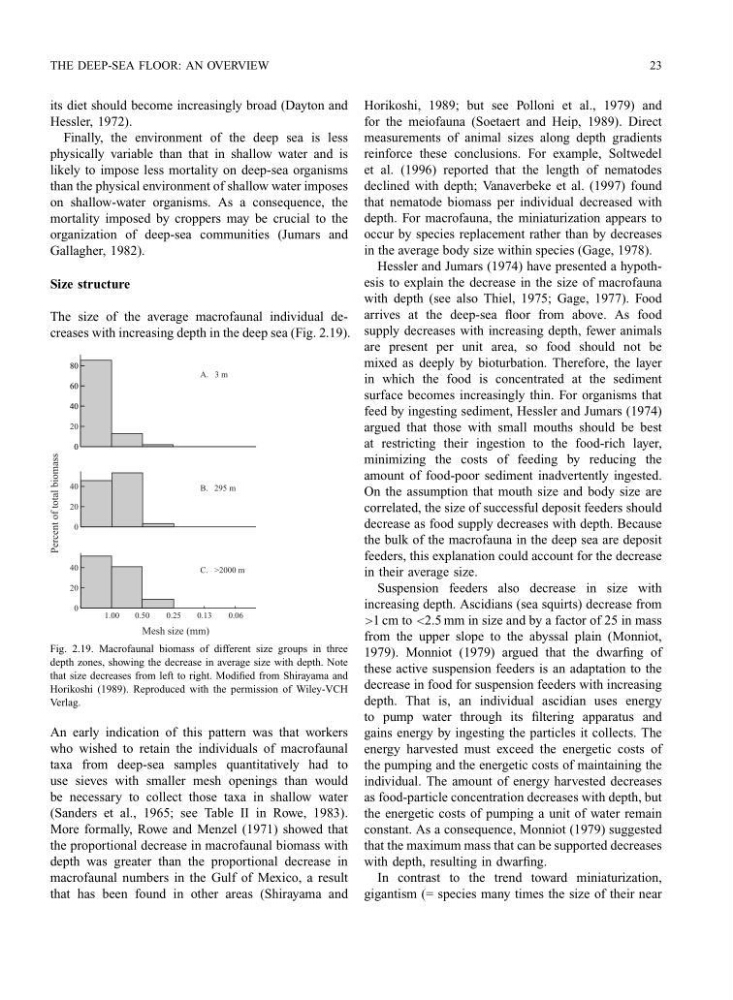
The size of the average macrofaunal individual decreases with increasing depth in the deep sea (Fig. 2.19).
0
20
40
0
20
40
60
80
0
40
60
80
0
1.00
0.50
0.25
0.13
0.06
20
40
Mesh size (mm)
Percent of total biomass
A. 3 m
B. 295 m
C. >2000 m
Fig. 2.19. Macrofaunal biomass of different size groups in three
depth zones, showing the decrease in average size with depth. Note
that size decreases from left to right. Modified from Shirayama and
Horikoshi (1989). Reproduced with the permission of Wiley-VCH
Verlag.
An early indication of this pattern was that workers
who wished to retain the individuals of macrofaunal
taxa from deep-sea samples quantitatively had to
use sieves with smaller mesh openings than would
be necessary to collect those taxa in shallow water
(Sanders et al., 1965; see Table II in Rowe, 1983).
More formally, Rowe and Menzel (1971) showed that
the proportional decrease in macrofaunal biomass with
depth was greater than the proportional decrease in
macrofaunal numbers in the Gulf of Mexico, a result
that has been found in other areas (Shirayama and
Horikoshi, 1989; but see Polloni et al., 1979) and
for the meiofauna (Soetaert and Heip, 1989). Direct
measurements of animal sizes along depth gradients
reinforce these conclusions. For example, Soltwedel
et al. (1996) reported that the length of nematodes
declined with depth; Vanaverbeke et al. (1997) found
that nematode biomass per individual decreased with
depth. For macrofauna, the miniaturization appears to
occur by species replacement rather than by decreases
in the average body size within species (Gage, 1978).
Hessler and Jumars (1974) have presented a hypothesis to explain the decrease in the size of macrofauna
with depth (see also Thiel, 1975; Gage, 1977). Food
arrives at the deep-sea floor from above. As food
supply decreases with increasing depth, fewer animals
are present per unit area, so food should not be
mixed as deeply by bioturbation. Therefore, the layer
in which the food is concentrated at the sediment
surface becomes increasingly thin. For organisms that
feed by ingesting sediment, Hessler and Jumars (1974)
argued that those with small mouths should be best
at restricting their ingestion to the food-rich layer,
minimizing the costs of feeding by reducing the
amount of food-poor sediment inadvertently ingested.
On the assumption that mouth size and body size are
correlated, the size of successful deposit feeders should
decrease as food supply decreases with depth. Because
the bulk of the macrofauna in the deep sea are deposit
feeders, this explanation could account for the decrease
in their average size.
Suspension feeders also decrease in size with
increasing depth. Ascidians (sea squirts) decrease from
>1 cm to <2.5 mm in size and by a factor of 25 in mass
from the upper slope to the abyssal plain (Monniot,
1979). Monniot (1979) argued that the dwarfing of
these active suspension feeders is an adaptation to the
decrease in food for suspension feeders with increasing
depth. That is, an individual ascidian uses energy
to pump water through its filtering apparatus and
gains energy by ingesting the particles it collects. The
energy harvested must exceed the energetic costs of
the pumping and the energetic costs of maintaining the
individual. The amount of energy harvested decreases
as food-particle concentration decreases with depth, but
the energetic costs of pumping a unit of water remain
constant. As a consequence, Monniot (1979) suggested
that the maximum mass that can be supported decreases
with depth, resulting in dwarfing.
In contrast to the trend toward miniaturization,
gigantism (= species many times the size of their near
23
its diet should become increasingly broad (Dayton and
Hessler, 1972).
Finally, the environment of the deep sea is less
physically variable than that in shallow water and is
likely to impose less mortality on deep-sea organisms
than the physical environment of shallow water imposes
on shallow-water organisms. As a consequence, the
mortality imposed by croppers may be crucial to the
organization of deep-sea communities (Jumars and
Gallagher, 1982).
Size structure
The size of the average macrofaunal individual decreases with increasing depth in the deep sea (Fig. 2.19).
0
20
40
0
20
40
60
80
0
40
60
80
0
1.00
0.50
0.25
0.13
0.06
20
40
Mesh size (mm)
Percent of total biomass
A. 3 m
B. 295 m
C. >2000 m
Fig. 2.19. Macrofaunal biomass of different size groups in three
depth zones, showing the decrease in average size with depth. Note
that size decreases from left to right. Modified from Shirayama and
Horikoshi (1989). Reproduced with the permission of Wiley-VCH
Verlag.
An early indication of this pattern was that workers
who wished to retain the individuals of macrofaunal
taxa from deep-sea samples quantitatively had to
use sieves with smaller mesh openings than would
be necessary to collect those taxa in shallow water
(Sanders et al., 1965; see Table II in Rowe, 1983).
More formally, Rowe and Menzel (1971) showed that
the proportional decrease in macrofaunal biomass with
depth was greater than the proportional decrease in
macrofaunal numbers in the Gulf of Mexico, a result
that has been found in other areas (Shirayama and
Horikoshi, 1989; but see Polloni et al., 1979) and
for the meiofauna (Soetaert and Heip, 1989). Direct
measurements of animal sizes along depth gradients
reinforce these conclusions. For example, Soltwedel
et al. (1996) reported that the length of nematodes
declined with depth; Vanaverbeke et al. (1997) found
that nematode biomass per individual decreased with
depth. For macrofauna, the miniaturization appears to
occur by species replacement rather than by decreases
in the average body size within species (Gage, 1978).
Hessler and Jumars (1974) have presented a hypothesis to explain the decrease in the size of macrofauna
with depth (see also Thiel, 1975; Gage, 1977). Food
arrives at the deep-sea floor from above. As food
supply decreases with increasing depth, fewer animals
are present per unit area, so food should not be
mixed as deeply by bioturbation. Therefore, the layer
in which the food is concentrated at the sediment
surface becomes increasingly thin. For organisms that
feed by ingesting sediment, Hessler and Jumars (1974)
argued that those with small mouths should be best
at restricting their ingestion to the food-rich layer,
minimizing the costs of feeding by reducing the
amount of food-poor sediment inadvertently ingested.
On the assumption that mouth size and body size are
correlated, the size of successful deposit feeders should
decrease as food supply decreases with depth. Because
the bulk of the macrofauna in the deep sea are deposit
feeders, this explanation could account for the decrease
in their average size.
Suspension feeders also decrease in size with
increasing depth. Ascidians (sea squirts) decrease from
>1 cm to <2.5 mm in size and by a factor of 25 in mass
from the upper slope to the abyssal plain (Monniot,
1979). Monniot (1979) argued that the dwarfing of
these active suspension feeders is an adaptation to the
decrease in food for suspension feeders with increasing
depth. That is, an individual ascidian uses energy
to pump water through its filtering apparatus and
gains energy by ingesting the particles it collects. The
energy harvested must exceed the energetic costs of
the pumping and the energetic costs of maintaining the
individual. The amount of energy harvested decreases
as food-particle concentration decreases with depth, but
the energetic costs of pumping a unit of water remain
constant. As a consequence, Monniot (1979) suggested
that the maximum mass that can be supported decreases
with depth, resulting in dwarfing.
In contrast to the trend toward miniaturization,
gigantism (= species many times the size of their near