

LARGE-SCALE SPATIAL AND TEMPORAL PATTERNS OF DEEP-SEA BENTHIC SPECIES DIVERSITY
303
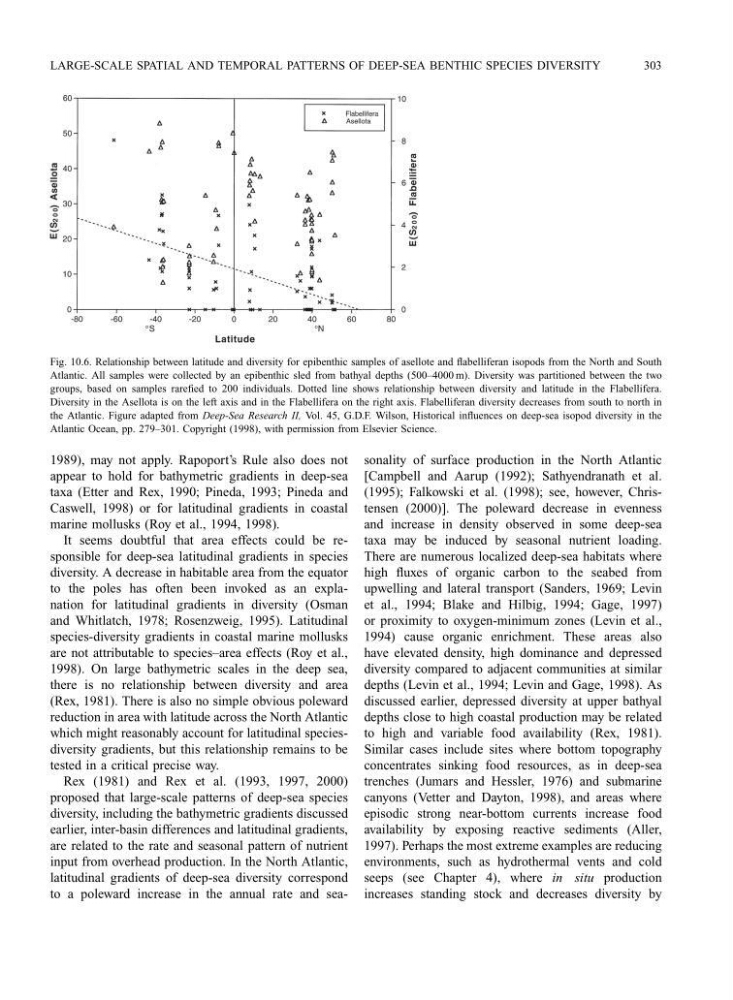
Fig. 10.6. Relationship between latitude and diversity for epibenthic samples of asellote and flabelliferan isopods from the North and South
Atlantic. All samples were collected by an epibenthic sled from bathyal depths (500–4000 m). Diversity was partitioned between the two
groups, based on samples rarefied to 200 individuals. Dotted line shows relationship between diversity and latitude in the Flabellifera.
Diversity in the Asellota is on the left axis and in the Flabellifera on the right axis. Flabelliferan diversity decreases from south to north in
the Atlantic. Figure adapted from Deep-Sea Research II, Vol. 45, G.D.F. Wilson, Historical influences on deep-sea isopod diversity in the
Atlantic Ocean, pp. 279–301. Copyright (1998), with permission from Elsevier Science.
1989), may not apply. Rapoport’s Rule also does not
appear to hold for bathymetric gradients in deep-sea
taxa (Etter and Rex, 1990; Pineda, 1993; Pineda and
Caswell, 1998) or for latitudinal gradients in coastal
marine mollusks (Roy et al., 1994, 1998).
It seems doubtful that area effects could be responsible for deep-sea latitudinal gradients in species
diversity. A decrease in habitable area from the equator
to the poles has often been invoked as an explanation for latitudinal gradients in diversity (Osman
and Whitlatch, 1978; Rosenzweig, 1995). Latitudinal
species-diversity gradients in coastal marine mollusks
are not attributable to species–area effects (Roy et al.,
1998). On large bathymetric scales in the deep sea,
there is no relationship between diversity and area
(Rex, 1981). There is also no simple obvious poleward
reduction in area with latitude across the North Atlantic
which might reasonably account for latitudinal speciesdiversity gradients, but this relationship remains to be
tested in a critical precise way.
Rex (1981) and Rex et al. (1993, 1997, 2000)
proposed that large-scale patterns of deep-sea species
diversity, including the bathymetric gradients discussed
earlier, inter-basin differences and latitudinal gradients,
are related to the rate and seasonal pattern of nutrient
input from overhead production. In the North Atlantic,
latitudinal gradients of deep-sea diversity correspond
to a poleward increase in the annual rate and seasonality of surface production in the North Atlantic
[Campbell and Aarup (1992); Sathyendranath et al.
(1995); Falkowski et al. (1998); see, however, Christensen (2000)]. The poleward decrease in evenness
and increase in density observed in some deep-sea
taxa may be induced by seasonal nutrient loading.
There are numerous localized deep-sea habitats where
high fluxes of organic carbon to the seabed from
upwelling and lateral transport (Sanders, 1969; Levin
et al., 1994; Blake and Hilbig, 1994; Gage, 1997)
or proximity to oxygen-minimum zones (Levin et al.,
1994) cause organic enrichment. These areas also
have elevated density, high dominance and depressed
diversity compared to adjacent communities at similar
depths (Levin et al., 1994; Levin and Gage, 1998). As
discussed earlier, depressed diversity at upper bathyal
depths close to high coastal production may be related
to high and variable food availability (Rex, 1981).
Similar cases include sites where bottom topography
concentrates sinking food resources, as in deep-sea
trenches (Jumars and Hessler, 1976) and submarine
canyons (Vetter and Dayton, 1998), and areas where
episodic strong near-bottom currents increase food
availability by exposing reactive sediments (Aller,
1997). Perhaps the most extreme examples are reducing
environments, such as hydrothermal vents and cold
seeps (see Chapter 4), where in situ production
increases standing stock and decreases diversity by
303
Fig. 10.6. Relationship between latitude and diversity for epibenthic samples of asellote and flabelliferan isopods from the North and South
Atlantic. All samples were collected by an epibenthic sled from bathyal depths (500–4000 m). Diversity was partitioned between the two
groups, based on samples rarefied to 200 individuals. Dotted line shows relationship between diversity and latitude in the Flabellifera.
Diversity in the Asellota is on the left axis and in the Flabellifera on the right axis. Flabelliferan diversity decreases from south to north in
the Atlantic. Figure adapted from Deep-Sea Research II, Vol. 45, G.D.F. Wilson, Historical influences on deep-sea isopod diversity in the
Atlantic Ocean, pp. 279–301. Copyright (1998), with permission from Elsevier Science.
1989), may not apply. Rapoport’s Rule also does not
appear to hold for bathymetric gradients in deep-sea
taxa (Etter and Rex, 1990; Pineda, 1993; Pineda and
Caswell, 1998) or for latitudinal gradients in coastal
marine mollusks (Roy et al., 1994, 1998).
It seems doubtful that area effects could be responsible for deep-sea latitudinal gradients in species
diversity. A decrease in habitable area from the equator
to the poles has often been invoked as an explanation for latitudinal gradients in diversity (Osman
and Whitlatch, 1978; Rosenzweig, 1995). Latitudinal
species-diversity gradients in coastal marine mollusks
are not attributable to species–area effects (Roy et al.,
1998). On large bathymetric scales in the deep sea,
there is no relationship between diversity and area
(Rex, 1981). There is also no simple obvious poleward
reduction in area with latitude across the North Atlantic
which might reasonably account for latitudinal speciesdiversity gradients, but this relationship remains to be
tested in a critical precise way.
Rex (1981) and Rex et al. (1993, 1997, 2000)
proposed that large-scale patterns of deep-sea species
diversity, including the bathymetric gradients discussed
earlier, inter-basin differences and latitudinal gradients,
are related to the rate and seasonal pattern of nutrient
input from overhead production. In the North Atlantic,
latitudinal gradients of deep-sea diversity correspond
to a poleward increase in the annual rate and seasonality of surface production in the North Atlantic
[Campbell and Aarup (1992); Sathyendranath et al.
(1995); Falkowski et al. (1998); see, however, Christensen (2000)]. The poleward decrease in evenness
and increase in density observed in some deep-sea
taxa may be induced by seasonal nutrient loading.
There are numerous localized deep-sea habitats where
high fluxes of organic carbon to the seabed from
upwelling and lateral transport (Sanders, 1969; Levin
et al., 1994; Blake and Hilbig, 1994; Gage, 1997)
or proximity to oxygen-minimum zones (Levin et al.,
1994) cause organic enrichment. These areas also
have elevated density, high dominance and depressed
diversity compared to adjacent communities at similar
depths (Levin et al., 1994; Levin and Gage, 1998). As
discussed earlier, depressed diversity at upper bathyal
depths close to high coastal production may be related
to high and variable food availability (Rex, 1981).
Similar cases include sites where bottom topography
concentrates sinking food resources, as in deep-sea
trenches (Jumars and Hessler, 1976) and submarine
canyons (Vetter and Dayton, 1998), and areas where
episodic strong near-bottom currents increase food
availability by exposing reactive sediments (Aller,
1997). Perhaps the most extreme examples are reducing
environments, such as hydrothermal vents and cold
seeps (see Chapter 4), where in situ production
increases standing stock and decreases diversity by