

20
David THISTLE
consumed the carcass. Rather, they preyed on the
parcel-attending amphipods.
Suspension feeders
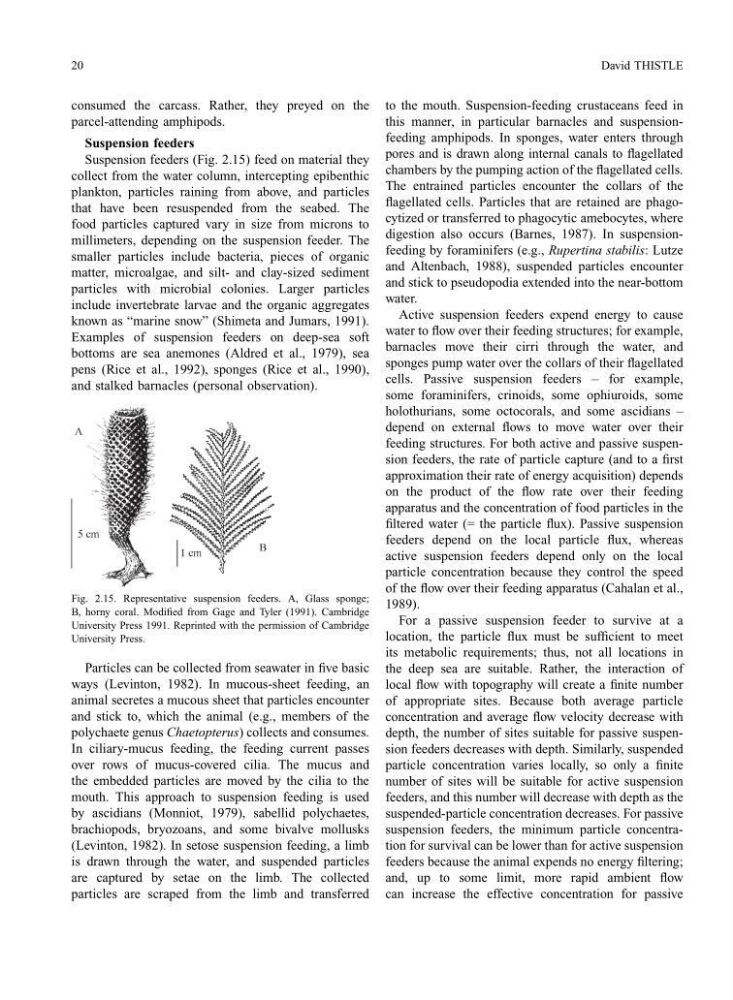
Suspension feeders (Fig. 2.15) feed on material they
collect from the water column, intercepting epibenthic
plankton, particles raining from above, and particles
that have been resuspended from the seabed. The
food particles captured vary in size from microns to
millimeters, depending on the suspension feeder. The
smaller particles include bacteria, pieces of organic
matter, microalgae, and silt- and clay-sized sediment
particles with microbial colonies. Larger particles
include invertebrate larvae and the organic aggregates
known as “marine snow” (Shimeta and Jumars, 1991).
Examples of suspension feeders on deep-sea soft
bottoms are sea anemones (Aldred et al., 1979), sea
pens (Rice et al., 1992), sponges (Rice et al., 1990),
and stalked barnacles (personal observation).
Fig. 2.15. Representative suspension feeders. A, Glass sponge;
B, horny coral. Modified from Gage and Tyler (1991). Cambridge
University Press 1991. Reprinted with the permission of Cambridge
University Press.
Particles can be collected from seawater in five basic
ways (Levinton, 1982). In mucous-sheet feeding, an
animal secretes a mucous sheet that particles encounter
and stick to, which the animal (e.g., members of the
polychaete genus Chaetopterus) collects and consumes.
In ciliary-mucus feeding, the feeding current passes
over rows of mucus-covered cilia. The mucus and
the embedded particles are moved by the cilia to the
mouth. This approach to suspension feeding is used
by ascidians (Monniot, 1979), sabellid polychaetes,
brachiopods, bryozoans, and some bivalve mollusks
(Levinton, 1982). In setose suspension feeding, a limb
is drawn through the water, and suspended particles
are captured by setae on the limb. The collected
particles are scraped from the limb and transferred
to the mouth. Suspension-feeding crustaceans feed in
this manner, in particular barnacles and suspensionfeeding amphipods. In sponges, water enters through
pores and is drawn along internal canals to flagellated
chambers by the pumping action of the flagellated cells.
The entrained particles encounter the collars of the
flagellated cells. Particles that are retained are phagocytized or transferred to phagocytic amebocytes, where
digestion also occurs (Barnes, 1987). In suspensionfeeding by foraminifers (e.g., Rupertina stabilis: Lutze
and Altenbach, 1988), suspended particles encounter
and stick to pseudopodia extended into the near-bottom
water.
Active suspension feeders expend energy to cause
water to flow over their feeding structures; for example,
barnacles move their cirri through the water, and
sponges pump water over the collars of their flagellated
cells. Passive suspension feeders – for example,
some foraminifers, crinoids, some ophiuroids, some
holothurians, some octocorals, and some ascidians –
depend on external flows to move water over their
feeding structures. For both active and passive suspension feeders, the rate of particle capture (and to a first
approximation their rate of energy acquisition) depends
on the product of the flow rate over their feeding
apparatus and the concentration of food particles in the
filtered water (= the particle flux). Passive suspension
feeders depend on the local particle flux, whereas
active suspension feeders depend only on the local
particle concentration because they control the speed
of the flow over their feeding apparatus (Cahalan et al.,
1989).
For a passive suspension feeder to survive at a
location, the particle flux must be sufficient to meet
its metabolic requirements; thus, not all locations in
the deep sea are suitable. Rather, the interaction of
local flow with topography will create a finite number
of appropriate sites. Because both average particle
concentration and average flow velocity decrease with
depth, the number of sites suitable for passive suspension feeders decreases with depth. Similarly, suspended
particle concentration varies locally, so only a finite
number of sites will be suitable for active suspension
feeders, and this number will decrease with depth as the
suspended-particle concentration decreases. For passive
suspension feeders, the minimum particle concentration for survival can be lower than for active suspension
feeders because the animal expends no energy filtering;
and, up to some limit, more rapid ambient flow
can increase the effective concentration for passive
David THISTLE
consumed the carcass. Rather, they preyed on the
parcel-attending amphipods.
Suspension feeders
Suspension feeders (Fig. 2.15) feed on material they
collect from the water column, intercepting epibenthic
plankton, particles raining from above, and particles
that have been resuspended from the seabed. The
food particles captured vary in size from microns to
millimeters, depending on the suspension feeder. The
smaller particles include bacteria, pieces of organic
matter, microalgae, and silt- and clay-sized sediment
particles with microbial colonies. Larger particles
include invertebrate larvae and the organic aggregates
known as “marine snow” (Shimeta and Jumars, 1991).
Examples of suspension feeders on deep-sea soft
bottoms are sea anemones (Aldred et al., 1979), sea
pens (Rice et al., 1992), sponges (Rice et al., 1990),
and stalked barnacles (personal observation).
Fig. 2.15. Representative suspension feeders. A, Glass sponge;
B, horny coral. Modified from Gage and Tyler (1991). Cambridge
University Press 1991. Reprinted with the permission of Cambridge
University Press.
Particles can be collected from seawater in five basic
ways (Levinton, 1982). In mucous-sheet feeding, an
animal secretes a mucous sheet that particles encounter
and stick to, which the animal (e.g., members of the
polychaete genus Chaetopterus) collects and consumes.
In ciliary-mucus feeding, the feeding current passes
over rows of mucus-covered cilia. The mucus and
the embedded particles are moved by the cilia to the
mouth. This approach to suspension feeding is used
by ascidians (Monniot, 1979), sabellid polychaetes,
brachiopods, bryozoans, and some bivalve mollusks
(Levinton, 1982). In setose suspension feeding, a limb
is drawn through the water, and suspended particles
are captured by setae on the limb. The collected
particles are scraped from the limb and transferred
to the mouth. Suspension-feeding crustaceans feed in
this manner, in particular barnacles and suspensionfeeding amphipods. In sponges, water enters through
pores and is drawn along internal canals to flagellated
chambers by the pumping action of the flagellated cells.
The entrained particles encounter the collars of the
flagellated cells. Particles that are retained are phagocytized or transferred to phagocytic amebocytes, where
digestion also occurs (Barnes, 1987). In suspensionfeeding by foraminifers (e.g., Rupertina stabilis: Lutze
and Altenbach, 1988), suspended particles encounter
and stick to pseudopodia extended into the near-bottom
water.
Active suspension feeders expend energy to cause
water to flow over their feeding structures; for example,
barnacles move their cirri through the water, and
sponges pump water over the collars of their flagellated
cells. Passive suspension feeders – for example,
some foraminifers, crinoids, some ophiuroids, some
holothurians, some octocorals, and some ascidians –
depend on external flows to move water over their
feeding structures. For both active and passive suspension feeders, the rate of particle capture (and to a first
approximation their rate of energy acquisition) depends
on the product of the flow rate over their feeding
apparatus and the concentration of food particles in the
filtered water (= the particle flux). Passive suspension
feeders depend on the local particle flux, whereas
active suspension feeders depend only on the local
particle concentration because they control the speed
of the flow over their feeding apparatus (Cahalan et al.,
1989).
For a passive suspension feeder to survive at a
location, the particle flux must be sufficient to meet
its metabolic requirements; thus, not all locations in
the deep sea are suitable. Rather, the interaction of
local flow with topography will create a finite number
of appropriate sites. Because both average particle
concentration and average flow velocity decrease with
depth, the number of sites suitable for passive suspension feeders decreases with depth. Similarly, suspended
particle concentration varies locally, so only a finite
number of sites will be suitable for active suspension
feeders, and this number will decrease with depth as the
suspended-particle concentration decreases. For passive
suspension feeders, the minimum particle concentration for survival can be lower than for active suspension
feeders because the animal expends no energy filtering;
and, up to some limit, more rapid ambient flow
can increase the effective concentration for passive