

296
Carol T. STUART et al.
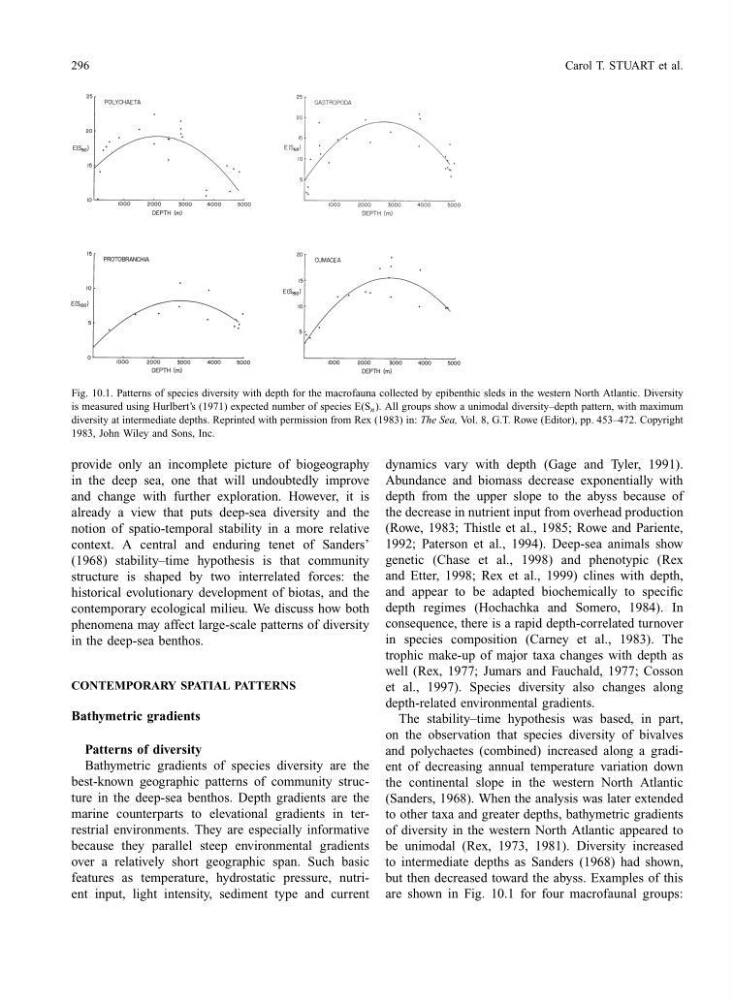
Fig. 10.1. Patterns of species diversity with depth for the macrofauna collected by epibenthic sleds in the western North Atlantic. Diversity
is measured using Hurlbert’s (1971) expected number of species E(S n ). All groups show a unimodal diversity–depth pattern, with maximum
diversity at intermediate depths. Reprinted with permission from Rex (1983) in: The Sea, Vol. 8, G.T. Rowe (Editor), pp. 453–472. Copyright
1983, John Wiley and Sons, Inc.
provide only an incomplete picture of biogeography
in the deep sea, one that will undoubtedly improve
and change with further exploration. However, it is
already a view that puts deep-sea diversity and the
notion of spatio-temporal stability in a more relative
context. A central and enduring tenet of Sanders’
(1968) stability–time hypothesis is that community
structure is shaped by two interrelated forces: the
historical evolutionary development of biotas, and the
contemporary ecological milieu. We discuss how both
phenomena may affect large-scale patterns of diversity
in the deep-sea benthos.
CONTEMPORARY SPATIAL PATTERNS
Bathymetric gradients
Patterns of diversity
Bathymetric gradients of species diversity are the
best-known geographic patterns of community structure in the deep-sea benthos. Depth gradients are the
marine counterparts to elevational gradients in terrestrial environments. They are especially informative
because they parallel steep environmental gradients
over a relatively short geographic span. Such basic
features as temperature, hydrostatic pressure, nutrient input, light intensity, sediment type and current
dynamics vary with depth (Gage and Tyler, 1991).
Abundance and biomass decrease exponentially with
depth from the upper slope to the abyss because of
the decrease in nutrient input from overhead production
(Rowe, 1983; Thistle et al., 1985; Rowe and Pariente,
1992; Paterson et al., 1994). Deep-sea animals show
genetic (Chase et al., 1998) and phenotypic (Rex
and Etter, 1998; Rex et al., 1999) clines with depth,
and appear to be adapted biochemically to specific
depth regimes (Hochachka and Somero, 1984). In
consequence, there is a rapid depth-correlated turnover
in species composition (Carney et al., 1983). The
trophic make-up of major taxa changes with depth as
well (Rex, 1977; Jumars and Fauchald, 1977; Cosson
et al., 1997). Species diversity also changes along
depth-related environmental gradients.
The stability–time hypothesis was based, in part,
on the observation that species diversity of bivalves
and polychaetes (combined) increased along a gradient of decreasing annual temperature variation down
the continental slope in the western North Atlantic
(Sanders, 1968). When the analysis was later extended
to other taxa and greater depths, bathymetric gradients
of diversity in the western North Atlantic appeared to
be unimodal (Rex, 1973, 1981). Diversity increased
to intermediate depths as Sanders (1968) had shown,
but then decreased toward the abyss. Examples of this
are shown in Fig. 10.1 for four macrofaunal groups:
Carol T. STUART et al.
Fig. 10.1. Patterns of species diversity with depth for the macrofauna collected by epibenthic sleds in the western North Atlantic. Diversity
is measured using Hurlbert’s (1971) expected number of species E(S n ). All groups show a unimodal diversity–depth pattern, with maximum
diversity at intermediate depths. Reprinted with permission from Rex (1983) in: The Sea, Vol. 8, G.T. Rowe (Editor), pp. 453–472. Copyright
1983, John Wiley and Sons, Inc.
provide only an incomplete picture of biogeography
in the deep sea, one that will undoubtedly improve
and change with further exploration. However, it is
already a view that puts deep-sea diversity and the
notion of spatio-temporal stability in a more relative
context. A central and enduring tenet of Sanders’
(1968) stability–time hypothesis is that community
structure is shaped by two interrelated forces: the
historical evolutionary development of biotas, and the
contemporary ecological milieu. We discuss how both
phenomena may affect large-scale patterns of diversity
in the deep-sea benthos.
CONTEMPORARY SPATIAL PATTERNS
Bathymetric gradients
Patterns of diversity
Bathymetric gradients of species diversity are the
best-known geographic patterns of community structure in the deep-sea benthos. Depth gradients are the
marine counterparts to elevational gradients in terrestrial environments. They are especially informative
because they parallel steep environmental gradients
over a relatively short geographic span. Such basic
features as temperature, hydrostatic pressure, nutrient input, light intensity, sediment type and current
dynamics vary with depth (Gage and Tyler, 1991).
Abundance and biomass decrease exponentially with
depth from the upper slope to the abyss because of
the decrease in nutrient input from overhead production
(Rowe, 1983; Thistle et al., 1985; Rowe and Pariente,
1992; Paterson et al., 1994). Deep-sea animals show
genetic (Chase et al., 1998) and phenotypic (Rex
and Etter, 1998; Rex et al., 1999) clines with depth,
and appear to be adapted biochemically to specific
depth regimes (Hochachka and Somero, 1984). In
consequence, there is a rapid depth-correlated turnover
in species composition (Carney et al., 1983). The
trophic make-up of major taxa changes with depth as
well (Rex, 1977; Jumars and Fauchald, 1977; Cosson
et al., 1997). Species diversity also changes along
depth-related environmental gradients.
The stability–time hypothesis was based, in part,
on the observation that species diversity of bivalves
and polychaetes (combined) increased along a gradient of decreasing annual temperature variation down
the continental slope in the western North Atlantic
(Sanders, 1968). When the analysis was later extended
to other taxa and greater depths, bathymetric gradients
of diversity in the western North Atlantic appeared to
be unimodal (Rex, 1973, 1981). Diversity increased
to intermediate depths as Sanders (1968) had shown,
but then decreased toward the abyss. Examples of this
are shown in Fig. 10.1 for four macrofaunal groups: