

THE PERIPHERAL DEEP SEAS
281
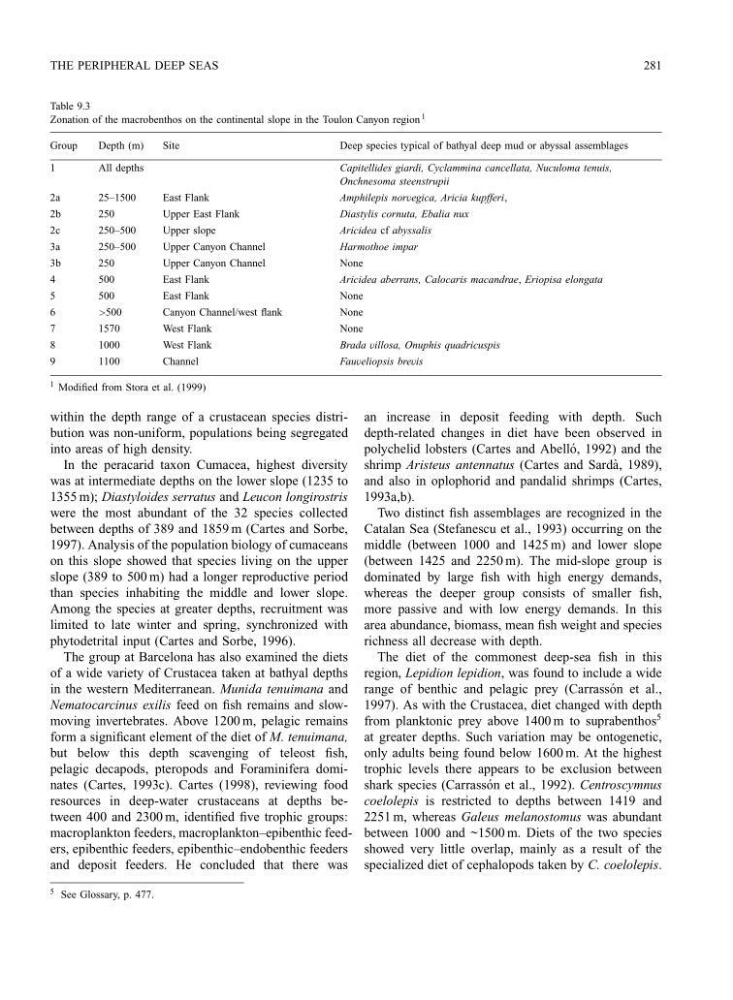
Table 9.3
Zonation of the macrobenthos on the continental slope in the Toulon Canyon region 1
Group
Depth (m)
Site
Deep species typical of bathyal deep mud or abyssal assemblages
1
All depths
Capitellides giardi, Cyclammina cancellata, Nuculoma tenuis,
Onchnesoma steenstrupii
2a
25–1500
East Flank
Amphilepis norvegica, Aricia kupfferi,
2b
250
Upper East Flank
Diastylis cornuta, Ebalia nux
2c
250–500
Upper slope
Aricidea cf abyssalis
3a
250–500
Upper Canyon Channel
Harmothoe impar
3b
250
Upper Canyon Channel
None
4
500
East Flank
Aricidea aberrans, Calocaris macandrae, Eriopisa elongata
5
500
East Flank
None
6
>500
Canyon Channel/west flank
None
7
1570
West Flank
None
8
1000
West Flank
Brada villosa, Onuphis quadricuspis
9
1100
Channel
Fauveliopsis brevis
1 Modified from Stora et al. (1999)
within the depth range of a crustacean species distribution was non-uniform, populations being segregated
into areas of high density.
In the peracarid taxon Cumacea, highest diversity
was at intermediate depths on the lower slope (1235 to
1355 m); Diastyloides serratus and Leucon longirostris
were the most abundant of the 32 species collected
between depths of 389 and 1859 m (Cartes and Sorbe,
1997). Analysis of the population biology of cumaceans
on this slope showed that species living on the upper
slope (389 to 500 m) had a longer reproductive period
than species inhabiting the middle and lower slope.
Among the species at greater depths, recruitment was
limited to late winter and spring, synchronized with
phytodetrital input (Cartes and Sorbe, 1996).
The group at Barcelona has also examined the diets
of a wide variety of Crustacea taken at bathyal depths
in the western Mediterranean. Munida tenuimana and
Nematocarcinus exilis feed on fish remains and slowmoving invertebrates. Above 1200 m, pelagic remains
form a significant element of the diet of M. tenuimana,
but below this depth scavenging of teleost fish,
pelagic decapods, pteropods and Foraminifera dominates (Cartes, 1993c). Cartes (1998), reviewing food
resources in deep-water crustaceans at depths between 400 and 2300 m, identified five trophic groups:
macroplankton feeders, macroplankton–epibenthic feeders, epibenthic feeders, epibenthic–endobenthic feeders
and deposit feeders. He concluded that there was
an increase in deposit feeding with depth. Such
depth-related changes in diet have been observed in
polychelid lobsters (Cartes and Abell´ o, 1992) and the
shrimp Aristeus antennatus (Cartes and Sard` a, 1989),
and also in oplophorid and pandalid shrimps (Cartes,
1993a,b).
Two distinct fish assemblages are recognized in the
Catalan Sea (Stefanescu et al., 1993) occurring on the
middle (between 1000 and 1425 m) and lower slope
(between 1425 and 2250 m). The mid-slope group is
dominated by large fish with high energy demands,
whereas the deeper group consists of smaller fish,
more passive and with low energy demands. In this
area abundance, biomass, mean fish weight and species
richness all decrease with depth.
The diet of the commonest deep-sea fish in this
region, Lepidion lepidion, was found to include a wide
range of benthic and pelagic prey (Carrass´ on et al.,
1997). As with the Crustacea, diet changed with depth
from planktonic prey above 1400 m to suprabenthos
5
at greater depths. Such variation may be ontogenetic,
only adults being found below 1600 m. At the highest
trophic levels there appears to be exclusion between
shark species (Carrass´ on et al., 1992). Centroscymnus
coelolepis is restricted to depths between 1419 and
2251 m, whereas Galeus melanostomus was abundant
between 1000 and ~1500 m. Diets of the two species
showed very little overlap, mainly as a result of the
specialized diet of cephalopods taken by C. coelolepis.
5 See Glossary, p. 477.
281
Table 9.3
Zonation of the macrobenthos on the continental slope in the Toulon Canyon region 1
Group
Depth (m)
Site
Deep species typical of bathyal deep mud or abyssal assemblages
1
All depths
Capitellides giardi, Cyclammina cancellata, Nuculoma tenuis,
Onchnesoma steenstrupii
2a
25–1500
East Flank
Amphilepis norvegica, Aricia kupfferi,
2b
250
Upper East Flank
Diastylis cornuta, Ebalia nux
2c
250–500
Upper slope
Aricidea cf abyssalis
3a
250–500
Upper Canyon Channel
Harmothoe impar
3b
250
Upper Canyon Channel
None
4
500
East Flank
Aricidea aberrans, Calocaris macandrae, Eriopisa elongata
5
500
East Flank
None
6
>500
Canyon Channel/west flank
None
7
1570
West Flank
None
8
1000
West Flank
Brada villosa, Onuphis quadricuspis
9
1100
Channel
Fauveliopsis brevis
1 Modified from Stora et al. (1999)
within the depth range of a crustacean species distribution was non-uniform, populations being segregated
into areas of high density.
In the peracarid taxon Cumacea, highest diversity
was at intermediate depths on the lower slope (1235 to
1355 m); Diastyloides serratus and Leucon longirostris
were the most abundant of the 32 species collected
between depths of 389 and 1859 m (Cartes and Sorbe,
1997). Analysis of the population biology of cumaceans
on this slope showed that species living on the upper
slope (389 to 500 m) had a longer reproductive period
than species inhabiting the middle and lower slope.
Among the species at greater depths, recruitment was
limited to late winter and spring, synchronized with
phytodetrital input (Cartes and Sorbe, 1996).
The group at Barcelona has also examined the diets
of a wide variety of Crustacea taken at bathyal depths
in the western Mediterranean. Munida tenuimana and
Nematocarcinus exilis feed on fish remains and slowmoving invertebrates. Above 1200 m, pelagic remains
form a significant element of the diet of M. tenuimana,
but below this depth scavenging of teleost fish,
pelagic decapods, pteropods and Foraminifera dominates (Cartes, 1993c). Cartes (1998), reviewing food
resources in deep-water crustaceans at depths between 400 and 2300 m, identified five trophic groups:
macroplankton feeders, macroplankton–epibenthic feeders, epibenthic feeders, epibenthic–endobenthic feeders
and deposit feeders. He concluded that there was
an increase in deposit feeding with depth. Such
depth-related changes in diet have been observed in
polychelid lobsters (Cartes and Abell´ o, 1992) and the
shrimp Aristeus antennatus (Cartes and Sard` a, 1989),
and also in oplophorid and pandalid shrimps (Cartes,
1993a,b).
Two distinct fish assemblages are recognized in the
Catalan Sea (Stefanescu et al., 1993) occurring on the
middle (between 1000 and 1425 m) and lower slope
(between 1425 and 2250 m). The mid-slope group is
dominated by large fish with high energy demands,
whereas the deeper group consists of smaller fish,
more passive and with low energy demands. In this
area abundance, biomass, mean fish weight and species
richness all decrease with depth.
The diet of the commonest deep-sea fish in this
region, Lepidion lepidion, was found to include a wide
range of benthic and pelagic prey (Carrass´ on et al.,
1997). As with the Crustacea, diet changed with depth
from planktonic prey above 1400 m to suprabenthos
5
at greater depths. Such variation may be ontogenetic,
only adults being found below 1600 m. At the highest
trophic levels there appears to be exclusion between
shark species (Carrass´ on et al., 1992). Centroscymnus
coelolepis is restricted to depths between 1419 and
2251 m, whereas Galeus melanostomus was abundant
between 1000 and ~1500 m. Diets of the two species
showed very little overlap, mainly as a result of the
specialized diet of cephalopods taken by C. coelolepis.
5 See Glossary, p. 477.