

THE DEEP-SEA FLOOR: AN OVERVIEW
17
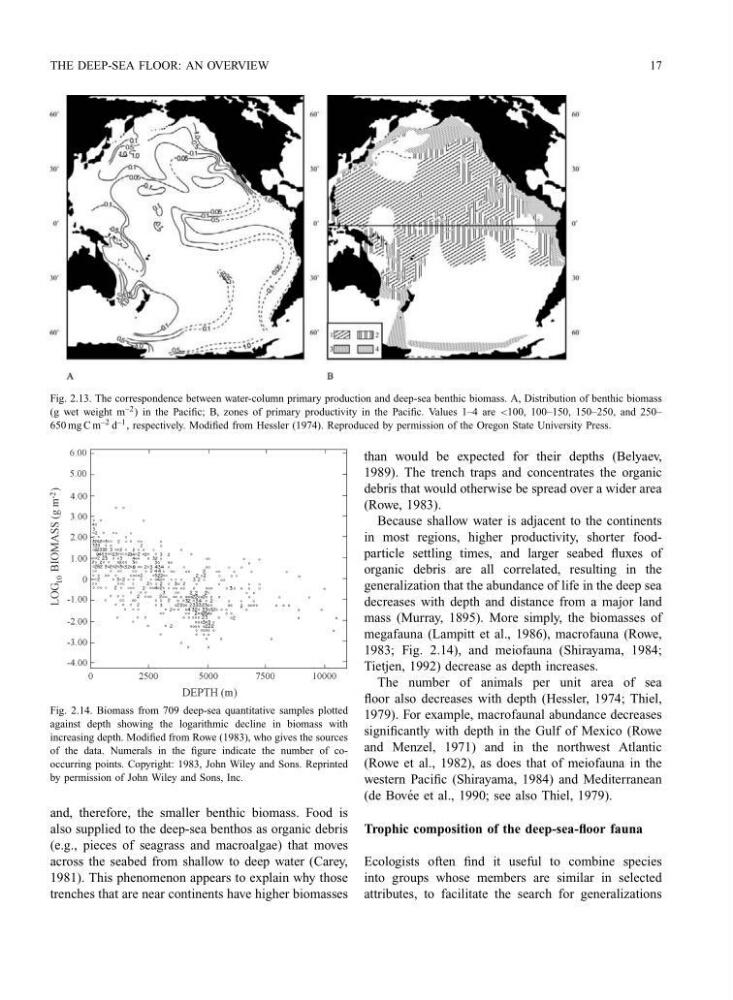
Fig. 2.13. The correspondence between water-column primary production and deep-sea benthic biomass. A, Distribution of benthic biomass
(g wet weight m −2 ) in the Pacific; B, zones of primary productivity in the Pacific. Values 1–4 are <100, 100–150, 150–250, and 250–
650 mg C m −2 d −1 , respectively. Modified from Hessler (1974). Reproduced by permission of the Oregon State University Press.
Fig. 2.14. Biomass from 709 deep-sea quantitative samples plotted
against depth showing the logarithmic decline in biomass with
increasing depth. Modified from Rowe (1983), who gives the sources
of the data. Numerals in the figure indicate the number of cooccurring points. Copyright: 1983, John Wiley and Sons. Reprinted
by permission of John Wiley and Sons, Inc.
and, therefore, the smaller benthic biomass. Food is
also supplied to the deep-sea benthos as organic debris
(e.g., pieces of seagrass and macroalgae) that moves
across the seabed from shallow to deep water (Carey,
1981). This phenomenon appears to explain why those
trenches that are near continents have higher biomasses
than would be expected for their depths (Belyaev,
1989). The trench traps and concentrates the organic
debris that would otherwise be spread over a wider area
(Rowe, 1983).
Because shallow water is adjacent to the continents
in most regions, higher productivity, shorter foodparticle settling times, and larger seabed fluxes of
organic debris are all correlated, resulting in the
generalization that the abundance of life in the deep sea
decreases with depth and distance from a major land
mass (Murray, 1895). More simply, the biomasses of
megafauna (Lampitt et al., 1986), macrofauna (Rowe,
1983; Fig. 2.14), and meiofauna (Shirayama, 1984;
Tietjen, 1992) decrease as depth increases.
The number of animals per unit area of sea
floor also decreases with depth (Hessler, 1974; Thiel,
1979). For example, macrofaunal abundance decreases
significantly with depth in the Gulf of Mexico (Rowe
and Menzel, 1971) and in the northwest Atlantic
(Rowe et al., 1982), as does that of meiofauna in the
western Pacific (Shirayama, 1984) and Mediterranean
(de Bov´ ee et al., 1990; see also Thiel, 1979).
Trophic composition of the deep-sea-floor fauna
Ecologists often find it useful to combine species
into groups whose members are similar in selected
attributes, to facilitate the search for generalizations
17
Fig. 2.13. The correspondence between water-column primary production and deep-sea benthic biomass. A, Distribution of benthic biomass
(g wet weight m −2 ) in the Pacific; B, zones of primary productivity in the Pacific. Values 1–4 are <100, 100–150, 150–250, and 250–
650 mg C m −2 d −1 , respectively. Modified from Hessler (1974). Reproduced by permission of the Oregon State University Press.
Fig. 2.14. Biomass from 709 deep-sea quantitative samples plotted
against depth showing the logarithmic decline in biomass with
increasing depth. Modified from Rowe (1983), who gives the sources
of the data. Numerals in the figure indicate the number of cooccurring points. Copyright: 1983, John Wiley and Sons. Reprinted
by permission of John Wiley and Sons, Inc.
and, therefore, the smaller benthic biomass. Food is
also supplied to the deep-sea benthos as organic debris
(e.g., pieces of seagrass and macroalgae) that moves
across the seabed from shallow to deep water (Carey,
1981). This phenomenon appears to explain why those
trenches that are near continents have higher biomasses
than would be expected for their depths (Belyaev,
1989). The trench traps and concentrates the organic
debris that would otherwise be spread over a wider area
(Rowe, 1983).
Because shallow water is adjacent to the continents
in most regions, higher productivity, shorter foodparticle settling times, and larger seabed fluxes of
organic debris are all correlated, resulting in the
generalization that the abundance of life in the deep sea
decreases with depth and distance from a major land
mass (Murray, 1895). More simply, the biomasses of
megafauna (Lampitt et al., 1986), macrofauna (Rowe,
1983; Fig. 2.14), and meiofauna (Shirayama, 1984;
Tietjen, 1992) decrease as depth increases.
The number of animals per unit area of sea
floor also decreases with depth (Hessler, 1974; Thiel,
1979). For example, macrofaunal abundance decreases
significantly with depth in the Gulf of Mexico (Rowe
and Menzel, 1971) and in the northwest Atlantic
(Rowe et al., 1982), as does that of meiofauna in the
western Pacific (Shirayama, 1984) and Mediterranean
(de Bov´ ee et al., 1990; see also Thiel, 1979).
Trophic composition of the deep-sea-floor fauna
Ecologists often find it useful to combine species
into groups whose members are similar in selected
attributes, to facilitate the search for generalizations