

264
Paul A. TYLER
Western Mediterranean
Deep water
Eastern Mediterranean
Deep Water
Levantine
Intermediate Water
Cretan Sea Deep Water
Surface Circulation
Western Basin
Eastern Basin
Strait of
Gibraltar
Strait of
Sicily
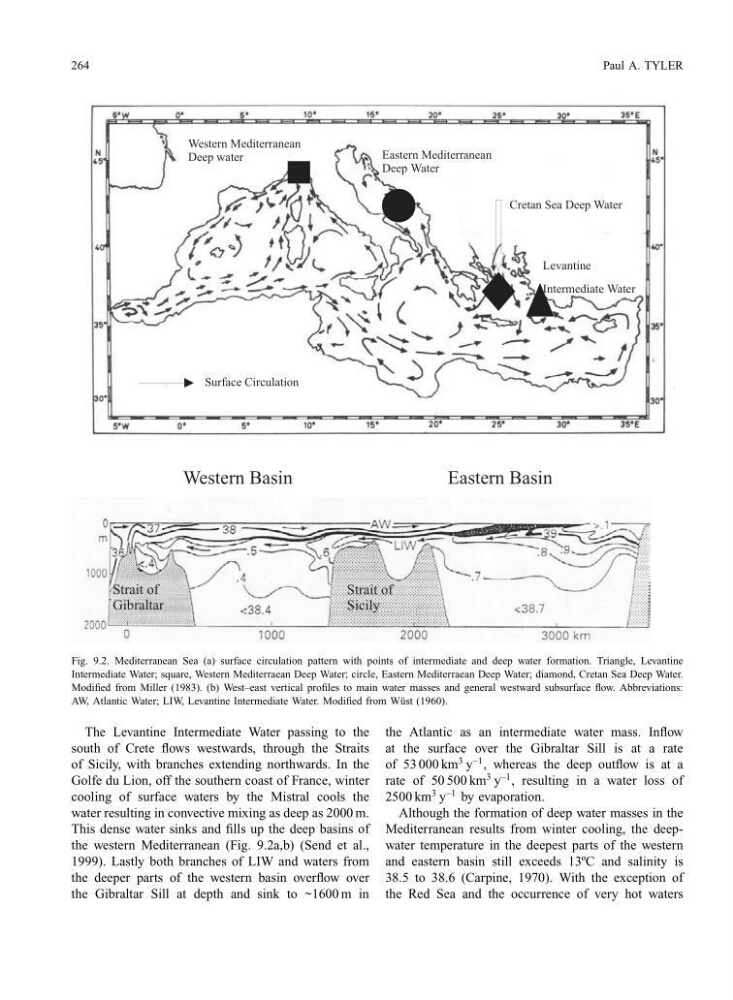
Fig. 9.2. Mediterranean Sea (a) surface circulation pattern with points of intermediate and deep water formation. Triangle, Levantine
Intermediate Water; square, Western Mediterraean Deep Water; circle, Eastern Mediterraean Deep Water; diamond, Cretan Sea Deep Water.
Modified from Miller (1983). (b) West–east vertical profiles to main water masses and general westward subsurface flow. Abbreviations:
AW, Atlantic Water; LIW, Levantine Intermediate Water. Modified from W¨ ust (1960).
The Levantine Intermediate Water passing to the
south of Crete flows westwards, through the Straits
of Sicily, with branches extending northwards. In the
Golfe du Lion, off the southern coast of France, winter
cooling of surface waters by the Mistral cools the
water resulting in convective mixing as deep as 2000 m.
This dense water sinks and fills up the deep basins of
the western Mediterranean (Fig. 9.2a,b) (Send et al.,
1999). Lastly both branches of LIW and waters from
the deeper parts of the western basin overflow over
the Gibraltar Sill at depth and sink to ~1600 m in
the Atlantic as an intermediate water mass. Inflow
at the surface over the Gibraltar Sill is at a rate
of 53 000 km
3 y
−1 , whereas the deep outflow is at a
rate of 50 500 km
3 y
−1 , resulting in a water loss of
2500 km
3 y
−1 by evaporation.
Although the formation of deep water masses in the
Mediterranean results from winter cooling, the deepwater temperature in the deepest parts of the western
and eastern basin still exceeds 13ºC and salinity is
38.5 to 38.6 (Carpine, 1970). With the exception of
the Red Sea and the occurrence of very hot waters
Paul A. TYLER
Western Mediterranean
Deep water
Eastern Mediterranean
Deep Water
Levantine
Intermediate Water
Cretan Sea Deep Water
Surface Circulation
Western Basin
Eastern Basin
Strait of
Gibraltar
Strait of
Sicily
Fig. 9.2. Mediterranean Sea (a) surface circulation pattern with points of intermediate and deep water formation. Triangle, Levantine
Intermediate Water; square, Western Mediterraean Deep Water; circle, Eastern Mediterraean Deep Water; diamond, Cretan Sea Deep Water.
Modified from Miller (1983). (b) West–east vertical profiles to main water masses and general westward subsurface flow. Abbreviations:
AW, Atlantic Water; LIW, Levantine Intermediate Water. Modified from W¨ ust (1960).
The Levantine Intermediate Water passing to the
south of Crete flows westwards, through the Straits
of Sicily, with branches extending northwards. In the
Golfe du Lion, off the southern coast of France, winter
cooling of surface waters by the Mistral cools the
water resulting in convective mixing as deep as 2000 m.
This dense water sinks and fills up the deep basins of
the western Mediterranean (Fig. 9.2a,b) (Send et al.,
1999). Lastly both branches of LIW and waters from
the deeper parts of the western basin overflow over
the Gibraltar Sill at depth and sink to ~1600 m in
the Atlantic as an intermediate water mass. Inflow
at the surface over the Gibraltar Sill is at a rate
of 53 000 km
3 y
−1 , whereas the deep outflow is at a
rate of 50 500 km
3 y
−1 , resulting in a water loss of
2500 km
3 y
−1 by evaporation.
Although the formation of deep water masses in the
Mediterranean results from winter cooling, the deepwater temperature in the deepest parts of the western
and eastern basin still exceeds 13ºC and salinity is
38.5 to 38.6 (Carpine, 1970). With the exception of
the Red Sea and the occurrence of very hot waters