

THE POLAR DEEP SEAS
247
all marine organisms or of both hemispheres (Clarke,
1992; Clarke and Crame, 1997).
Most of the data pertinent to a discussion of
latitudinal diversity clines in the sea come from shallow
or continental-shelf waters (Kendall and Aschan, 1993;
Kendall, 1996). Recently, however, Rex and colleagues
have argued that a latitudinal cline in diversity is to
be found in the deep sea (Rex et al., 1993, 1997;
Stuart and Rex, 1994). A particularly striking cline is
exhibited by prosobranch gastropods where the number
of species to be expected in a sample of 50 individuals
decreases from >20 in the abyssal equatorial Atlantic to
<5 in the Norwegian Deep (Fig. 8.4). Although no data
were included for the Arctic Ocean itself, the latitudinal
cline is very marked. Similarly distinct clines have
been shown in the northern hemisphere for deep-sea
isopods and bivalves (Rex et al., 1993). These clines
are, however, particularly strongly influenced by the
data for the Norwegian Sea (which has a genuinely
depauperate fauna: Dahl et al., 1976; Gray, 1994). For
some taxa (for example bivalves) removing the data
from the highest latitudes leaves a pattern with no
apparent latitudinal variation; for others (for example
gastropods: Fig. 8.4) a strong cline remains. There
are also statistical problems in the use of rarefaction
to estimate diversity from small samples, and the
difficulty of attaching a suitable confidence interval
(Gotelli and Graves, 1996; Svavarsson, 1997).
As with so many aspects of deep sea biology, the
question of the existence of a latitudinal cline in
diversity for all taxa is one where the hypotheses
exceed the data with which to test them. Nevertheless
the most careful analysis of the existing data does
suggest a strong latitudinal cline in the diversity of
deep-sea faunas (Rex et al., 1993, 1997). This would
suggest that the low taxonomic richness suggested
by the limited data for the Arctic deep-sea fauna is
explicable, at least in part, by global-scale processes.
The explanation for the latitudinal cline in diversity (if
indeed there is a single explanation) is not yet clear
[see discussion by Clarke and Crame (1997)], but the
evolutionary history of the fauna is clearly important.
Faunal affinities and evolutionary history
The evolutionary history of the Arctic fauna has
been reviewed by Menzies et al. (1973), Golikov and
Scarlato (1989), and Dunton (1992). It is now well
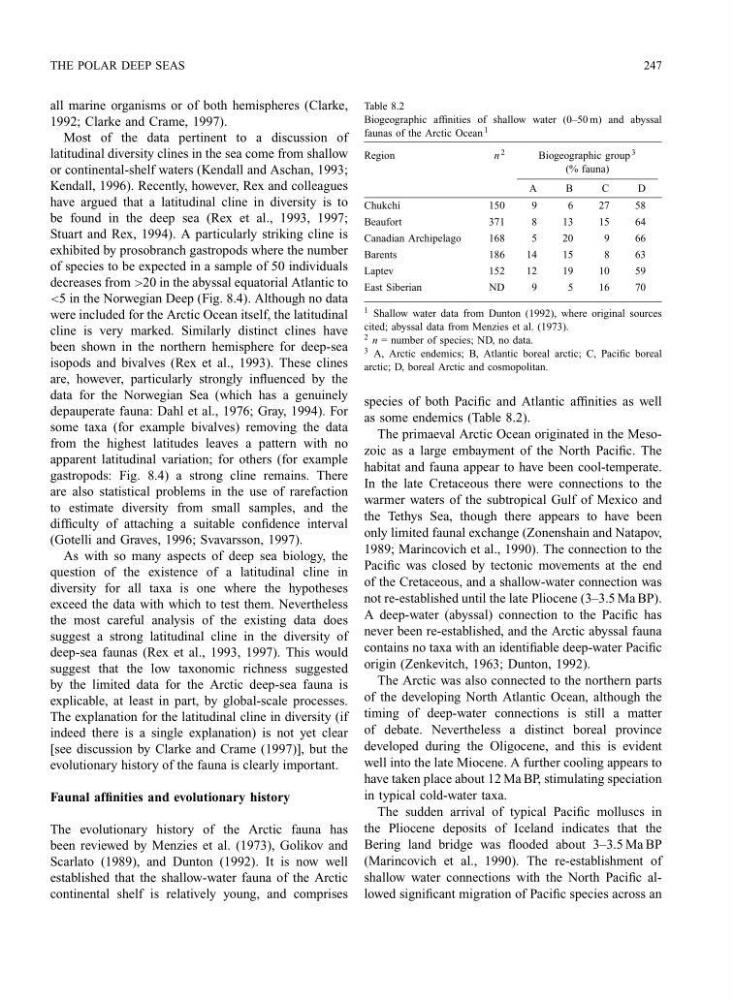
established that the shallow-water fauna of the Arctic
continental shelf is relatively young, and comprises
Table 8.2
Biogeographic affinities of shallow water (0–50 m) and abyssal
faunas of the Arctic Ocean 1
Region
n 2
Biogeographic group 3
(% fauna)
A
B
C
D
Chukchi
150
9
6
27
58
Beaufort
371
8
13
15
64
Canadian Archipelago
168
5
20
9
66
Barents
186
14
15
8
63
Laptev
152
12
19
10
59
East Siberian
ND
9
5
16
70
1 Shallow water data from Dunton (1992), where original sources
cited; abyssal data from Menzies et al. (1973).
2 n = number of species; ND, no data.
3 A, Arctic endemics; B, Atlantic boreal arctic; C, Pacific boreal
arctic; D, boreal Arctic and cosmopolitan.
species of both Pacific and Atlantic affinities as well
as some endemics (Table 8.2).
The primaeval Arctic Ocean originated in the Mesozoic as a large embayment of the North Pacific. The
habitat and fauna appear to have been cool-temperate.
In the late Cretaceous there were connections to the
warmer waters of the subtropical Gulf of Mexico and
the Tethys Sea, though there appears to have been
only limited faunal exchange (Zonenshain and Natapov,
1989; Marincovich et al., 1990). The connection to the
Pacific was closed by tectonic movements at the end
of the Cretaceous, and a shallow-water connection was
not re-established until the late Pliocene (3–3.5 Ma BP).
A deep-water (abyssal) connection to the Pacific has
never been re-established, and the Arctic abyssal fauna
contains no taxa with an identifiable deep-water Pacific
origin (Zenkevitch, 1963; Dunton, 1992).
The Arctic was also connected to the northern parts
of the developing North Atlantic Ocean, although the
timing of deep-water connections is still a matter
of debate. Nevertheless a distinct boreal province
developed during the Oligocene, and this is evident
well into the late Miocene. A further cooling appears to
have taken place about 12 Ma BP, stimulating speciation
in typical cold-water taxa.
The sudden arrival of typical Pacific molluscs in
the Pliocene deposits of Iceland indicates that the
Bering land bridge was flooded about 3–3.5 Ma BP
(Marincovich et al., 1990). The re-establishment of
shallow water connections with the North Pacific allowed significant migration of Pacific species across an
247
all marine organisms or of both hemispheres (Clarke,
1992; Clarke and Crame, 1997).
Most of the data pertinent to a discussion of
latitudinal diversity clines in the sea come from shallow
or continental-shelf waters (Kendall and Aschan, 1993;
Kendall, 1996). Recently, however, Rex and colleagues
have argued that a latitudinal cline in diversity is to
be found in the deep sea (Rex et al., 1993, 1997;
Stuart and Rex, 1994). A particularly striking cline is
exhibited by prosobranch gastropods where the number
of species to be expected in a sample of 50 individuals
decreases from >20 in the abyssal equatorial Atlantic to
<5 in the Norwegian Deep (Fig. 8.4). Although no data
were included for the Arctic Ocean itself, the latitudinal
cline is very marked. Similarly distinct clines have
been shown in the northern hemisphere for deep-sea
isopods and bivalves (Rex et al., 1993). These clines
are, however, particularly strongly influenced by the
data for the Norwegian Sea (which has a genuinely
depauperate fauna: Dahl et al., 1976; Gray, 1994). For
some taxa (for example bivalves) removing the data
from the highest latitudes leaves a pattern with no
apparent latitudinal variation; for others (for example
gastropods: Fig. 8.4) a strong cline remains. There
are also statistical problems in the use of rarefaction
to estimate diversity from small samples, and the
difficulty of attaching a suitable confidence interval
(Gotelli and Graves, 1996; Svavarsson, 1997).
As with so many aspects of deep sea biology, the
question of the existence of a latitudinal cline in
diversity for all taxa is one where the hypotheses
exceed the data with which to test them. Nevertheless
the most careful analysis of the existing data does
suggest a strong latitudinal cline in the diversity of
deep-sea faunas (Rex et al., 1993, 1997). This would
suggest that the low taxonomic richness suggested
by the limited data for the Arctic deep-sea fauna is
explicable, at least in part, by global-scale processes.
The explanation for the latitudinal cline in diversity (if
indeed there is a single explanation) is not yet clear
[see discussion by Clarke and Crame (1997)], but the
evolutionary history of the fauna is clearly important.
Faunal affinities and evolutionary history
The evolutionary history of the Arctic fauna has
been reviewed by Menzies et al. (1973), Golikov and
Scarlato (1989), and Dunton (1992). It is now well
established that the shallow-water fauna of the Arctic
continental shelf is relatively young, and comprises
Table 8.2
Biogeographic affinities of shallow water (0–50 m) and abyssal
faunas of the Arctic Ocean 1
Region
n 2
Biogeographic group 3
(% fauna)
A
B
C
D
Chukchi
150
9
6
27
58
Beaufort
371
8
13
15
64
Canadian Archipelago
168
5
20
9
66
Barents
186
14
15
8
63
Laptev
152
12
19
10
59
East Siberian
ND
9
5
16
70
1 Shallow water data from Dunton (1992), where original sources
cited; abyssal data from Menzies et al. (1973).
2 n = number of species; ND, no data.
3 A, Arctic endemics; B, Atlantic boreal arctic; C, Pacific boreal
arctic; D, boreal Arctic and cosmopolitan.
species of both Pacific and Atlantic affinities as well
as some endemics (Table 8.2).
The primaeval Arctic Ocean originated in the Mesozoic as a large embayment of the North Pacific. The
habitat and fauna appear to have been cool-temperate.
In the late Cretaceous there were connections to the
warmer waters of the subtropical Gulf of Mexico and
the Tethys Sea, though there appears to have been
only limited faunal exchange (Zonenshain and Natapov,
1989; Marincovich et al., 1990). The connection to the
Pacific was closed by tectonic movements at the end
of the Cretaceous, and a shallow-water connection was
not re-established until the late Pliocene (3–3.5 Ma BP).
A deep-water (abyssal) connection to the Pacific has
never been re-established, and the Arctic abyssal fauna
contains no taxa with an identifiable deep-water Pacific
origin (Zenkevitch, 1963; Dunton, 1992).
The Arctic was also connected to the northern parts
of the developing North Atlantic Ocean, although the
timing of deep-water connections is still a matter
of debate. Nevertheless a distinct boreal province
developed during the Oligocene, and this is evident
well into the late Miocene. A further cooling appears to
have taken place about 12 Ma BP, stimulating speciation
in typical cold-water taxa.
The sudden arrival of typical Pacific molluscs in
the Pliocene deposits of Iceland indicates that the
Bering land bridge was flooded about 3–3.5 Ma BP
(Marincovich et al., 1990). The re-establishment of
shallow water connections with the North Pacific allowed significant migration of Pacific species across an