

THE POLAR DEEP SEAS
245
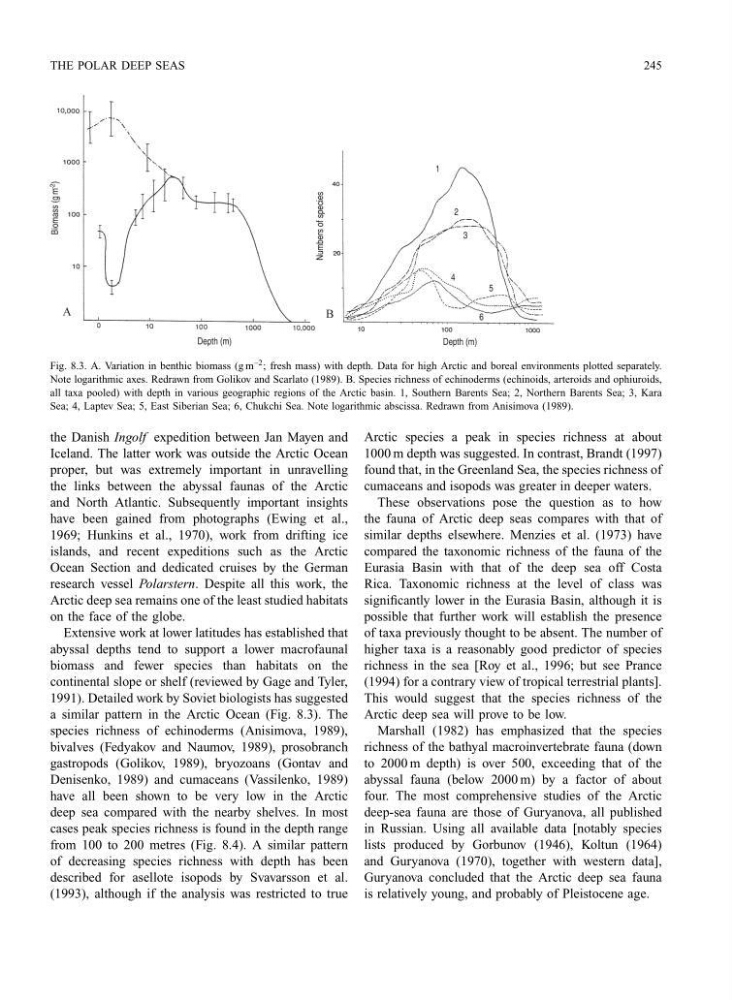
Fig. 8.3. A. Variation in benthic biomass (g m −2 ; fresh mass) with depth. Data for high Arctic and boreal environments plotted separately.
Note logarithmic axes. Redrawn from Golikov and Scarlato (1989). B. Species richness of echinoderms (echinoids, arteroids and ophiuroids,
all taxa pooled) with depth in various geographic regions of the Arctic basin. 1, Southern Barents Sea; 2, Northern Barents Sea; 3, Kara
Sea; 4, Laptev Sea; 5, East Siberian Sea; 6, Chukchi Sea. Note logarithmic abscissa. Redrawn from Anisimova (1989).
the Danish Ingolf expedition between Jan Mayen and
Iceland. The latter work was outside the Arctic Ocean
proper, but was extremely important in unravelling
the links between the abyssal faunas of the Arctic
and North Atlantic. Subsequently important insights
have been gained from photographs (Ewing et al.,
1969; Hunkins et al., 1970), work from drifting ice
islands, and recent expeditions such as the Arctic
Ocean Section and dedicated cruises by the German
research vessel Polarstern. Despite all this work, the
Arctic deep sea remains one of the least studied habitats
on the face of the globe.
Extensive work at lower latitudes has established that
abyssal depths tend to support a lower macrofaunal
biomass and fewer species than habitats on the
continental slope or shelf (reviewed by Gage and Tyler,
1991). Detailed work by Soviet biologists has suggested
a similar pattern in the Arctic Ocean (Fig. 8.3). The
species richness of echinoderms (Anisimova, 1989),
bivalves (Fedyakov and Naumov, 1989), prosobranch
gastropods (Golikov, 1989), bryozoans (Gontav and
Denisenko, 1989) and cumaceans (Vassilenko, 1989)
have all been shown to be very low in the Arctic
deep sea compared with the nearby shelves. In most
cases peak species richness is found in the depth range
from 100 to 200 metres (Fig. 8.4). A similar pattern
of decreasing species richness with depth has been
described for asellote isopods by Svavarsson et al.
(1993), although if the analysis was restricted to true
Arctic species a peak in species richness at about
1000 m depth was suggested. In contrast, Brandt (1997)
found that, in the Greenland Sea, the species richness of
cumaceans and isopods was greater in deeper waters.
These observations pose the question as to how
the fauna of Arctic deep seas compares with that of
similar depths elsewhere. Menzies et al. (1973) have
compared the taxonomic richness of the fauna of the
Eurasia Basin with that of the deep sea off Costa
Rica. Taxonomic richness at the level of class was
significantly lower in the Eurasia Basin, although it is
possible that further work will establish the presence
of taxa previously thought to be absent. The number of
higher taxa is a reasonably good predictor of species
richness in the sea [Roy et al., 1996; but see Prance
(1994) for a contrary view of tropical terrestrial plants].
This would suggest that the species richness of the
Arctic deep sea will prove to be low.
Marshall (1982) has emphasized that the species
richness of the bathyal macroinvertebrate fauna (down
to 2000 m depth) is over 500, exceeding that of the
abyssal fauna (below 2000 m) by a factor of about
four. The most comprehensive studies of the Arctic
deep-sea fauna are those of Guryanova, all published
in Russian. Using all available data [notably species
lists produced by Gorbunov (1946), Koltun (1964)
and Guryanova (1970), together with western data],
Guryanova concluded that the Arctic deep sea fauna
is relatively young, and probably of Pleistocene age.
245
Fig. 8.3. A. Variation in benthic biomass (g m −2 ; fresh mass) with depth. Data for high Arctic and boreal environments plotted separately.
Note logarithmic axes. Redrawn from Golikov and Scarlato (1989). B. Species richness of echinoderms (echinoids, arteroids and ophiuroids,
all taxa pooled) with depth in various geographic regions of the Arctic basin. 1, Southern Barents Sea; 2, Northern Barents Sea; 3, Kara
Sea; 4, Laptev Sea; 5, East Siberian Sea; 6, Chukchi Sea. Note logarithmic abscissa. Redrawn from Anisimova (1989).
the Danish Ingolf expedition between Jan Mayen and
Iceland. The latter work was outside the Arctic Ocean
proper, but was extremely important in unravelling
the links between the abyssal faunas of the Arctic
and North Atlantic. Subsequently important insights
have been gained from photographs (Ewing et al.,
1969; Hunkins et al., 1970), work from drifting ice
islands, and recent expeditions such as the Arctic
Ocean Section and dedicated cruises by the German
research vessel Polarstern. Despite all this work, the
Arctic deep sea remains one of the least studied habitats
on the face of the globe.
Extensive work at lower latitudes has established that
abyssal depths tend to support a lower macrofaunal
biomass and fewer species than habitats on the
continental slope or shelf (reviewed by Gage and Tyler,
1991). Detailed work by Soviet biologists has suggested
a similar pattern in the Arctic Ocean (Fig. 8.3). The
species richness of echinoderms (Anisimova, 1989),
bivalves (Fedyakov and Naumov, 1989), prosobranch
gastropods (Golikov, 1989), bryozoans (Gontav and
Denisenko, 1989) and cumaceans (Vassilenko, 1989)
have all been shown to be very low in the Arctic
deep sea compared with the nearby shelves. In most
cases peak species richness is found in the depth range
from 100 to 200 metres (Fig. 8.4). A similar pattern
of decreasing species richness with depth has been
described for asellote isopods by Svavarsson et al.
(1993), although if the analysis was restricted to true
Arctic species a peak in species richness at about
1000 m depth was suggested. In contrast, Brandt (1997)
found that, in the Greenland Sea, the species richness of
cumaceans and isopods was greater in deeper waters.
These observations pose the question as to how
the fauna of Arctic deep seas compares with that of
similar depths elsewhere. Menzies et al. (1973) have
compared the taxonomic richness of the fauna of the
Eurasia Basin with that of the deep sea off Costa
Rica. Taxonomic richness at the level of class was
significantly lower in the Eurasia Basin, although it is
possible that further work will establish the presence
of taxa previously thought to be absent. The number of
higher taxa is a reasonably good predictor of species
richness in the sea [Roy et al., 1996; but see Prance
(1994) for a contrary view of tropical terrestrial plants].
This would suggest that the species richness of the
Arctic deep sea will prove to be low.
Marshall (1982) has emphasized that the species
richness of the bathyal macroinvertebrate fauna (down
to 2000 m depth) is over 500, exceeding that of the
abyssal fauna (below 2000 m) by a factor of about
four. The most comprehensive studies of the Arctic
deep-sea fauna are those of Guryanova, all published
in Russian. Using all available data [notably species
lists produced by Gorbunov (1946), Koltun (1964)
and Guryanova (1970), together with western data],
Guryanova concluded that the Arctic deep sea fauna
is relatively young, and probably of Pleistocene age.