

14
David THISTLE
pressure wave that precedes the corer (even in the
most advanced designs only about 50% of the area
above the sample box is open) displaces material of low
mass (e.g., the flocculent layer, phytodetritus; Jumars,
1975; Smith et al., 1996), if any is present (Thistle and
Sherman, 1985). Therefore, box-corer samples usually
underestimate abundances of organisms that live at the
sediment surface or in the upper millimeters. The bias
becomes worse as animals decrease in size and mass
(see Bett et al., 1994).
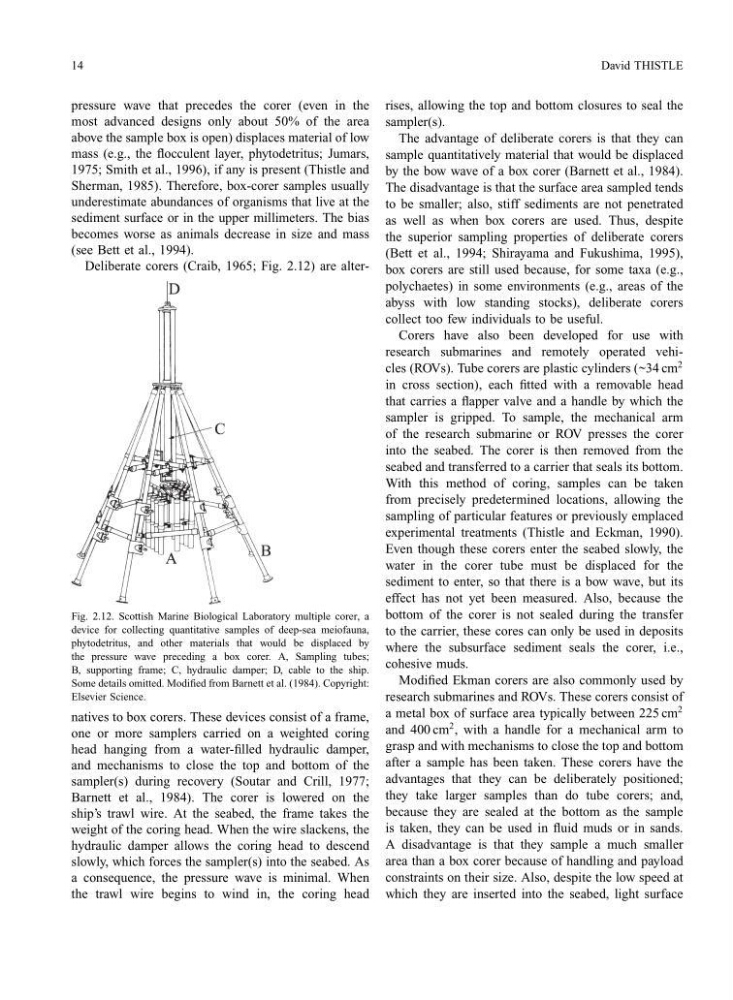
Deliberate corers (Craib, 1965; Fig. 2.12) are alterFig. 2.12. Scottish Marine Biological Laboratory multiple corer, a
device for collecting quantitative samples of deep-sea meiofauna,
phytodetritus, and other materials that would be displaced by
the pressure wave preceding a box corer. A, Sampling tubes;
B, supporting frame; C, hydraulic damper; D, cable to the ship.
Some details omitted. Modified from Barnett et al. (1984). Copyright:
Elsevier Science.
natives to box corers. These devices consist of a frame,
one or more samplers carried on a weighted coring
head hanging from a water-filled hydraulic damper,
and mechanisms to close the top and bottom of the
sampler(s) during recovery (Soutar and Crill, 1977;
Barnett et al., 1984). The corer is lowered on the
ship’s trawl wire. At the seabed, the frame takes the
weight of the coring head. When the wire slackens, the
hydraulic damper allows the coring head to descend
slowly, which forces the sampler(s) into the seabed. As
a consequence, the pressure wave is minimal. When
the trawl wire begins to wind in, the coring head
rises, allowing the top and bottom closures to seal the
sampler(s).
The advantage of deliberate corers is that they can
sample quantitatively material that would be displaced
by the bow wave of a box corer (Barnett et al., 1984).
The disadvantage is that the surface area sampled tends
to be smaller; also, stiff sediments are not penetrated
as well as when box corers are used. Thus, despite
the superior sampling properties of deliberate corers
(Bett et al., 1994; Shirayama and Fukushima, 1995),
box corers are still used because, for some taxa (e.g.,
polychaetes) in some environments (e.g., areas of the
abyss with low standing stocks), deliberate corers
collect too few individuals to be useful.
Corers have also been developed for use with
research submarines and remotely operated vehicles (ROVs). Tube corers are plastic cylinders (~34 cm
2
in cross section), each fitted with a removable head
that carries a flapper valve and a handle by which the
sampler is gripped. To sample, the mechanical arm
of the research submarine or ROV presses the corer
into the seabed. The corer is then removed from the
seabed and transferred to a carrier that seals its bottom.
With this method of coring, samples can be taken
from precisely predetermined locations, allowing the
sampling of particular features or previously emplaced
experimental treatments (Thistle and Eckman, 1990).
Even though these corers enter the seabed slowly, the
water in the corer tube must be displaced for the
sediment to enter, so that there is a bow wave, but its
effect has not yet been measured. Also, because the
bottom of the corer is not sealed during the transfer
to the carrier, these cores can only be used in deposits
where the subsurface sediment seals the corer, i.e.,
cohesive muds.
Modified Ekman corers are also commonly used by
research submarines and ROVs. These corers consist of
a metal box of surface area typically between 225 cm
2
and 400 cm
2 , with a handle for a mechanical arm to
grasp and with mechanisms to close the top and bottom
after a sample has been taken. These corers have the
advantages that they can be deliberately positioned;
they take larger samples than do tube corers; and,
because they are sealed at the bottom as the sample
is taken, they can be used in fluid muds or in sands.
A disadvantage is that they sample a much smaller
area than a box corer because of handling and payload
constraints on their size. Also, despite the low speed at
which they are inserted into the seabed, light surface
David THISTLE
pressure wave that precedes the corer (even in the
most advanced designs only about 50% of the area
above the sample box is open) displaces material of low
mass (e.g., the flocculent layer, phytodetritus; Jumars,
1975; Smith et al., 1996), if any is present (Thistle and
Sherman, 1985). Therefore, box-corer samples usually
underestimate abundances of organisms that live at the
sediment surface or in the upper millimeters. The bias
becomes worse as animals decrease in size and mass
(see Bett et al., 1994).
Deliberate corers (Craib, 1965; Fig. 2.12) are alterFig. 2.12. Scottish Marine Biological Laboratory multiple corer, a
device for collecting quantitative samples of deep-sea meiofauna,
phytodetritus, and other materials that would be displaced by
the pressure wave preceding a box corer. A, Sampling tubes;
B, supporting frame; C, hydraulic damper; D, cable to the ship.
Some details omitted. Modified from Barnett et al. (1984). Copyright:
Elsevier Science.
natives to box corers. These devices consist of a frame,
one or more samplers carried on a weighted coring
head hanging from a water-filled hydraulic damper,
and mechanisms to close the top and bottom of the
sampler(s) during recovery (Soutar and Crill, 1977;
Barnett et al., 1984). The corer is lowered on the
ship’s trawl wire. At the seabed, the frame takes the
weight of the coring head. When the wire slackens, the
hydraulic damper allows the coring head to descend
slowly, which forces the sampler(s) into the seabed. As
a consequence, the pressure wave is minimal. When
the trawl wire begins to wind in, the coring head
rises, allowing the top and bottom closures to seal the
sampler(s).
The advantage of deliberate corers is that they can
sample quantitatively material that would be displaced
by the bow wave of a box corer (Barnett et al., 1984).
The disadvantage is that the surface area sampled tends
to be smaller; also, stiff sediments are not penetrated
as well as when box corers are used. Thus, despite
the superior sampling properties of deliberate corers
(Bett et al., 1994; Shirayama and Fukushima, 1995),
box corers are still used because, for some taxa (e.g.,
polychaetes) in some environments (e.g., areas of the
abyss with low standing stocks), deliberate corers
collect too few individuals to be useful.
Corers have also been developed for use with
research submarines and remotely operated vehicles (ROVs). Tube corers are plastic cylinders (~34 cm
2
in cross section), each fitted with a removable head
that carries a flapper valve and a handle by which the
sampler is gripped. To sample, the mechanical arm
of the research submarine or ROV presses the corer
into the seabed. The corer is then removed from the
seabed and transferred to a carrier that seals its bottom.
With this method of coring, samples can be taken
from precisely predetermined locations, allowing the
sampling of particular features or previously emplaced
experimental treatments (Thistle and Eckman, 1990).
Even though these corers enter the seabed slowly, the
water in the corer tube must be displaced for the
sediment to enter, so that there is a bow wave, but its
effect has not yet been measured. Also, because the
bottom of the corer is not sealed during the transfer
to the carrier, these cores can only be used in deposits
where the subsurface sediment seals the corer, i.e.,
cohesive muds.
Modified Ekman corers are also commonly used by
research submarines and ROVs. These corers consist of
a metal box of surface area typically between 225 cm
2
and 400 cm
2 , with a handle for a mechanical arm to
grasp and with mechanisms to close the top and bottom
after a sample has been taken. These corers have the
advantages that they can be deliberately positioned;
they take larger samples than do tube corers; and,
because they are sealed at the bottom as the sample
is taken, they can be used in fluid muds or in sands.
A disadvantage is that they sample a much smaller
area than a box corer because of handling and payload
constraints on their size. Also, despite the low speed at
which they are inserted into the seabed, light surface