

224
Amanda W.J. DEMOPOULOS et al.
Clay or no Deposit
Calcareous Ooze
Siliceous Ooze
Shelf and Slope Deposits
Deep-Sea Muds
Glacial Debris
m
0
1000
2000
MILES
0
Km
3000
m
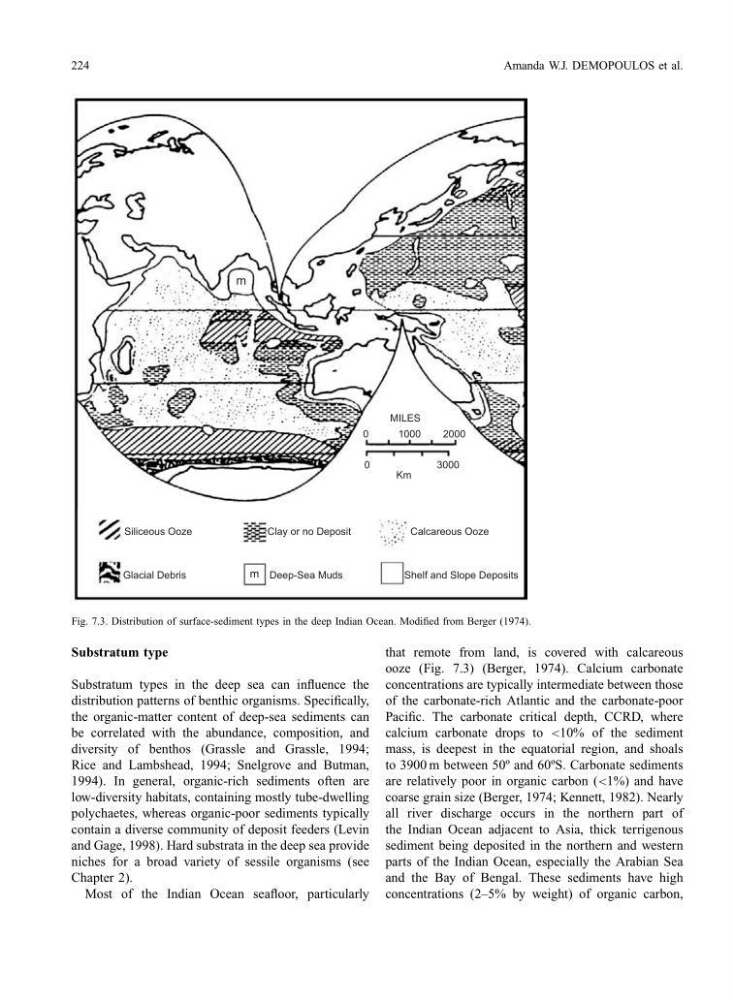
Fig. 7.3. Distribution of surface-sediment types in the deep Indian Ocean. Modified from Berger (1974).
Substratum type
Substratum types in the deep sea can influence the
distribution patterns of benthic organisms. Specifically,
the organic-matter content of deep-sea sediments can
be correlated with the abundance, composition, and
diversity of benthos (Grassle and Grassle, 1994;
Rice and Lambshead, 1994; Snelgrove and Butman,
1994). In general, organic-rich sediments often are
low-diversity habitats, containing mostly tube-dwelling
polychaetes, whereas organic-poor sediments typically
contain a diverse community of deposit feeders (Levin
and Gage, 1998). Hard substrata in the deep sea provide
niches for a broad variety of sessile organisms (see
Chapter 2).
Most of the Indian Ocean seafloor, particularly
that remote from land, is covered with calcareous
ooze (Fig. 7.3) (Berger, 1974). Calcium carbonate
concentrations are typically intermediate between those
of the carbonate-rich Atlantic and the carbonate-poor
Pacific. The carbonate critical depth, CCRD, where
calcium carbonate drops to <10% of the sediment
mass, is deepest in the equatorial region, and shoals
to 3900 m between 50º and 60ºS. Carbonate sediments
are relatively poor in organic carbon (<1%) and have
coarse grain size (Berger, 1974; Kennett, 1982). Nearly
all river discharge occurs in the northern part of
the Indian Ocean adjacent to Asia, thick terrigenous
sediment being deposited in the northern and western
parts of the Indian Ocean, especially the Arabian Sea
and the Bay of Bengal. These sediments have high
concentrations (2–5% by weight) of organic carbon,
Amanda W.J. DEMOPOULOS et al.
Clay or no Deposit
Calcareous Ooze
Siliceous Ooze
Shelf and Slope Deposits
Deep-Sea Muds
Glacial Debris
m
0
1000
2000
MILES
0
Km
3000
m
Fig. 7.3. Distribution of surface-sediment types in the deep Indian Ocean. Modified from Berger (1974).
Substratum type
Substratum types in the deep sea can influence the
distribution patterns of benthic organisms. Specifically,
the organic-matter content of deep-sea sediments can
be correlated with the abundance, composition, and
diversity of benthos (Grassle and Grassle, 1994;
Rice and Lambshead, 1994; Snelgrove and Butman,
1994). In general, organic-rich sediments often are
low-diversity habitats, containing mostly tube-dwelling
polychaetes, whereas organic-poor sediments typically
contain a diverse community of deposit feeders (Levin
and Gage, 1998). Hard substrata in the deep sea provide
niches for a broad variety of sessile organisms (see
Chapter 2).
Most of the Indian Ocean seafloor, particularly
that remote from land, is covered with calcareous
ooze (Fig. 7.3) (Berger, 1974). Calcium carbonate
concentrations are typically intermediate between those
of the carbonate-rich Atlantic and the carbonate-poor
Pacific. The carbonate critical depth, CCRD, where
calcium carbonate drops to <10% of the sediment
mass, is deepest in the equatorial region, and shoals
to 3900 m between 50º and 60ºS. Carbonate sediments
are relatively poor in organic carbon (<1%) and have
coarse grain size (Berger, 1974; Kennett, 1982). Nearly
all river discharge occurs in the northern part of
the Indian Ocean adjacent to Asia, thick terrigenous
sediment being deposited in the northern and western
parts of the Indian Ocean, especially the Arabian Sea
and the Bay of Bengal. These sediments have high
concentrations (2–5% by weight) of organic carbon,