

194
Craig R. SMITH and Amanda W.J. DEMOPOULOS
a very small proportion of the soft-sediment Californiaslope benthos. For example, less than 0.2% of the
epibenthic megafauna in the Santa Catalina Basin
belong to taxa likely to include obligate predators (e.g.,
the rockfish species Sebastolobus altivelis, neptunid
gastropods, and asteroids: Smith and Hamilton, 1983).
Similarly, predators are estimated to constitute no
more than 3% of the macrofaunal community in
the Santa Catalina Basin and less (probably much
less) than 13% of the polychaetes in the San Diego
Trough (Jumars and Gallagher, 1982). Based in part
on the apparent paucity of specialized predators, it
has been suggested that most predation in the deepsea (including the California slope), is performed by
omnivores that ingest a broad range of particle types
including live animals, sediments, and/or the remains of
dead organisms (e.g., carrion and phytodetritus: Dayton
and Hessler, 1972).
Rates of key ecological processes: To understand
the biological and geochemical dynamics of sediment
communities, it is useful to evaluate the rates of a number of key community processes including respiration,
production, bioturbation and recolonization following
disturbance. Evaluation of community production in
the deep Pacific is extremely problematic because
rates of individual and population growth, as well
as ratios of production to biomass and production
to respiration, are unknown for any major biotic
components. However, rates of respiration, bioturbation
and recolonization have been evaluated in a number of
California-slope communities.
Sediment-community respiration, or organic-carbon
mineralization, has been relatively well studied on the
California margin, having been evaluated at more than
20 sites with either in situ respirometers (e.g., Smith
and Hinga, 1983) or porewater measurements and
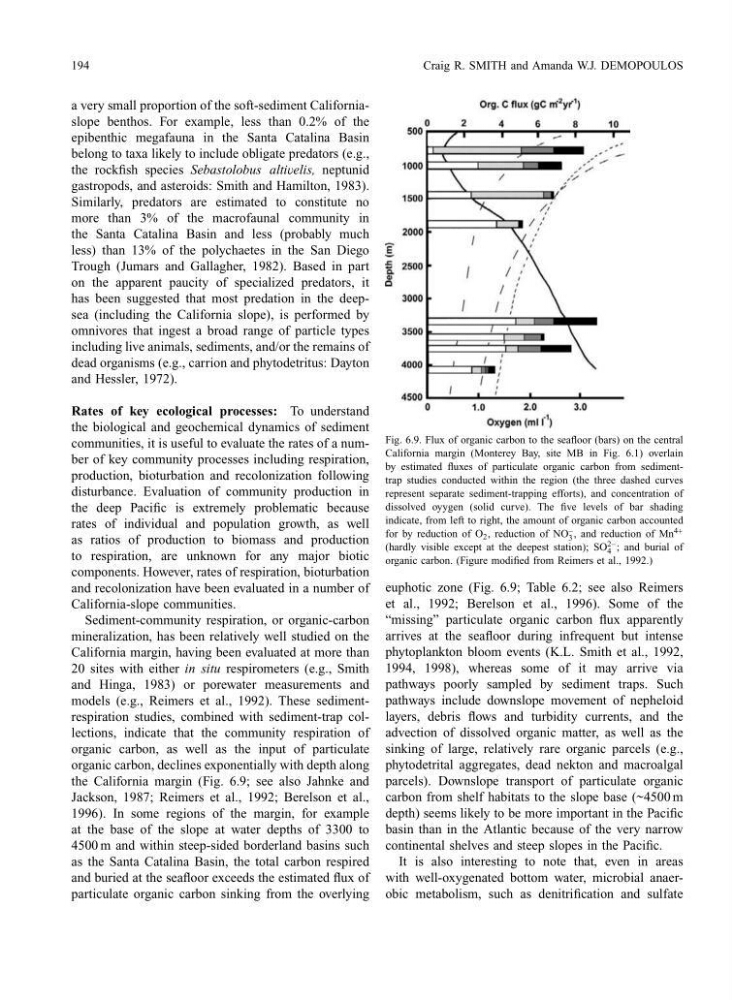
models (e.g., Reimers et al., 1992). These sedimentrespiration studies, combined with sediment-trap collections, indicate that the community respiration of
organic carbon, as well as the input of particulate
organic carbon, declines exponentially with depth along
the California margin (Fig. 6.9; see also Jahnke and
Jackson, 1987; Reimers et al., 1992; Berelson et al.,
1996). In some regions of the margin, for example
at the base of the slope at water depths of 3300 to
4500 m and within steep-sided borderland basins such
as the Santa Catalina Basin, the total carbon respired
and buried at the seafloor exceeds the estimated flux of
particulate organic carbon sinking from the overlying
Fig. 6.9. Flux of organic carbon to the seafloor (bars) on the central
California margin (Monterey Bay, site MB in Fig. 6.1) overlain
by estimated fluxes of particulate organic carbon from sedimenttrap studies conducted within the region (the three dashed curves
represent separate sediment-trapping efforts), and concentration of
dissolved oyygen (solid curve). The five levels of bar shading
indicate, from left to right, the amount of organic carbon accounted
for by reduction of O 2 , reduction of NO −
3 , and reduction of Mn 4+
(hardly visible except at the deepest station); SO 2−
4 ; and burial of
organic carbon. (Figure modified from Reimers et al., 1992.)
euphotic zone (Fig. 6.9; Table 6.2; see also Reimers
et al., 1992; Berelson et al., 1996). Some of the
“missing” particulate organic carbon flux apparently
arrives at the seafloor during infrequent but intense
phytoplankton bloom events (K.L. Smith et al., 1992,
1994, 1998), whereas some of it may arrive via
pathways poorly sampled by sediment traps. Such
pathways include downslope movement of nepheloid
layers, debris flows and turbidity currents, and the
advection of dissolved organic matter, as well as the
sinking of large, relatively rare organic parcels (e.g.,
phytodetrital aggregates, dead nekton and macroalgal
parcels). Downslope transport of particulate organic
carbon from shelf habitats to the slope base (~4500 m
depth) seems likely to be more important in the Pacific
basin than in the Atlantic because of the very narrow
continental shelves and steep slopes in the Pacific.
It is also interesting to note that, even in areas
with well-oxygenated bottom water, microbial anaerobic metabolism, such as denitrification and sulfate
Craig R. SMITH and Amanda W.J. DEMOPOULOS
a very small proportion of the soft-sediment Californiaslope benthos. For example, less than 0.2% of the
epibenthic megafauna in the Santa Catalina Basin
belong to taxa likely to include obligate predators (e.g.,
the rockfish species Sebastolobus altivelis, neptunid
gastropods, and asteroids: Smith and Hamilton, 1983).
Similarly, predators are estimated to constitute no
more than 3% of the macrofaunal community in
the Santa Catalina Basin and less (probably much
less) than 13% of the polychaetes in the San Diego
Trough (Jumars and Gallagher, 1982). Based in part
on the apparent paucity of specialized predators, it
has been suggested that most predation in the deepsea (including the California slope), is performed by
omnivores that ingest a broad range of particle types
including live animals, sediments, and/or the remains of
dead organisms (e.g., carrion and phytodetritus: Dayton
and Hessler, 1972).
Rates of key ecological processes: To understand
the biological and geochemical dynamics of sediment
communities, it is useful to evaluate the rates of a number of key community processes including respiration,
production, bioturbation and recolonization following
disturbance. Evaluation of community production in
the deep Pacific is extremely problematic because
rates of individual and population growth, as well
as ratios of production to biomass and production
to respiration, are unknown for any major biotic
components. However, rates of respiration, bioturbation
and recolonization have been evaluated in a number of
California-slope communities.
Sediment-community respiration, or organic-carbon
mineralization, has been relatively well studied on the
California margin, having been evaluated at more than
20 sites with either in situ respirometers (e.g., Smith
and Hinga, 1983) or porewater measurements and
models (e.g., Reimers et al., 1992). These sedimentrespiration studies, combined with sediment-trap collections, indicate that the community respiration of
organic carbon, as well as the input of particulate
organic carbon, declines exponentially with depth along
the California margin (Fig. 6.9; see also Jahnke and
Jackson, 1987; Reimers et al., 1992; Berelson et al.,
1996). In some regions of the margin, for example
at the base of the slope at water depths of 3300 to
4500 m and within steep-sided borderland basins such
as the Santa Catalina Basin, the total carbon respired
and buried at the seafloor exceeds the estimated flux of
particulate organic carbon sinking from the overlying
Fig. 6.9. Flux of organic carbon to the seafloor (bars) on the central
California margin (Monterey Bay, site MB in Fig. 6.1) overlain
by estimated fluxes of particulate organic carbon from sedimenttrap studies conducted within the region (the three dashed curves
represent separate sediment-trapping efforts), and concentration of
dissolved oyygen (solid curve). The five levels of bar shading
indicate, from left to right, the amount of organic carbon accounted
for by reduction of O 2 , reduction of NO −
3 , and reduction of Mn 4+
(hardly visible except at the deepest station); SO 2−
4 ; and burial of
organic carbon. (Figure modified from Reimers et al., 1992.)
euphotic zone (Fig. 6.9; Table 6.2; see also Reimers
et al., 1992; Berelson et al., 1996). Some of the
“missing” particulate organic carbon flux apparently
arrives at the seafloor during infrequent but intense
phytoplankton bloom events (K.L. Smith et al., 1992,
1994, 1998), whereas some of it may arrive via
pathways poorly sampled by sediment traps. Such
pathways include downslope movement of nepheloid
layers, debris flows and turbidity currents, and the
advection of dissolved organic matter, as well as the
sinking of large, relatively rare organic parcels (e.g.,
phytodetrital aggregates, dead nekton and macroalgal
parcels). Downslope transport of particulate organic
carbon from shelf habitats to the slope base (~4500 m
depth) seems likely to be more important in the Pacific
basin than in the Atlantic because of the very narrow
continental shelves and steep slopes in the Pacific.
It is also interesting to note that, even in areas
with well-oxygenated bottom water, microbial anaerobic metabolism, such as denitrification and sulfate