

THE DEEP-SEA FLOOR: AN OVERVIEW
9
0
200
400
600
800
1000
1200
10 -11
10 -9
10 -7
10 -5
10 -3
10 -1
10 1
10 3
10 5
Light intensity ( W cm )
m
-2
Limit of
phytoplankton
growth
Cle ar coa sta l wa ter
Depth (m)
C l e a r e s t o c e a n w a t e r
Euphotic
Aphotic
Disphotic
Limit of crustacean
phototaxis
Detection limit for deep-sea fishes
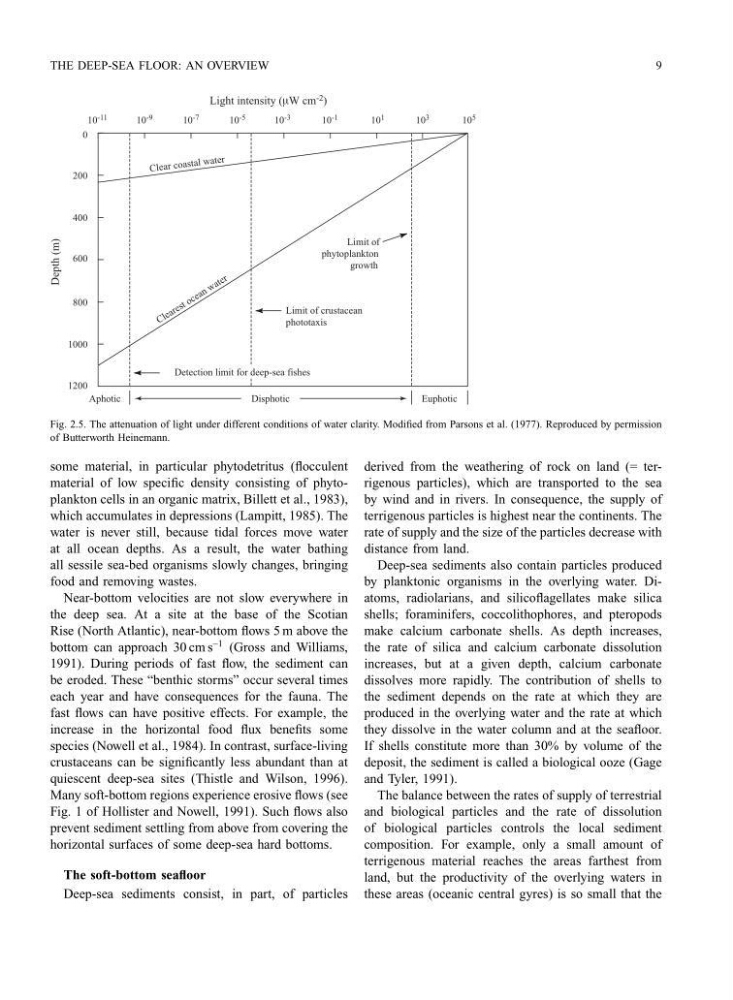
Fig. 2.5. The attenuation of light under different conditions of water clarity. Modified from Parsons et al. (1977). Reproduced by permission
of Butterworth Heinemann.
some material, in particular phytodetritus (flocculent
material of low specific density consisting of phytoplankton cells in an organic matrix, Billett et al., 1983),
which accumulates in depressions (Lampitt, 1985). The
water is never still, because tidal forces move water
at all ocean depths. As a result, the water bathing
all sessile sea-bed organisms slowly changes, bringing
food and removing wastes.
Near-bottom velocities are not slow everywhere in
the deep sea. At a site at the base of the Scotian
Rise (North Atlantic), near-bottom flows 5 m above the
bottom can approach 30 cm s
−1 (Gross and Williams,
1991). During periods of fast flow, the sediment can
be eroded. These “benthic storms” occur several times
each year and have consequences for the fauna. The
fast flows can have positive effects. For example, the
increase in the horizontal food flux benefits some
species (Nowell et al., 1984). In contrast, surface-living
crustaceans can be significantly less abundant than at
quiescent deep-sea sites (Thistle and Wilson, 1996).
Many soft-bottom regions experience erosive flows (see
Fig. 1 of Hollister and Nowell, 1991). Such flows also
prevent sediment settling from above from covering the
horizontal surfaces of some deep-sea hard bottoms.
The soft-bottom seafloor
Deep-sea sediments consist, in part, of particles
derived from the weathering of rock on land (= terrigenous particles), which are transported to the sea
by wind and in rivers. In consequence, the supply of
terrigenous particles is highest near the continents. The
rate of supply and the size of the particles decrease with
distance from land.
Deep-sea sediments also contain particles produced
by planktonic organisms in the overlying water. Diatoms, radiolarians, and silicoflagellates make silica
shells; foraminifers, coccolithophores, and pteropods
make calcium carbonate shells. As depth increases,
the rate of silica and calcium carbonate dissolution
increases, but at a given depth, calcium carbonate
dissolves more rapidly. The contribution of shells to
the sediment depends on the rate at which they are
produced in the overlying water and the rate at which
they dissolve in the water column and at the seafloor.
If shells constitute more than 30% by volume of the
deposit, the sediment is called a biological ooze (Gage
and Tyler, 1991).
The balance between the rates of supply of terrestrial
and biological particles and the rate of dissolution
of biological particles controls the local sediment
composition. For example, only a small amount of
terrigenous material reaches the areas farthest from
land, but the productivity of the overlying waters in
these areas (oceanic central gyres) is so small that the
9
0
200
400
600
800
1000
1200
10 -11
10 -9
10 -7
10 -5
10 -3
10 -1
10 1
10 3
10 5
Light intensity ( W cm )
m
-2
Limit of
phytoplankton
growth
Cle ar coa sta l wa ter
Depth (m)
C l e a r e s t o c e a n w a t e r
Euphotic
Aphotic
Disphotic
Limit of crustacean
phototaxis
Detection limit for deep-sea fishes
Fig. 2.5. The attenuation of light under different conditions of water clarity. Modified from Parsons et al. (1977). Reproduced by permission
of Butterworth Heinemann.
some material, in particular phytodetritus (flocculent
material of low specific density consisting of phytoplankton cells in an organic matrix, Billett et al., 1983),
which accumulates in depressions (Lampitt, 1985). The
water is never still, because tidal forces move water
at all ocean depths. As a result, the water bathing
all sessile sea-bed organisms slowly changes, bringing
food and removing wastes.
Near-bottom velocities are not slow everywhere in
the deep sea. At a site at the base of the Scotian
Rise (North Atlantic), near-bottom flows 5 m above the
bottom can approach 30 cm s
−1 (Gross and Williams,
1991). During periods of fast flow, the sediment can
be eroded. These “benthic storms” occur several times
each year and have consequences for the fauna. The
fast flows can have positive effects. For example, the
increase in the horizontal food flux benefits some
species (Nowell et al., 1984). In contrast, surface-living
crustaceans can be significantly less abundant than at
quiescent deep-sea sites (Thistle and Wilson, 1996).
Many soft-bottom regions experience erosive flows (see
Fig. 1 of Hollister and Nowell, 1991). Such flows also
prevent sediment settling from above from covering the
horizontal surfaces of some deep-sea hard bottoms.
The soft-bottom seafloor
Deep-sea sediments consist, in part, of particles
derived from the weathering of rock on land (= terrigenous particles), which are transported to the sea
by wind and in rivers. In consequence, the supply of
terrigenous particles is highest near the continents. The
rate of supply and the size of the particles decrease with
distance from land.
Deep-sea sediments also contain particles produced
by planktonic organisms in the overlying water. Diatoms, radiolarians, and silicoflagellates make silica
shells; foraminifers, coccolithophores, and pteropods
make calcium carbonate shells. As depth increases,
the rate of silica and calcium carbonate dissolution
increases, but at a given depth, calcium carbonate
dissolves more rapidly. The contribution of shells to
the sediment depends on the rate at which they are
produced in the overlying water and the rate at which
they dissolve in the water column and at the seafloor.
If shells constitute more than 30% by volume of the
deposit, the sediment is called a biological ooze (Gage
and Tyler, 1991).
The balance between the rates of supply of terrestrial
and biological particles and the rate of dissolution
of biological particles controls the local sediment
composition. For example, only a small amount of
terrigenous material reaches the areas farthest from
land, but the productivity of the overlying waters in
these areas (oceanic central gyres) is so small that the