

THE DEEP PACIFIC OCEAN FLOOR
185
habitats formed in this manner are common on the
California slope between depths of 500 m and 1000 m
(Emery, 1960; Reimers et al., 1992; see also Fig. 2.4
in Chapter 2), in the eastern tropical Pacific between
roughly 100 and 1000 m (Wishner et al., 1990),
and along the Peru–Chile margin at depths of tens
to hundreds of meters (Diaz and Rosenberg, 1995).
Partially enclosed basins may also contain bottom
water with little or no oxygen at depths far below the
oxygen-minimum zone if the deepest point of entry
into the basin (i.e., its sill depth) falls within this zone;
this is because the densest water entering the basin
comes from the sill depth, and thus fills all deeper
levels. Several such low-oxygen basins (e.g., the Santa
Barbara, Santa Monica and San Pedro Basins) occur in
the borderland region off southern California (Emery,
1960).
Sinking flux of particulate organic carbon
The primary source of food material for deep-sea
communities, excluding hydrothermal vents and cold
seeps, appears to be the rain of organic particles,
ranging from individual phytoplankton cells to dead
whales, sinking from the euphotic zone (Chapter 2).
The organic matter in the smaller of these particles
degrades and is consumed by midwater animals during
transit through the water column, generally yielding
a very low flux of food to the deep-sea floor.
Consequently, benthic assemblages of the abyss are
among those with the poorest supply of food and
the smallest biomass on the Earth’s solid surface. As
might be expected in an energy-poor ecosystem, the
total biomass in many size-classes of benthos (e.g., the
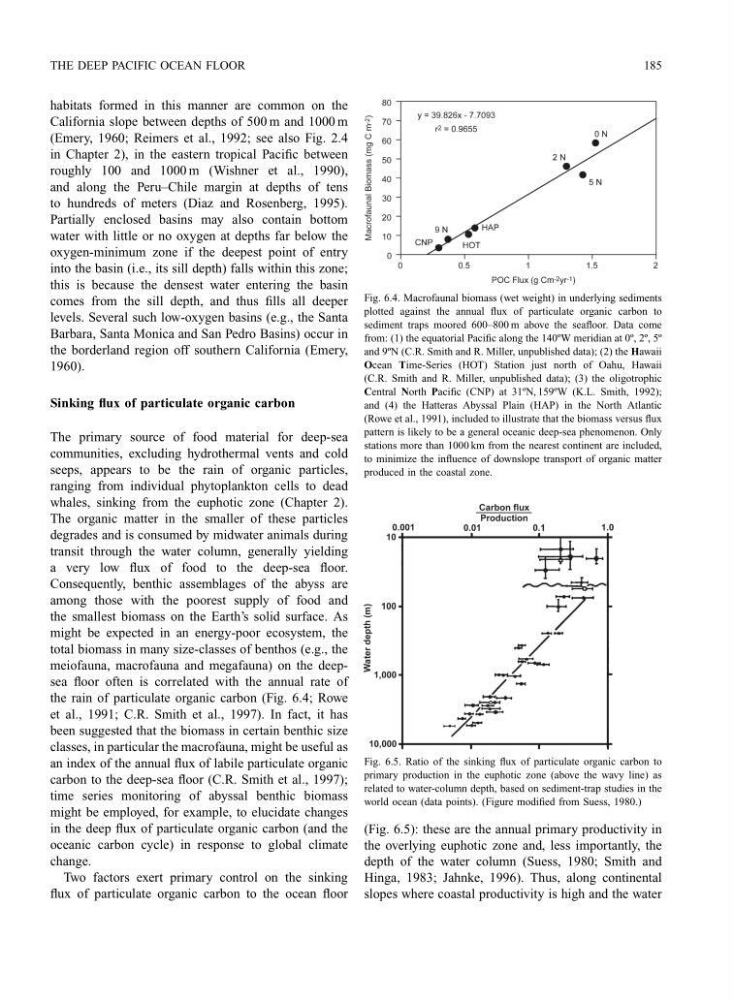
meiofauna, macrofauna and megafauna) on the deepsea floor often is correlated with the annual rate of
the rain of particulate organic carbon (Fig. 6.4; Rowe
et al., 1991; C.R. Smith et al., 1997). In fact, it has
been suggested that the biomass in certain benthic size
classes, in particular the macrofauna, might be useful as
an index of the annual flux of labile particulate organic
carbon to the deep-sea floor (C.R. Smith et al., 1997);
time series monitoring of abyssal benthic biomass
might be employed, for example, to elucidate changes
in the deep flux of particulate organic carbon (and the
oceanic carbon cycle) in response to global climate
change.
Two factors exert primary control on the sinking
flux of particulate organic carbon to the ocean floor
Fig. 6.4. Macrofaunal biomass (wet weight) in underlying sediments
plotted against the annual flux of particulate organic carbon to
sediment traps moored 600–800 m above the seafloor. Data come
from: (1) the equatorial Pacific along the 140ºW meridian at 0º, 2º, 5º
and 9ºN (C.R. Smith and R. Miller, unpublished data); (2) the Hawaii
Ocean Time-Series (HOT) Station just north of Oahu, Hawaii
(C.R. Smith and R. Miller, unpublished data); (3) the oligotrophic
Central North Pacific (CNP) at 31ºN, 159ºW (K.L. Smith, 1992);
and (4) the Hatteras Abyssal Plain (HAP) in the North Atlantic
(Rowe et al., 1991), included to illustrate that the biomass versus flux
pattern is likely to be a general oceanic deep-sea phenomenon. Only
stations more than 1000 km from the nearest continent are included,
to minimize the influence of downslope transport of organic matter
produced in the coastal zone.
Fig. 6.5. Ratio of the sinking flux of particulate organic carbon to
primary production in the euphotic zone (above the wavy line) as
related to water-column depth, based on sediment-trap studies in the
world ocean (data points). (Figure modified from Suess, 1980.)
(Fig. 6.5): these are the annual primary productivity in
the overlying euphotic zone and, less importantly, the
depth of the water column (Suess, 1980; Smith and
Hinga, 1983; Jahnke, 1996). Thus, along continental
slopes where coastal productivity is high and the water
185
habitats formed in this manner are common on the
California slope between depths of 500 m and 1000 m
(Emery, 1960; Reimers et al., 1992; see also Fig. 2.4
in Chapter 2), in the eastern tropical Pacific between
roughly 100 and 1000 m (Wishner et al., 1990),
and along the Peru–Chile margin at depths of tens
to hundreds of meters (Diaz and Rosenberg, 1995).
Partially enclosed basins may also contain bottom
water with little or no oxygen at depths far below the
oxygen-minimum zone if the deepest point of entry
into the basin (i.e., its sill depth) falls within this zone;
this is because the densest water entering the basin
comes from the sill depth, and thus fills all deeper
levels. Several such low-oxygen basins (e.g., the Santa
Barbara, Santa Monica and San Pedro Basins) occur in
the borderland region off southern California (Emery,
1960).
Sinking flux of particulate organic carbon
The primary source of food material for deep-sea
communities, excluding hydrothermal vents and cold
seeps, appears to be the rain of organic particles,
ranging from individual phytoplankton cells to dead
whales, sinking from the euphotic zone (Chapter 2).
The organic matter in the smaller of these particles
degrades and is consumed by midwater animals during
transit through the water column, generally yielding
a very low flux of food to the deep-sea floor.
Consequently, benthic assemblages of the abyss are
among those with the poorest supply of food and
the smallest biomass on the Earth’s solid surface. As
might be expected in an energy-poor ecosystem, the
total biomass in many size-classes of benthos (e.g., the
meiofauna, macrofauna and megafauna) on the deepsea floor often is correlated with the annual rate of
the rain of particulate organic carbon (Fig. 6.4; Rowe
et al., 1991; C.R. Smith et al., 1997). In fact, it has
been suggested that the biomass in certain benthic size
classes, in particular the macrofauna, might be useful as
an index of the annual flux of labile particulate organic
carbon to the deep-sea floor (C.R. Smith et al., 1997);
time series monitoring of abyssal benthic biomass
might be employed, for example, to elucidate changes
in the deep flux of particulate organic carbon (and the
oceanic carbon cycle) in response to global climate
change.
Two factors exert primary control on the sinking
flux of particulate organic carbon to the ocean floor
Fig. 6.4. Macrofaunal biomass (wet weight) in underlying sediments
plotted against the annual flux of particulate organic carbon to
sediment traps moored 600–800 m above the seafloor. Data come
from: (1) the equatorial Pacific along the 140ºW meridian at 0º, 2º, 5º
and 9ºN (C.R. Smith and R. Miller, unpublished data); (2) the Hawaii
Ocean Time-Series (HOT) Station just north of Oahu, Hawaii
(C.R. Smith and R. Miller, unpublished data); (3) the oligotrophic
Central North Pacific (CNP) at 31ºN, 159ºW (K.L. Smith, 1992);
and (4) the Hatteras Abyssal Plain (HAP) in the North Atlantic
(Rowe et al., 1991), included to illustrate that the biomass versus flux
pattern is likely to be a general oceanic deep-sea phenomenon. Only
stations more than 1000 km from the nearest continent are included,
to minimize the influence of downslope transport of organic matter
produced in the coastal zone.
Fig. 6.5. Ratio of the sinking flux of particulate organic carbon to
primary production in the euphotic zone (above the wavy line) as
related to water-column depth, based on sediment-trap studies in the
world ocean (data points). (Figure modified from Suess, 1980.)
(Fig. 6.5): these are the annual primary productivity in
the overlying euphotic zone and, less importantly, the
depth of the water column (Suess, 1980; Smith and
Hinga, 1983; Jahnke, 1996). Thus, along continental
slopes where coastal productivity is high and the water