

THE DEEP PACIFIC OCEAN FLOOR
183
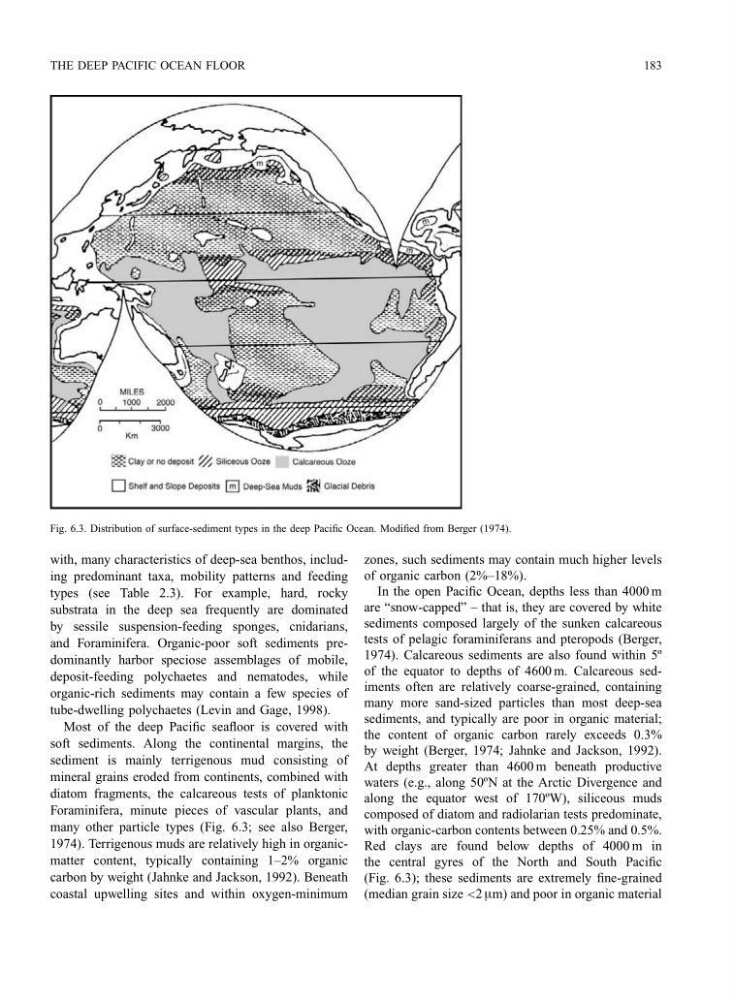
Fig. 6.3. Distribution of surface-sediment types in the deep Pacific Ocean. Modified from Berger (1974).
with, many characteristics of deep-sea benthos, including predominant taxa, mobility patterns and feeding
types (see Table 2.3). For example, hard, rocky
substrata in the deep sea frequently are dominated
by sessile suspension-feeding sponges, cnidarians,
and Foraminifera. Organic-poor soft sediments predominantly harbor speciose assemblages of mobile,
deposit-feeding polychaetes and nematodes, while
organic-rich sediments may contain a few species of
tube-dwelling polychaetes (Levin and Gage, 1998).
Most of the deep Pacific seafloor is covered with
soft sediments. Along the continental margins, the
sediment is mainly terrigenous mud consisting of
mineral grains eroded from continents, combined with
diatom fragments, the calcareous tests of planktonic
Foraminifera, minute pieces of vascular plants, and
many other particle types (Fig. 6.3; see also Berger,
1974). Terrigenous muds are relatively high in organicmatter content, typically containing 1–2% organic
carbon by weight (Jahnke and Jackson, 1992). Beneath
coastal upwelling sites and within oxygen-minimum
zones, such sediments may contain much higher levels
of organic carbon (2%–18%).
In the open Pacific Ocean, depths less than 4000 m
are “snow-capped” – that is, they are covered by white
sediments composed largely of the sunken calcareous
tests of pelagic foraminiferans and pteropods (Berger,
1974). Calcareous sediments are also found within 5º
of the equator to depths of 4600 m. Calcareous sediments often are relatively coarse-grained, containing
many more sand-sized particles than most deep-sea
sediments, and typically are poor in organic material;
the content of organic carbon rarely exceeds 0.3%
by weight (Berger, 1974; Jahnke and Jackson, 1992).
At depths greater than 4600 m beneath productive
waters (e.g., along 50ºN at the Arctic Divergence and
along the equator west of 170ºW), siliceous muds
composed of diatom and radiolarian tests predominate,
with organic-carbon contents between 0.25% and 0.5%.
Red clays are found below depths of 4000 m in
the central gyres of the North and South Pacific
(Fig. 6.3); these sediments are extremely fine-grained
(median grain size <2 mm) and poor in organic material
183
Fig. 6.3. Distribution of surface-sediment types in the deep Pacific Ocean. Modified from Berger (1974).
with, many characteristics of deep-sea benthos, including predominant taxa, mobility patterns and feeding
types (see Table 2.3). For example, hard, rocky
substrata in the deep sea frequently are dominated
by sessile suspension-feeding sponges, cnidarians,
and Foraminifera. Organic-poor soft sediments predominantly harbor speciose assemblages of mobile,
deposit-feeding polychaetes and nematodes, while
organic-rich sediments may contain a few species of
tube-dwelling polychaetes (Levin and Gage, 1998).
Most of the deep Pacific seafloor is covered with
soft sediments. Along the continental margins, the
sediment is mainly terrigenous mud consisting of
mineral grains eroded from continents, combined with
diatom fragments, the calcareous tests of planktonic
Foraminifera, minute pieces of vascular plants, and
many other particle types (Fig. 6.3; see also Berger,
1974). Terrigenous muds are relatively high in organicmatter content, typically containing 1–2% organic
carbon by weight (Jahnke and Jackson, 1992). Beneath
coastal upwelling sites and within oxygen-minimum
zones, such sediments may contain much higher levels
of organic carbon (2%–18%).
In the open Pacific Ocean, depths less than 4000 m
are “snow-capped” – that is, they are covered by white
sediments composed largely of the sunken calcareous
tests of pelagic foraminiferans and pteropods (Berger,
1974). Calcareous sediments are also found within 5º
of the equator to depths of 4600 m. Calcareous sediments often are relatively coarse-grained, containing
many more sand-sized particles than most deep-sea
sediments, and typically are poor in organic material;
the content of organic carbon rarely exceeds 0.3%
by weight (Berger, 1974; Jahnke and Jackson, 1992).
At depths greater than 4600 m beneath productive
waters (e.g., along 50ºN at the Arctic Divergence and
along the equator west of 170ºW), siliceous muds
composed of diatom and radiolarian tests predominate,
with organic-carbon contents between 0.25% and 0.5%.
Red clays are found below depths of 4000 m in
the central gyres of the North and South Pacific
(Fig. 6.3); these sediments are extremely fine-grained
(median grain size <2 mm) and poor in organic material