

THE DEEP ATLANTIC OCEAN
159
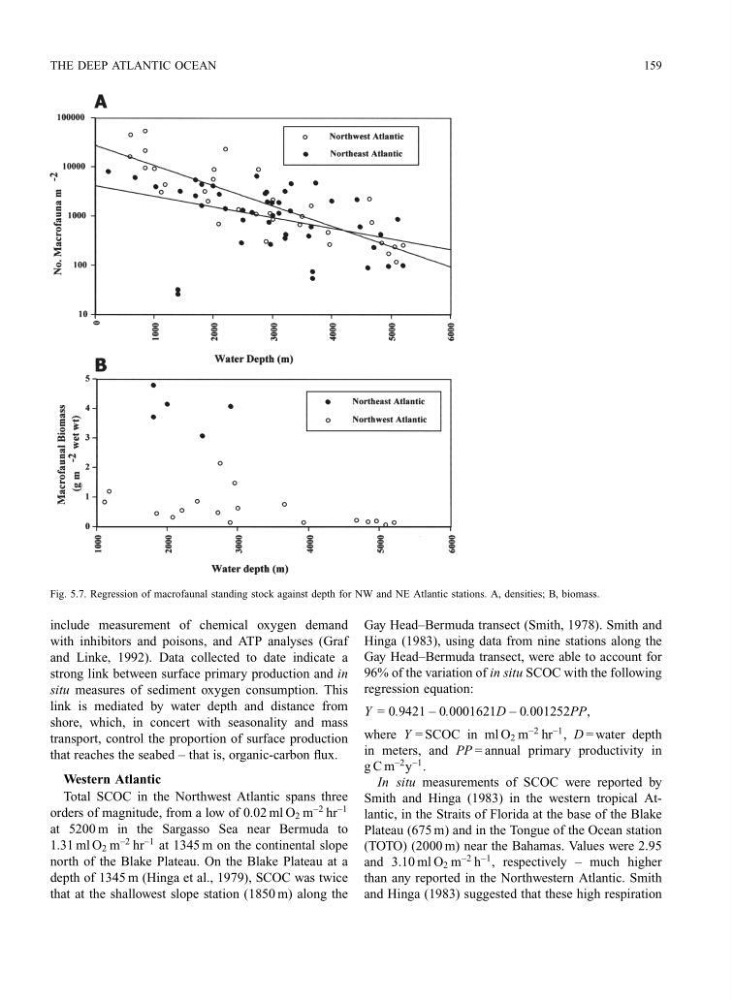
Fig. 5.7. Regression of macrofaunal standing stock against depth for NW and NE Atlantic stations. A, densities; B, biomass.
include measurement of chemical oxygen demand
with inhibitors and poisons, and ATP analyses (Graf
and Linke, 1992). Data collected to date indicate a
strong link between surface primary production and in
situ measures of sediment oxygen consumption. This
link is mediated by water depth and distance from
shore, which, in concert with seasonality and mass
transport, control the proportion of surface production
that reaches the seabed – that is, organic-carbon flux.
Western Atlantic
Total SCOC in the Northwest Atlantic spans three
orders of magnitude, from a low of 0.02 ml O 2 m
−2 hr
−1
at 5200 m in the Sargasso Sea near Bermuda to
1.31 ml O 2 m
−2 hr
−1 at 1345 m on the continental slope
north of the Blake Plateau. On the Blake Plateau at a
depth of 1345 m (Hinga et al., 1979), SCOC was twice
that at the shallowest slope station (1850 m) along the
Gay Head–Bermuda transect (Smith, 1978). Smith and
Hinga (1983), using data from nine stations along the
Gay Head–Bermuda transect, were able to account for
96% of the variation of in situ SCOC with the following
regression equation:
Y = 0.9421 − 0.0001621D − 0.001252PP,
where Y = SCOC in ml O 2 m
−2 hr
−1 , D = water depth
in meters, and PP = annual primary productivity in
g C m
−2 y
−1 .
In situ measurements of SCOC were reported by
Smith and Hinga (1983) in the western tropical Atlantic, in the Straits of Florida at the base of the Blake
Plateau (675 m) and in the Tongue of the Ocean station
(TOTO) (2000 m) near the Bahamas. Values were 2.95
and 3.10 ml O 2 m
−2 h
−1 , respectively – much higher
than any reported in the Northwestern Atlantic. Smith
and Hinga (1983) suggested that these high respiration
159
Fig. 5.7. Regression of macrofaunal standing stock against depth for NW and NE Atlantic stations. A, densities; B, biomass.
include measurement of chemical oxygen demand
with inhibitors and poisons, and ATP analyses (Graf
and Linke, 1992). Data collected to date indicate a
strong link between surface primary production and in
situ measures of sediment oxygen consumption. This
link is mediated by water depth and distance from
shore, which, in concert with seasonality and mass
transport, control the proportion of surface production
that reaches the seabed – that is, organic-carbon flux.
Western Atlantic
Total SCOC in the Northwest Atlantic spans three
orders of magnitude, from a low of 0.02 ml O 2 m
−2 hr
−1
at 5200 m in the Sargasso Sea near Bermuda to
1.31 ml O 2 m
−2 hr
−1 at 1345 m on the continental slope
north of the Blake Plateau. On the Blake Plateau at a
depth of 1345 m (Hinga et al., 1979), SCOC was twice
that at the shallowest slope station (1850 m) along the
Gay Head–Bermuda transect (Smith, 1978). Smith and
Hinga (1983), using data from nine stations along the
Gay Head–Bermuda transect, were able to account for
96% of the variation of in situ SCOC with the following
regression equation:
Y = 0.9421 − 0.0001621D − 0.001252PP,
where Y = SCOC in ml O 2 m
−2 hr
−1 , D = water depth
in meters, and PP = annual primary productivity in
g C m
−2 y
−1 .
In situ measurements of SCOC were reported by
Smith and Hinga (1983) in the western tropical Atlantic, in the Straits of Florida at the base of the Blake
Plateau (675 m) and in the Tongue of the Ocean station
(TOTO) (2000 m) near the Bahamas. Values were 2.95
and 3.10 ml O 2 m
−2 h
−1 , respectively – much higher
than any reported in the Northwestern Atlantic. Smith
and Hinga (1983) suggested that these high respiration