

Chapter 2
THE DEEP-SEA FLOOR: AN OVERVIEW
David THISTLE
INTRODUCTION
This chapter provides a general introduction to the
ecosystem of the deep-sea floor, beginning with a
description of the physical environment of the deep sea.
A section on how information is obtained about the
deep-sea-floor ecosystem follows, because knowledge
of this ecosystem is greatly influenced by the effectiveness of the available technology. Introductions to the
fauna of the deep sea where the substratum is sediment
(soft bottoms) and where it is not (hard bottoms) follow.
The chapter concludes with a section on the pace of life
in the deep sea.
The geographic extent of the deep-sea-floor
ecosystem
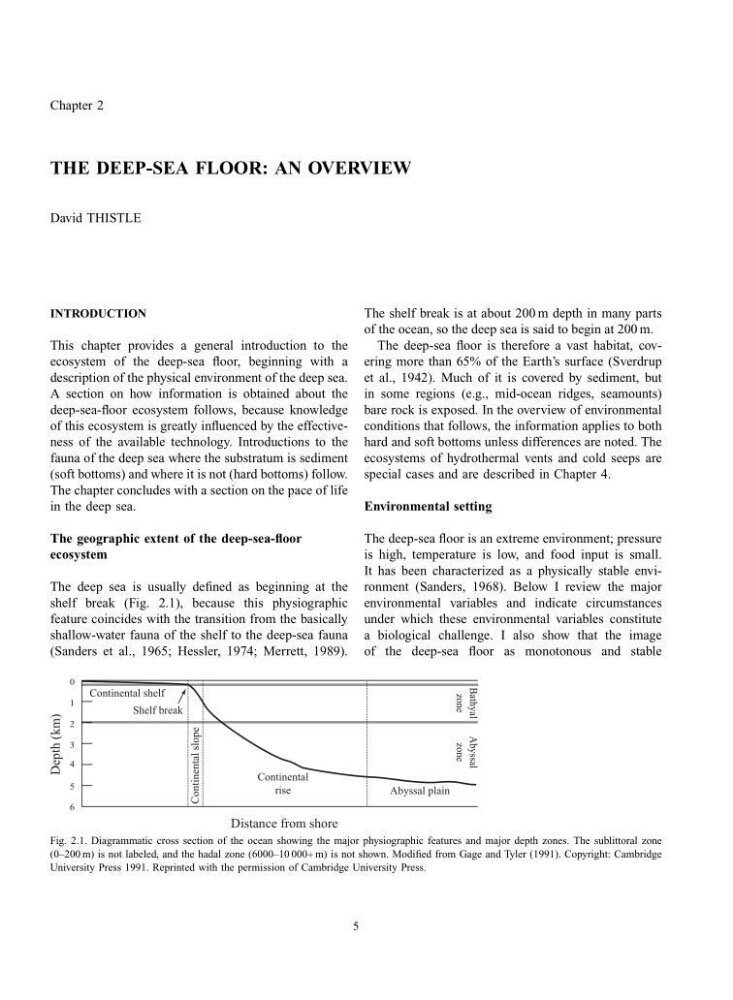
The deep sea is usually defined as beginning at the
shelf break (Fig. 2.1), because this physiographic
feature coincides with the transition from the basically
shallow-water fauna of the shelf to the deep-sea fauna
(Sanders et al., 1965; Hessler, 1974; Merrett, 1989).
The shelf break is at about 200 m depth in many parts
of the ocean, so the deep sea is said to begin at 200 m.
The deep-sea floor is therefore a vast habitat, covering more than 65% of the Earth’s surface (Sverdrup
et al., 1942). Much of it is covered by sediment, but
in some regions (e.g., mid-ocean ridges, seamounts)
bare rock is exposed. In the overview of environmental
conditions that follows, the information applies to both
hard and soft bottoms unless differences are noted. The
ecosystems of hydrothermal vents and cold seeps are
special cases and are described in Chapter 4.
Environmental setting
The deep-sea floor is an extreme environment; pressure
is high, temperature is low, and food input is small.
It has been characterized as a physically stable environment (Sanders, 1968). Below I review the major
environmental variables and indicate circumstances
under which these environmental variables constitute
a biological challenge. I also show that the image
of the deep-sea floor as monotonous and stable
0
1
2
3
4
5
6
Distance from shore
Depth (km)
Continental shelf
Continental
rise
Abyssal plain
Shelf break
Continental slope
Bathyal
zone
Abyssal
zone
Fig. 2.1. Diagrammatic cross section of the ocean showing the major physiographic features and major depth zones. The sublittoral zone
(0–200 m) is not labeled, and the hadal zone (6000–10 000+ m) is not shown. Modified from Gage and Tyler (1991). Copyright: Cambridge
University Press 1991. Reprinted with the permission of Cambridge University Press.
5
THE DEEP-SEA FLOOR: AN OVERVIEW
David THISTLE
INTRODUCTION
This chapter provides a general introduction to the
ecosystem of the deep-sea floor, beginning with a
description of the physical environment of the deep sea.
A section on how information is obtained about the
deep-sea-floor ecosystem follows, because knowledge
of this ecosystem is greatly influenced by the effectiveness of the available technology. Introductions to the
fauna of the deep sea where the substratum is sediment
(soft bottoms) and where it is not (hard bottoms) follow.
The chapter concludes with a section on the pace of life
in the deep sea.
The geographic extent of the deep-sea-floor
ecosystem
The deep sea is usually defined as beginning at the
shelf break (Fig. 2.1), because this physiographic
feature coincides with the transition from the basically
shallow-water fauna of the shelf to the deep-sea fauna
(Sanders et al., 1965; Hessler, 1974; Merrett, 1989).
The shelf break is at about 200 m depth in many parts
of the ocean, so the deep sea is said to begin at 200 m.
The deep-sea floor is therefore a vast habitat, covering more than 65% of the Earth’s surface (Sverdrup
et al., 1942). Much of it is covered by sediment, but
in some regions (e.g., mid-ocean ridges, seamounts)
bare rock is exposed. In the overview of environmental
conditions that follows, the information applies to both
hard and soft bottoms unless differences are noted. The
ecosystems of hydrothermal vents and cold seeps are
special cases and are described in Chapter 4.
Environmental setting
The deep-sea floor is an extreme environment; pressure
is high, temperature is low, and food input is small.
It has been characterized as a physically stable environment (Sanders, 1968). Below I review the major
environmental variables and indicate circumstances
under which these environmental variables constitute
a biological challenge. I also show that the image
of the deep-sea floor as monotonous and stable
0
1
2
3
4
5
6
Distance from shore
Depth (km)
Continental shelf
Continental
rise
Abyssal plain
Shelf break
Continental slope
Bathyal
zone
Abyssal
zone
Fig. 2.1. Diagrammatic cross section of the ocean showing the major physiographic features and major depth zones. The sublittoral zone
(0–200 m) is not labeled, and the hadal zone (6000–10 000+ m) is not shown. Modified from Gage and Tyler (1991). Copyright: Cambridge
University Press 1991. Reprinted with the permission of Cambridge University Press.
5