

136
Lisa A. LEVIN and Andrew J. GOODAY
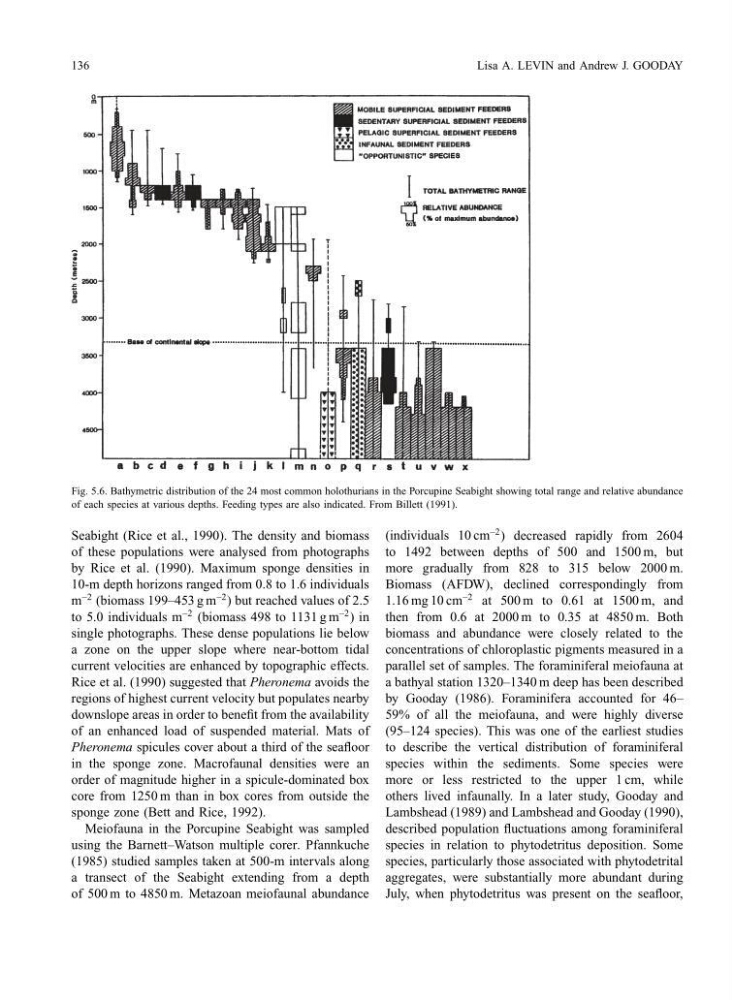
Fig. 5.6. Bathymetric distribution of the 24 most common holothurians in the Porcupine Seabight showing total range and relative abundance
of each species at various depths. Feeding types are also indicated. From Billett (1991).
Seabight (Rice et al., 1990). The density and biomass
of these populations were analysed from photographs
by Rice et al. (1990). Maximum sponge densities in
10-m depth horizons ranged from 0.8 to 1.6 individuals
m
−2 (biomass 199–453 g m
−2 ) but reached values of 2.5
to 5.0 individuals m
−2 (biomass 498 to 1131 g m
−2 ) in
single photographs. These dense populations lie below
a zone on the upper slope where near-bottom tidal
current velocities are enhanced by topographic effects.
Rice et al. (1990) suggested that Pheronema avoids the
regions of highest current velocity but populates nearby
downslope areas in order to benefit from the availability
of an enhanced load of suspended material. Mats of
Pheronema spicules cover about a third of the seafloor
in the sponge zone. Macrofaunal densities were an
order of magnitude higher in a spicule-dominated box
core from 1250 m than in box cores from outside the
sponge zone (Bett and Rice, 1992).
Meiofauna in the Porcupine Seabight was sampled
using the Barnett–Watson multiple corer. Pfannkuche
(1985) studied samples taken at 500-m intervals along
a transect of the Seabight extending from a depth
of 500 m to 4850 m. Metazoan meiofaunal abundance
(individuals 10 cm
−2 ) decreased rapidly from 2604
to 1492 between depths of 500 and 1500 m, but
more gradually from 828 to 315 below 2000 m.
Biomass (AFDW), declined correspondingly from
1.16 mg 10 cm
−2 at 500 m to 0.61 at 1500 m, and
then from 0.6 at 2000 m to 0.35 at 4850 m. Both
biomass and abundance were closely related to the
concentrations of chloroplastic pigments measured in a
parallel set of samples. The foraminiferal meiofauna at
a bathyal station 1320–1340 m deep has been described
by Gooday (1986). Foraminifera accounted for 46–
59% of all the meiofauna, and were highly diverse
(95–124 species). This was one of the earliest studies
to describe the vertical distribution of foraminiferal
species within the sediments. Some species were
more or less restricted to the upper 1 cm, while
others lived infaunally. In a later study, Gooday and
Lambshead (1989) and Lambshead and Gooday (1990),
described population fluctuations among foraminiferal
species in relation to phytodetritus deposition. Some
species, particularly those associated with phytodetrital
aggregates, were substantially more abundant during
July, when phytodetritus was present on the seafloor,
Lisa A. LEVIN and Andrew J. GOODAY
Fig. 5.6. Bathymetric distribution of the 24 most common holothurians in the Porcupine Seabight showing total range and relative abundance
of each species at various depths. Feeding types are also indicated. From Billett (1991).
Seabight (Rice et al., 1990). The density and biomass
of these populations were analysed from photographs
by Rice et al. (1990). Maximum sponge densities in
10-m depth horizons ranged from 0.8 to 1.6 individuals
m
−2 (biomass 199–453 g m
−2 ) but reached values of 2.5
to 5.0 individuals m
−2 (biomass 498 to 1131 g m
−2 ) in
single photographs. These dense populations lie below
a zone on the upper slope where near-bottom tidal
current velocities are enhanced by topographic effects.
Rice et al. (1990) suggested that Pheronema avoids the
regions of highest current velocity but populates nearby
downslope areas in order to benefit from the availability
of an enhanced load of suspended material. Mats of
Pheronema spicules cover about a third of the seafloor
in the sponge zone. Macrofaunal densities were an
order of magnitude higher in a spicule-dominated box
core from 1250 m than in box cores from outside the
sponge zone (Bett and Rice, 1992).
Meiofauna in the Porcupine Seabight was sampled
using the Barnett–Watson multiple corer. Pfannkuche
(1985) studied samples taken at 500-m intervals along
a transect of the Seabight extending from a depth
of 500 m to 4850 m. Metazoan meiofaunal abundance
(individuals 10 cm
−2 ) decreased rapidly from 2604
to 1492 between depths of 500 and 1500 m, but
more gradually from 828 to 315 below 2000 m.
Biomass (AFDW), declined correspondingly from
1.16 mg 10 cm
−2 at 500 m to 0.61 at 1500 m, and
then from 0.6 at 2000 m to 0.35 at 4850 m. Both
biomass and abundance were closely related to the
concentrations of chloroplastic pigments measured in a
parallel set of samples. The foraminiferal meiofauna at
a bathyal station 1320–1340 m deep has been described
by Gooday (1986). Foraminifera accounted for 46–
59% of all the meiofauna, and were highly diverse
(95–124 species). This was one of the earliest studies
to describe the vertical distribution of foraminiferal
species within the sediments. Some species were
more or less restricted to the upper 1 cm, while
others lived infaunally. In a later study, Gooday and
Lambshead (1989) and Lambshead and Gooday (1990),
described population fluctuations among foraminiferal
species in relation to phytodetritus deposition. Some
species, particularly those associated with phytodetrital
aggregates, were substantially more abundant during
July, when phytodetritus was present on the seafloor,