

130
Lisa A. LEVIN and Andrew J. GOODAY
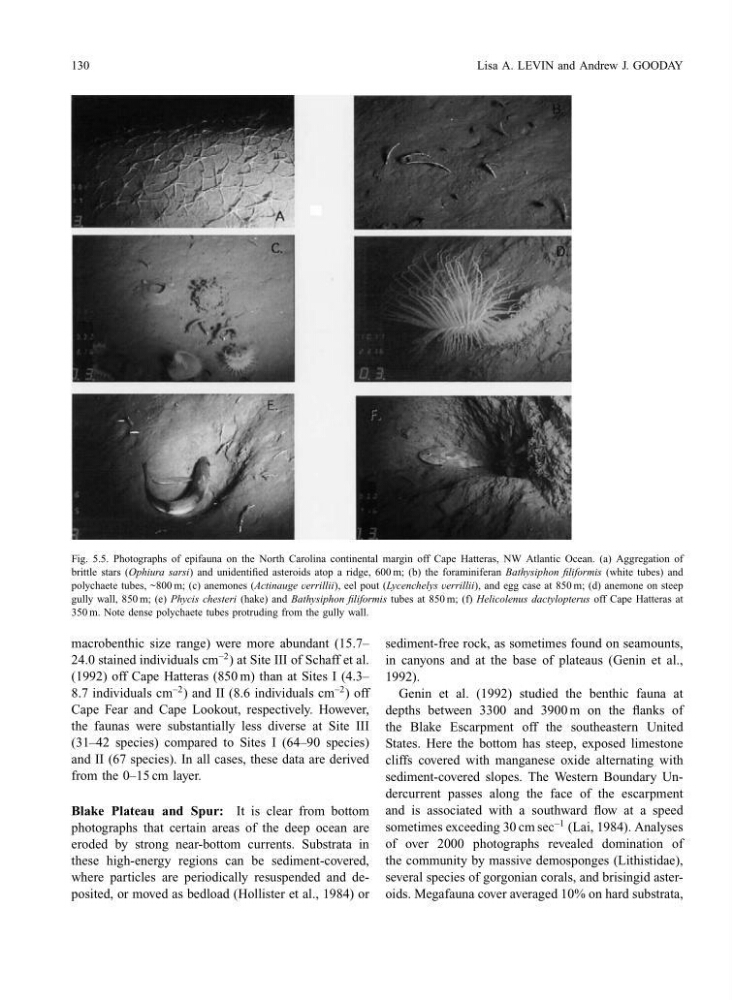
Fig. 5.5. Photographs of epifauna on the North Carolina continental margin off Cape Hatteras, NW Atlantic Ocean. (a) Aggregation of
brittle stars (Ophiura sarsi) and unidentified asteroids atop a ridge, 600 m; (b) the foraminiferan Bathysiphon filiformis (white tubes) and
polychaete tubes, ~800 m; (c) anemones (Actinauge verrillii), eel pout (Lycenchelys verrillii), and egg case at 850 m; (d) anemone on steep
gully wall, 850 m; (e) Phycis chesteri (hake) and Bathysiphon filiformis tubes at 850 m; (f) Helicolenus dactylopterus off Cape Hatteras at
350 m. Note dense polychaete tubes protruding from the gully wall.
macrobenthic size range) were more abundant (15.7–
24.0 stained individuals cm
−2 ) at Site III of Schaff et al.
(1992) off Cape Hatteras (850 m) than at Sites I (4.3–
8.7 individuals cm
−2 ) and II (8.6 individuals cm
−2 ) off
Cape Fear and Cape Lookout, respectively. However,
the faunas were substantially less diverse at Site III
(31–42 species) compared to Sites I (64–90 species)
and II (67 species). In all cases, these data are derived
from the 0–15 cm layer.
Blake Plateau and Spur: It is clear from bottom
photographs that certain areas of the deep ocean are
eroded by strong near-bottom currents. Substrata in
these high-energy regions can be sediment-covered,
where particles are periodically resuspended and deposited, or moved as bedload (Hollister et al., 1984) or
sediment-free rock, as sometimes found on seamounts,
in canyons and at the base of plateaus (Genin et al.,
1992).
Genin et al. (1992) studied the benthic fauna at
depths between 3300 and 3900 m on the flanks of
the Blake Escarpment off the southeastern United
States. Here the bottom has steep, exposed limestone
cliffs covered with manganese oxide alternating with
sediment-covered slopes. The Western Boundary Undercurrent passes along the face of the escarpment
and is associated with a southward flow at a speed
sometimes exceeding 30 cm sec
−1 (Lai, 1984). Analyses
of over 2000 photographs revealed domination of
the community by massive demosponges (Lithistidae),
several species of gorgonian corals, and brisingid asteroids. Megafauna cover averaged 10% on hard substrata,
Lisa A. LEVIN and Andrew J. GOODAY
Fig. 5.5. Photographs of epifauna on the North Carolina continental margin off Cape Hatteras, NW Atlantic Ocean. (a) Aggregation of
brittle stars (Ophiura sarsi) and unidentified asteroids atop a ridge, 600 m; (b) the foraminiferan Bathysiphon filiformis (white tubes) and
polychaete tubes, ~800 m; (c) anemones (Actinauge verrillii), eel pout (Lycenchelys verrillii), and egg case at 850 m; (d) anemone on steep
gully wall, 850 m; (e) Phycis chesteri (hake) and Bathysiphon filiformis tubes at 850 m; (f) Helicolenus dactylopterus off Cape Hatteras at
350 m. Note dense polychaete tubes protruding from the gully wall.
macrobenthic size range) were more abundant (15.7–
24.0 stained individuals cm
−2 ) at Site III of Schaff et al.
(1992) off Cape Hatteras (850 m) than at Sites I (4.3–
8.7 individuals cm
−2 ) and II (8.6 individuals cm
−2 ) off
Cape Fear and Cape Lookout, respectively. However,
the faunas were substantially less diverse at Site III
(31–42 species) compared to Sites I (64–90 species)
and II (67 species). In all cases, these data are derived
from the 0–15 cm layer.
Blake Plateau and Spur: It is clear from bottom
photographs that certain areas of the deep ocean are
eroded by strong near-bottom currents. Substrata in
these high-energy regions can be sediment-covered,
where particles are periodically resuspended and deposited, or moved as bedload (Hollister et al., 1984) or
sediment-free rock, as sometimes found on seamounts,
in canyons and at the base of plateaus (Genin et al.,
1992).
Genin et al. (1992) studied the benthic fauna at
depths between 3300 and 3900 m on the flanks of
the Blake Escarpment off the southeastern United
States. Here the bottom has steep, exposed limestone
cliffs covered with manganese oxide alternating with
sediment-covered slopes. The Western Boundary Undercurrent passes along the face of the escarpment
and is associated with a southward flow at a speed
sometimes exceeding 30 cm sec
−1 (Lai, 1984). Analyses
of over 2000 photographs revealed domination of
the community by massive demosponges (Lithistidae),
several species of gorgonian corals, and brisingid asteroids. Megafauna cover averaged 10% on hard substrata,