

128
Lisa A. LEVIN and Andrew J. GOODAY
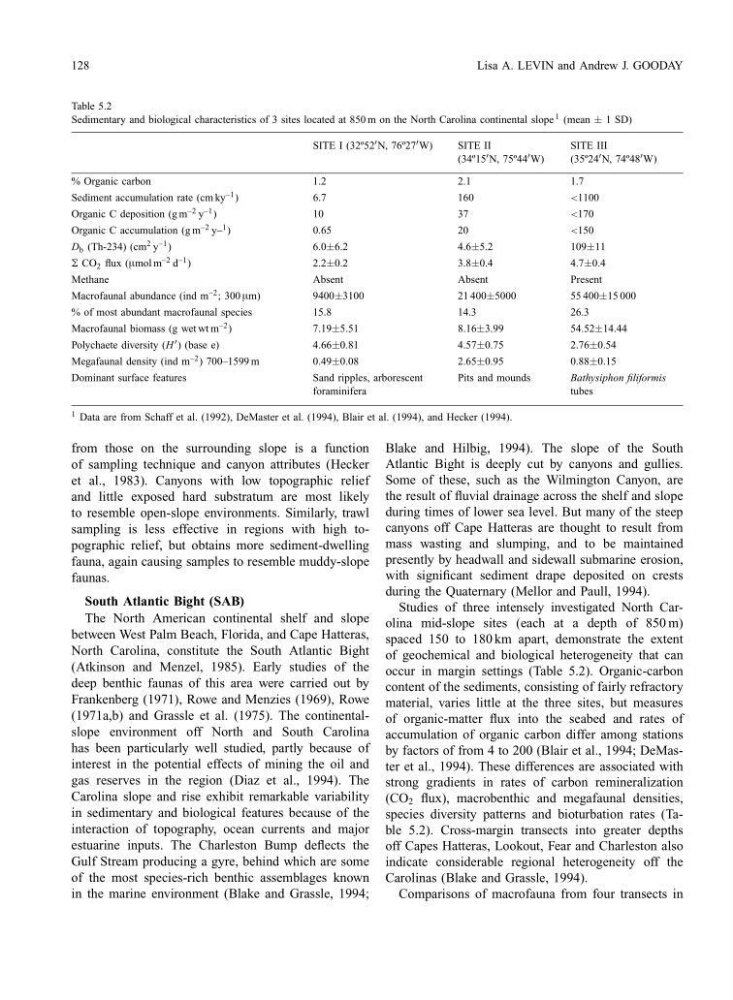
Table 5.2
Sedimentary and biological characteristics of 3 sites located at 850 m on the North Carolina continental slope 1 (mean ± 1 SD)
SITE I (32º52 N, 76º27 W)
SITE II
(34º15 N, 75º44 W)
SITE III
(35º24 N, 74º48 W)
% Organic carbon
1.2
2.1
1.7
Sediment accumulation rate (cm ky −1 )
6.7
160
<1100
Organic C deposition (g m −2 y −1 )
1 0
3 7
<170
Organic C accumulation (g m −2 y _1 )
0.65
20
<150
D b (Th-234) (cm 2 y −1 )
6.0±6.2
4.6±5.2
109±11
S CO 2 flux (mmol m −2 d −1 )
2.2±0.2
3.8±0.4
4.7±0.4
Methane
Absent
Absent
Present
Macrofaunal abundance (ind m −2 ; 300 mm)
9400±3100
21 400±5000
55 400±15 000
% of most abundant macrofaunal species
15.8
14.3
26.3
Macrofaunal biomass (g wet wt m −2 )
7.19±5.51
8.16±3.99
54.52±14.44
Polychaete diversity (H ) (base e)
4.66±0.81
4.57±0.75
2.76±0.54
Megafaunal density (ind m −2 ) 700–1599 m
0.49±0.08
2.65±0.95
0.88±0.15
Dominant surface features
Sand ripples, arborescent
foraminifera
Pits and mounds
Bathysiphon filiformis
tubes
1 Data are from Schaff et al. (1992), DeMaster et al. (1994), Blair et al. (1994), and Hecker (1994).
from those on the surrounding slope is a function
of sampling technique and canyon attributes (Hecker
et al., 1983). Canyons with low topographic relief
and little exposed hard substratum are most likely
to resemble open-slope environments. Similarly, trawl
sampling is less effective in regions with high topographic relief, but obtains more sediment-dwelling
fauna, again causing samples to resemble muddy-slope
faunas.
South Atlantic Bight (SAB)
The North American continental shelf and slope
between West Palm Beach, Florida, and Cape Hatteras,
North Carolina, constitute the South Atlantic Bight
(Atkinson and Menzel, 1985). Early studies of the
deep benthic faunas of this area were carried out by
Frankenberg (1971), Rowe and Menzies (1969), Rowe
(1971a,b) and Grassle et al. (1975). The continentalslope environment off North and South Carolina
has been particularly well studied, partly because of
interest in the potential effects of mining the oil and
gas reserves in the region (Diaz et al., 1994). The
Carolina slope and rise exhibit remarkable variability
in sedimentary and biological features because of the
interaction of topography, ocean currents and major
estuarine inputs. The Charleston Bump deflects the
Gulf Stream producing a gyre, behind which are some
of the most species-rich benthic assemblages known
in the marine environment (Blake and Grassle, 1994;
Blake and Hilbig, 1994). The slope of the South
Atlantic Bight is deeply cut by canyons and gullies.
Some of these, such as the Wilmington Canyon, are
the result of fluvial drainage across the shelf and slope
during times of lower sea level. But many of the steep
canyons off Cape Hatteras are thought to result from
mass wasting and slumping, and to be maintained
presently by headwall and sidewall submarine erosion,
with significant sediment drape deposited on crests
during the Quaternary (Mellor and Paull, 1994).
Studies of three intensely investigated North Carolina mid-slope sites (each at a depth of 850 m)
spaced 150 to 180 km apart, demonstrate the extent
of geochemical and biological heterogeneity that can
occur in margin settings (Table 5.2). Organic-carbon
content of the sediments, consisting of fairly refractory
material, varies little at the three sites, but measures
of organic-matter flux into the seabed and rates of
accumulation of organic carbon differ among stations
by factors of from 4 to 200 (Blair et al., 1994; DeMaster et al., 1994). These differences are associated with
strong gradients in rates of carbon remineralization
(CO 2 flux), macrobenthic and megafaunal densities,
species diversity patterns and bioturbation rates (Table 5.2). Cross-margin transects into greater depths
off Capes Hatteras, Lookout, Fear and Charleston also
indicate considerable regional heterogeneity off the
Carolinas (Blake and Grassle, 1994).
Comparisons of macrofauna from four transects in
Lisa A. LEVIN and Andrew J. GOODAY
Table 5.2
Sedimentary and biological characteristics of 3 sites located at 850 m on the North Carolina continental slope 1 (mean ± 1 SD)
SITE I (32º52 N, 76º27 W)
SITE II
(34º15 N, 75º44 W)
SITE III
(35º24 N, 74º48 W)
% Organic carbon
1.2
2.1
1.7
Sediment accumulation rate (cm ky −1 )
6.7
160
<1100
Organic C deposition (g m −2 y −1 )
1 0
3 7
<170
Organic C accumulation (g m −2 y _1 )
0.65
20
<150
D b (Th-234) (cm 2 y −1 )
6.0±6.2
4.6±5.2
109±11
S CO 2 flux (mmol m −2 d −1 )
2.2±0.2
3.8±0.4
4.7±0.4
Methane
Absent
Absent
Present
Macrofaunal abundance (ind m −2 ; 300 mm)
9400±3100
21 400±5000
55 400±15 000
% of most abundant macrofaunal species
15.8
14.3
26.3
Macrofaunal biomass (g wet wt m −2 )
7.19±5.51
8.16±3.99
54.52±14.44
Polychaete diversity (H ) (base e)
4.66±0.81
4.57±0.75
2.76±0.54
Megafaunal density (ind m −2 ) 700–1599 m
0.49±0.08
2.65±0.95
0.88±0.15
Dominant surface features
Sand ripples, arborescent
foraminifera
Pits and mounds
Bathysiphon filiformis
tubes
1 Data are from Schaff et al. (1992), DeMaster et al. (1994), Blair et al. (1994), and Hecker (1994).
from those on the surrounding slope is a function
of sampling technique and canyon attributes (Hecker
et al., 1983). Canyons with low topographic relief
and little exposed hard substratum are most likely
to resemble open-slope environments. Similarly, trawl
sampling is less effective in regions with high topographic relief, but obtains more sediment-dwelling
fauna, again causing samples to resemble muddy-slope
faunas.
South Atlantic Bight (SAB)
The North American continental shelf and slope
between West Palm Beach, Florida, and Cape Hatteras,
North Carolina, constitute the South Atlantic Bight
(Atkinson and Menzel, 1985). Early studies of the
deep benthic faunas of this area were carried out by
Frankenberg (1971), Rowe and Menzies (1969), Rowe
(1971a,b) and Grassle et al. (1975). The continentalslope environment off North and South Carolina
has been particularly well studied, partly because of
interest in the potential effects of mining the oil and
gas reserves in the region (Diaz et al., 1994). The
Carolina slope and rise exhibit remarkable variability
in sedimentary and biological features because of the
interaction of topography, ocean currents and major
estuarine inputs. The Charleston Bump deflects the
Gulf Stream producing a gyre, behind which are some
of the most species-rich benthic assemblages known
in the marine environment (Blake and Grassle, 1994;
Blake and Hilbig, 1994). The slope of the South
Atlantic Bight is deeply cut by canyons and gullies.
Some of these, such as the Wilmington Canyon, are
the result of fluvial drainage across the shelf and slope
during times of lower sea level. But many of the steep
canyons off Cape Hatteras are thought to result from
mass wasting and slumping, and to be maintained
presently by headwall and sidewall submarine erosion,
with significant sediment drape deposited on crests
during the Quaternary (Mellor and Paull, 1994).
Studies of three intensely investigated North Carolina mid-slope sites (each at a depth of 850 m)
spaced 150 to 180 km apart, demonstrate the extent
of geochemical and biological heterogeneity that can
occur in margin settings (Table 5.2). Organic-carbon
content of the sediments, consisting of fairly refractory
material, varies little at the three sites, but measures
of organic-matter flux into the seabed and rates of
accumulation of organic carbon differ among stations
by factors of from 4 to 200 (Blair et al., 1994; DeMaster et al., 1994). These differences are associated with
strong gradients in rates of carbon remineralization
(CO 2 flux), macrobenthic and megafaunal densities,
species diversity patterns and bioturbation rates (Table 5.2). Cross-margin transects into greater depths
off Capes Hatteras, Lookout, Fear and Charleston also
indicate considerable regional heterogeneity off the
Carolinas (Blake and Grassle, 1994).
Comparisons of macrofauna from four transects in