

122
Lisa A. LEVIN and Andrew J. GOODAY
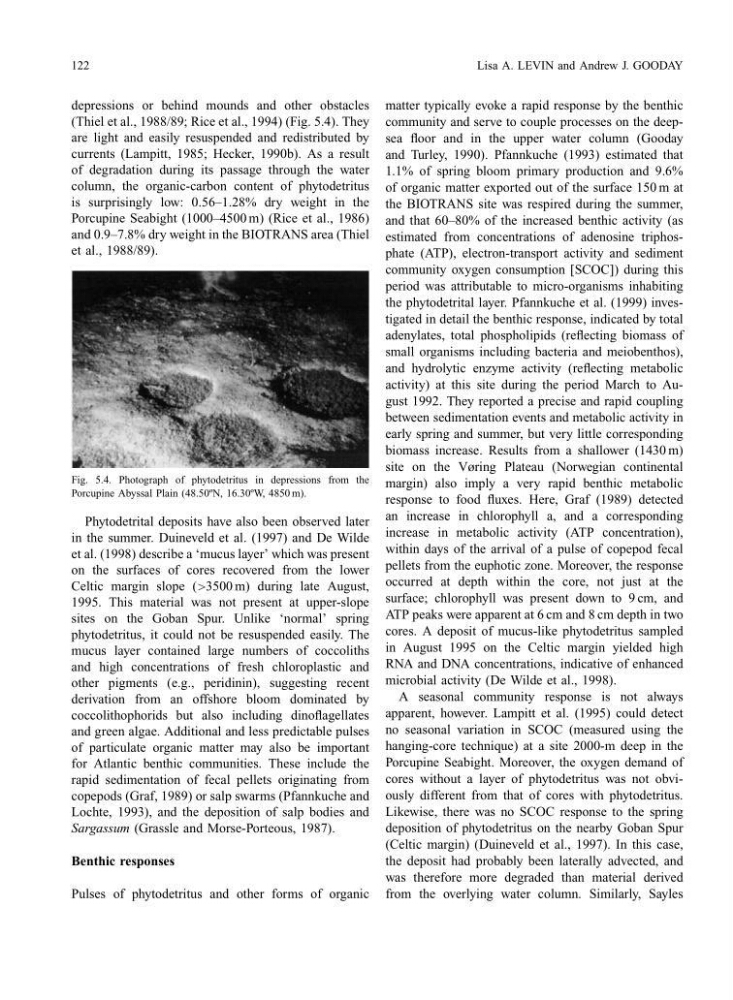
depressions or behind mounds and other obstacles
(Thiel et al., 1988/89; Rice et al., 1994) (Fig. 5.4). They
are light and easily resuspended and redistributed by
currents (Lampitt, 1985; Hecker, 1990b). As a result
of degradation during its passage through the water
column, the organic-carbon content of phytodetritus
is surprisingly low: 0.56–1.28% dry weight in the
Porcupine Seabight (1000–4500 m) (Rice et al., 1986)
and 0.9–7.8% dry weight in the BIOTRANS area (Thiel
et al., 1988/89).
Fig. 5.4. Photograph of phytodetritus in depressions from the
Porcupine Abyssal Plain (48.50ºN, 16.30ºW, 4850 m).
Phytodetrital deposits have also been observed later
in the summer. Duineveld et al. (1997) and De Wilde
et al. (1998) describe a ‘mucus layer’ which was present
on the surfaces of cores recovered from the lower
Celtic margin slope (>3500 m) during late August,
1995. This material was not present at upper-slope
sites on the Goban Spur. Unlike ‘normal’ spring
phytodetritus, it could not be resuspended easily. The
mucus layer contained large numbers of coccoliths
and high concentrations of fresh chloroplastic and
other pigments (e.g., peridinin), suggesting recent
derivation from an offshore bloom dominated by
coccolithophorids but also including dinoflagellates
and green algae. Additional and less predictable pulses
of particulate organic matter may also be important
for Atlantic benthic communities. These include the
rapid sedimentation of fecal pellets originating from
copepods (Graf, 1989) or salp swarms (Pfannkuche and
Lochte, 1993), and the deposition of salp bodies and
Sargassum (Grassle and Morse-Porteous, 1987).
Benthic responses
Pulses of phytodetritus and other forms of organic
matter typically evoke a rapid response by the benthic
community and serve to couple processes on the deepsea floor and in the upper water column (Gooday
and Turley, 1990). Pfannkuche (1993) estimated that
1.1% of spring bloom primary production and 9.6%
of organic matter exported out of the surface 150 m at
the BIOTRANS site was respired during the summer,
and that 60–80% of the increased benthic activity (as
estimated from concentrations of adenosine triphosphate (ATP), electron-transport activity and sediment
community oxygen consumption [SCOC]) during this
period was attributable to micro-organisms inhabiting
the phytodetrital layer. Pfannkuche et al. (1999) investigated in detail the benthic response, indicated by total
adenylates, total phospholipids (reflecting biomass of
small organisms including bacteria and meiobenthos),
and hydrolytic enzyme activity (reflecting metabolic
activity) at this site during the period March to August 1992. They reported a precise and rapid coupling
between sedimentation events and metabolic activity in
early spring and summer, but very little corresponding
biomass increase. Results from a shallower (1430 m)
site on the Vøring Plateau (Norwegian continental
margin) also imply a very rapid benthic metabolic
response to food fluxes. Here, Graf (1989) detected
an increase in chlorophyll a, and a corresponding
increase in metabolic activity (ATP concentration),
within days of the arrival of a pulse of copepod fecal
pellets from the euphotic zone. Moreover, the response
occurred at depth within the core, not just at the
surface; chlorophyll was present down to 9 cm, and
ATP peaks were apparent at 6 cm and 8 cm depth in two
cores. A deposit of mucus-like phytodetritus sampled
in August 1995 on the Celtic margin yielded high
RNA and DNA concentrations, indicative of enhanced
microbial activity (De Wilde et al., 1998).
A seasonal community response is not always
apparent, however. Lampitt et al. (1995) could detect
no seasonal variation in SCOC (measured using the
hanging-core technique) at a site 2000-m deep in the
Porcupine Seabight. Moreover, the oxygen demand of
cores without a layer of phytodetritus was not obviously different from that of cores with phytodetritus.
Likewise, there was no SCOC response to the spring
deposition of phytodetritus on the nearby Goban Spur
(Celtic margin) (Duineveld et al., 1997). In this case,
the deposit had probably been laterally advected, and
was therefore more degraded than material derived
from the overlying water column. Similarly, Sayles
Lisa A. LEVIN and Andrew J. GOODAY
depressions or behind mounds and other obstacles
(Thiel et al., 1988/89; Rice et al., 1994) (Fig. 5.4). They
are light and easily resuspended and redistributed by
currents (Lampitt, 1985; Hecker, 1990b). As a result
of degradation during its passage through the water
column, the organic-carbon content of phytodetritus
is surprisingly low: 0.56–1.28% dry weight in the
Porcupine Seabight (1000–4500 m) (Rice et al., 1986)
and 0.9–7.8% dry weight in the BIOTRANS area (Thiel
et al., 1988/89).
Fig. 5.4. Photograph of phytodetritus in depressions from the
Porcupine Abyssal Plain (48.50ºN, 16.30ºW, 4850 m).
Phytodetrital deposits have also been observed later
in the summer. Duineveld et al. (1997) and De Wilde
et al. (1998) describe a ‘mucus layer’ which was present
on the surfaces of cores recovered from the lower
Celtic margin slope (>3500 m) during late August,
1995. This material was not present at upper-slope
sites on the Goban Spur. Unlike ‘normal’ spring
phytodetritus, it could not be resuspended easily. The
mucus layer contained large numbers of coccoliths
and high concentrations of fresh chloroplastic and
other pigments (e.g., peridinin), suggesting recent
derivation from an offshore bloom dominated by
coccolithophorids but also including dinoflagellates
and green algae. Additional and less predictable pulses
of particulate organic matter may also be important
for Atlantic benthic communities. These include the
rapid sedimentation of fecal pellets originating from
copepods (Graf, 1989) or salp swarms (Pfannkuche and
Lochte, 1993), and the deposition of salp bodies and
Sargassum (Grassle and Morse-Porteous, 1987).
Benthic responses
Pulses of phytodetritus and other forms of organic
matter typically evoke a rapid response by the benthic
community and serve to couple processes on the deepsea floor and in the upper water column (Gooday
and Turley, 1990). Pfannkuche (1993) estimated that
1.1% of spring bloom primary production and 9.6%
of organic matter exported out of the surface 150 m at
the BIOTRANS site was respired during the summer,
and that 60–80% of the increased benthic activity (as
estimated from concentrations of adenosine triphosphate (ATP), electron-transport activity and sediment
community oxygen consumption [SCOC]) during this
period was attributable to micro-organisms inhabiting
the phytodetrital layer. Pfannkuche et al. (1999) investigated in detail the benthic response, indicated by total
adenylates, total phospholipids (reflecting biomass of
small organisms including bacteria and meiobenthos),
and hydrolytic enzyme activity (reflecting metabolic
activity) at this site during the period March to August 1992. They reported a precise and rapid coupling
between sedimentation events and metabolic activity in
early spring and summer, but very little corresponding
biomass increase. Results from a shallower (1430 m)
site on the Vøring Plateau (Norwegian continental
margin) also imply a very rapid benthic metabolic
response to food fluxes. Here, Graf (1989) detected
an increase in chlorophyll a, and a corresponding
increase in metabolic activity (ATP concentration),
within days of the arrival of a pulse of copepod fecal
pellets from the euphotic zone. Moreover, the response
occurred at depth within the core, not just at the
surface; chlorophyll was present down to 9 cm, and
ATP peaks were apparent at 6 cm and 8 cm depth in two
cores. A deposit of mucus-like phytodetritus sampled
in August 1995 on the Celtic margin yielded high
RNA and DNA concentrations, indicative of enhanced
microbial activity (De Wilde et al., 1998).
A seasonal community response is not always
apparent, however. Lampitt et al. (1995) could detect
no seasonal variation in SCOC (measured using the
hanging-core technique) at a site 2000-m deep in the
Porcupine Seabight. Moreover, the oxygen demand of
cores without a layer of phytodetritus was not obviously different from that of cores with phytodetritus.
Likewise, there was no SCOC response to the spring
deposition of phytodetritus on the nearby Goban Spur
(Celtic margin) (Duineveld et al., 1997). In this case,
the deposit had probably been laterally advected, and
was therefore more degraded than material derived
from the overlying water column. Similarly, Sayles