

120
Lisa A. LEVIN and Andrew J. GOODAY
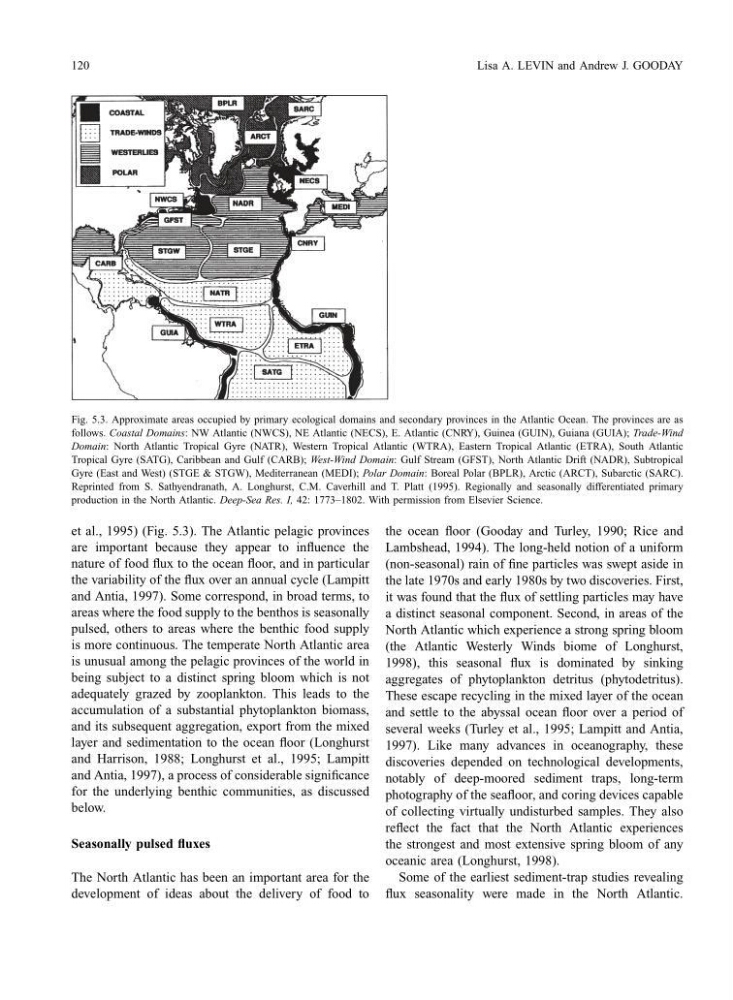
Fig. 5.3. Approximate areas occupied by primary ecological domains and secondary provinces in the Atlantic Ocean. The provinces are as
follows. Coastal Domains: NW Atlantic (NWCS), NE Atlantic (NECS), E. Atlantic (CNRY), Guinea (GUIN), Guiana (GUIA); Trade-Wind
Domain: North Atlantic Tropical Gyre (NATR), Western Tropical Atlantic (WTRA), Eastern Tropical Atlantic (ETRA), South Atlantic
Tropical Gyre (SATG), Caribbean and Gulf (CARB); West-Wind Domain: Gulf Stream (GFST), North Atlantic Drift (NADR), Subtropical
Gyre (East and West) (STGE & STGW), Mediterranean (MEDI); Polar Domain: Boreal Polar (BPLR), Arctic (ARCT), Subarctic (SARC).
Reprinted from S. Sathyendranath, A. Longhurst, C.M. Caverhill and T. Platt (1995). Regionally and seasonally differentiated primary
production in the North Atlantic. Deep-Sea Res. I, 42: 1773–1802. With permission from Elsevier Science.
et al., 1995) (Fig. 5.3). The Atlantic pelagic provinces
are important because they appear to influence the
nature of food flux to the ocean floor, and in particular
the variability of the flux over an annual cycle (Lampitt
and Antia, 1997). Some correspond, in broad terms, to
areas where the food supply to the benthos is seasonally
pulsed, others to areas where the benthic food supply
is more continuous. The temperate North Atlantic area
is unusual among the pelagic provinces of the world in
being subject to a distinct spring bloom which is not
adequately grazed by zooplankton. This leads to the
accumulation of a substantial phytoplankton biomass,
and its subsequent aggregation, export from the mixed
layer and sedimentation to the ocean floor (Longhurst
and Harrison, 1988; Longhurst et al., 1995; Lampitt
and Antia, 1997), a process of considerable significance
for the underlying benthic communities, as discussed
below.
Seasonally pulsed fluxes
The North Atlantic has been an important area for the
development of ideas about the delivery of food to
the ocean floor (Gooday and Turley, 1990; Rice and
Lambshead, 1994). The long-held notion of a uniform
(non-seasonal) rain of fine particles was swept aside in
the late 1970s and early 1980s by two discoveries. First,
it was found that the flux of settling particles may have
a distinct seasonal component. Second, in areas of the
North Atlantic which experience a strong spring bloom
(the Atlantic Westerly Winds biome of Longhurst,
1998), this seasonal flux is dominated by sinking
aggregates of phytoplankton detritus (phytodetritus).
These escape recycling in the mixed layer of the ocean
and settle to the abyssal ocean floor over a period of
several weeks (Turley et al., 1995; Lampitt and Antia,
1997). Like many advances in oceanography, these
discoveries depended on technological developments,
notably of deep-moored sediment traps, long-term
photography of the seafloor, and coring devices capable
of collecting virtually undisturbed samples. They also
reflect the fact that the North Atlantic experiences
the strongest and most extensive spring bloom of any
oceanic area (Longhurst, 1998).
Some of the earliest sediment-trap studies revealing
flux seasonality were made in the North Atlantic.
Lisa A. LEVIN and Andrew J. GOODAY
Fig. 5.3. Approximate areas occupied by primary ecological domains and secondary provinces in the Atlantic Ocean. The provinces are as
follows. Coastal Domains: NW Atlantic (NWCS), NE Atlantic (NECS), E. Atlantic (CNRY), Guinea (GUIN), Guiana (GUIA); Trade-Wind
Domain: North Atlantic Tropical Gyre (NATR), Western Tropical Atlantic (WTRA), Eastern Tropical Atlantic (ETRA), South Atlantic
Tropical Gyre (SATG), Caribbean and Gulf (CARB); West-Wind Domain: Gulf Stream (GFST), North Atlantic Drift (NADR), Subtropical
Gyre (East and West) (STGE & STGW), Mediterranean (MEDI); Polar Domain: Boreal Polar (BPLR), Arctic (ARCT), Subarctic (SARC).
Reprinted from S. Sathyendranath, A. Longhurst, C.M. Caverhill and T. Platt (1995). Regionally and seasonally differentiated primary
production in the North Atlantic. Deep-Sea Res. I, 42: 1773–1802. With permission from Elsevier Science.
et al., 1995) (Fig. 5.3). The Atlantic pelagic provinces
are important because they appear to influence the
nature of food flux to the ocean floor, and in particular
the variability of the flux over an annual cycle (Lampitt
and Antia, 1997). Some correspond, in broad terms, to
areas where the food supply to the benthos is seasonally
pulsed, others to areas where the benthic food supply
is more continuous. The temperate North Atlantic area
is unusual among the pelagic provinces of the world in
being subject to a distinct spring bloom which is not
adequately grazed by zooplankton. This leads to the
accumulation of a substantial phytoplankton biomass,
and its subsequent aggregation, export from the mixed
layer and sedimentation to the ocean floor (Longhurst
and Harrison, 1988; Longhurst et al., 1995; Lampitt
and Antia, 1997), a process of considerable significance
for the underlying benthic communities, as discussed
below.
Seasonally pulsed fluxes
The North Atlantic has been an important area for the
development of ideas about the delivery of food to
the ocean floor (Gooday and Turley, 1990; Rice and
Lambshead, 1994). The long-held notion of a uniform
(non-seasonal) rain of fine particles was swept aside in
the late 1970s and early 1980s by two discoveries. First,
it was found that the flux of settling particles may have
a distinct seasonal component. Second, in areas of the
North Atlantic which experience a strong spring bloom
(the Atlantic Westerly Winds biome of Longhurst,
1998), this seasonal flux is dominated by sinking
aggregates of phytoplankton detritus (phytodetritus).
These escape recycling in the mixed layer of the ocean
and settle to the abyssal ocean floor over a period of
several weeks (Turley et al., 1995; Lampitt and Antia,
1997). Like many advances in oceanography, these
discoveries depended on technological developments,
notably of deep-moored sediment traps, long-term
photography of the seafloor, and coring devices capable
of collecting virtually undisturbed samples. They also
reflect the fact that the North Atlantic experiences
the strongest and most extensive spring bloom of any
oceanic area (Longhurst, 1998).
Some of the earliest sediment-trap studies revealing
flux seasonality were made in the North Atlantic.