

THE DEEP ATLANTIC OCEAN
117
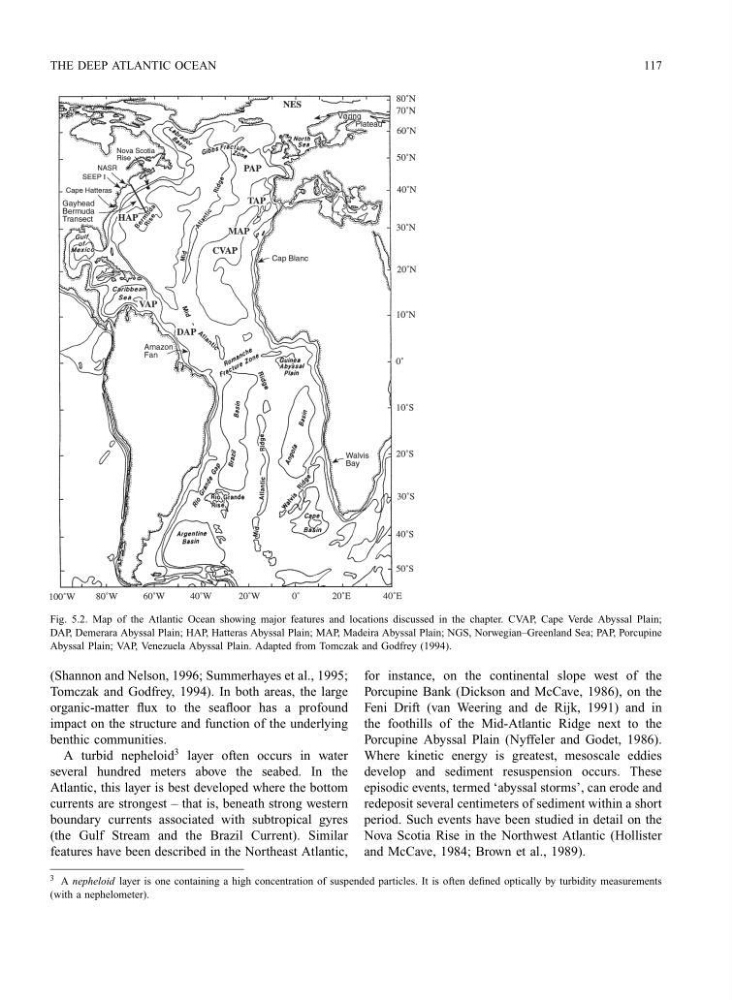
Fig. 5.2. Map of the Atlantic Ocean showing major features and locations discussed in the chapter. CVAP, Cape Verde Abyssal Plain;
DAP, Demerara Abyssal Plain; HAP, Hatteras Abyssal Plain; MAP, Madeira Abyssal Plain; NGS, Norwegian–Greenland Sea; PAP, Porcupine
Abyssal Plain; VAP, Venezuela Abyssal Plain. Adapted from Tomczak and Godfrey (1994).
(Shannon and Nelson, 1996; Summerhayes et al., 1995;
Tomczak and Godfrey, 1994). In both areas, the large
organic-matter flux to the seafloor has a profound
impact on the structure and function of the underlying
benthic communities.
A turbid nepheloid
3 layer often occurs in water
several hundred meters above the seabed. In the
Atlantic, this layer is best developed where the bottom
currents are strongest – that is, beneath strong western
boundary currents associated with subtropical gyres
(the Gulf Stream and the Brazil Current). Similar
features have been described in the Northeast Atlantic,
for instance, on the continental slope west of the
Porcupine Bank (Dickson and McCave, 1986), on the
Feni Drift (van Weering and de Rijk, 1991) and in
the foothills of the Mid-Atlantic Ridge next to the
Porcupine Abyssal Plain (Nyffeler and Godet, 1986).
Where kinetic energy is greatest, mesoscale eddies
develop and sediment resuspension occurs. These
episodic events, termed ‘abyssal storms’, can erode and
redeposit several centimeters of sediment within a short
period. Such events have been studied in detail on the
Nova Scotia Rise in the Northwest Atlantic (Hollister
and McCave, 1984; Brown et al., 1989).
3 A nepheloid layer is one containing a high concentration of suspended particles. It is often defined optically by turbidity measurements
(with a nephelometer).
117
Fig. 5.2. Map of the Atlantic Ocean showing major features and locations discussed in the chapter. CVAP, Cape Verde Abyssal Plain;
DAP, Demerara Abyssal Plain; HAP, Hatteras Abyssal Plain; MAP, Madeira Abyssal Plain; NGS, Norwegian–Greenland Sea; PAP, Porcupine
Abyssal Plain; VAP, Venezuela Abyssal Plain. Adapted from Tomczak and Godfrey (1994).
(Shannon and Nelson, 1996; Summerhayes et al., 1995;
Tomczak and Godfrey, 1994). In both areas, the large
organic-matter flux to the seafloor has a profound
impact on the structure and function of the underlying
benthic communities.
A turbid nepheloid
3 layer often occurs in water
several hundred meters above the seabed. In the
Atlantic, this layer is best developed where the bottom
currents are strongest – that is, beneath strong western
boundary currents associated with subtropical gyres
(the Gulf Stream and the Brazil Current). Similar
features have been described in the Northeast Atlantic,
for instance, on the continental slope west of the
Porcupine Bank (Dickson and McCave, 1986), on the
Feni Drift (van Weering and de Rijk, 1991) and in
the foothills of the Mid-Atlantic Ridge next to the
Porcupine Abyssal Plain (Nyffeler and Godet, 1986).
Where kinetic energy is greatest, mesoscale eddies
develop and sediment resuspension occurs. These
episodic events, termed ‘abyssal storms’, can erode and
redeposit several centimeters of sediment within a short
period. Such events have been studied in detail on the
Nova Scotia Rise in the Northwest Atlantic (Hollister
and McCave, 1984; Brown et al., 1989).
3 A nepheloid layer is one containing a high concentration of suspended particles. It is often defined optically by turbidity measurements
(with a nephelometer).