

100
Verena TUNNICLIFFE et al.
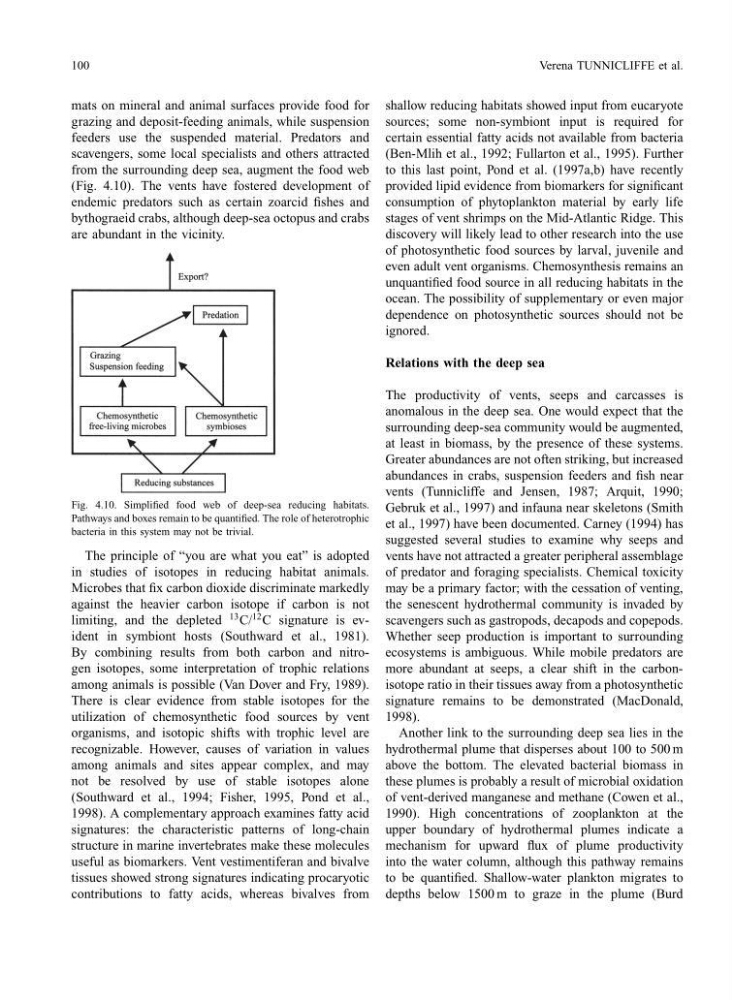
mats on mineral and animal surfaces provide food for
grazing and deposit-feeding animals, while suspension
feeders use the suspended material. Predators and
scavengers, some local specialists and others attracted
from the surrounding deep sea, augment the food web
(Fig. 4.10). The vents have fostered development of
endemic predators such as certain zoarcid fishes and
bythograeid crabs, although deep-sea octopus and crabs
are abundant in the vicinity.
Fig. 4.10. Simplified food web of deep-sea reducing habitats.
Pathways and boxes remain to be quantified. The role of heterotrophic
bacteria in this system may not be trivial.
The principle of “you are what you eat” is adopted
in studies of isotopes in reducing habitat animals.
Microbes that fix carbon dioxide discriminate markedly
against the heavier carbon isotope if carbon is not
limiting, and the depleted
13 C/
12 C signature is evident in symbiont hosts (Southward et al., 1981).
By combining results from both carbon and nitrogen isotopes, some interpretation of trophic relations
among animals is possible (Van Dover and Fry, 1989).
There is clear evidence from stable isotopes for the
utilization of chemosynthetic food sources by vent
organisms, and isotopic shifts with trophic level are
recognizable. However, causes of variation in values
among animals and sites appear complex, and may
not be resolved by use of stable isotopes alone
(Southward et al., 1994; Fisher, 1995, Pond et al.,
1998). A complementary approach examines fatty acid
signatures: the characteristic patterns of long-chain
structure in marine invertebrates make these molecules
useful as biomarkers. Vent vestimentiferan and bivalve
tissues showed strong signatures indicating procaryotic
contributions to fatty acids, whereas bivalves from
shallow reducing habitats showed input from eucaryote
sources; some non-symbiont input is required for
certain essential fatty acids not available from bacteria
(Ben-Mlih et al., 1992; Fullarton et al., 1995). Further
to this last point, Pond et al. (1997a,b) have recently
provided lipid evidence from biomarkers for significant
consumption of phytoplankton material by early life
stages of vent shrimps on the Mid-Atlantic Ridge. This
discovery will likely lead to other research into the use
of photosynthetic food sources by larval, juvenile and
even adult vent organisms. Chemosynthesis remains an
unquantified food source in all reducing habitats in the
ocean. The possibility of supplementary or even major
dependence on photosynthetic sources should not be
ignored.
Relations with the deep sea
The productivity of vents, seeps and carcasses is
anomalous in the deep sea. One would expect that the
surrounding deep-sea community would be augmented,
at least in biomass, by the presence of these systems.
Greater abundances are not often striking, but increased
abundances in crabs, suspension feeders and fish near
vents (Tunnicliffe and Jensen, 1987; Arquit, 1990;
Gebruk et al., 1997) and infauna near skeletons (Smith
et al., 1997) have been documented. Carney (1994) has
suggested several studies to examine why seeps and
vents have not attracted a greater peripheral assemblage
of predator and foraging specialists. Chemical toxicity
may be a primary factor; with the cessation of venting,
the senescent hydrothermal community is invaded by
scavengers such as gastropods, decapods and copepods.
Whether seep production is important to surrounding
ecosystems is ambiguous. While mobile predators are
more abundant at seeps, a clear shift in the carbonisotope ratio in their tissues away from a photosynthetic
signature remains to be demonstrated (MacDonald,
1998).
Another link to the surrounding deep sea lies in the
hydrothermal plume that disperses about 100 to 500 m
above the bottom. The elevated bacterial biomass in
these plumes is probably a result of microbial oxidation
of vent-derived manganese and methane (Cowen et al.,
1990). High concentrations of zooplankton at the
upper boundary of hydrothermal plumes indicate a
mechanism for upward flux of plume productivity
into the water column, although this pathway remains
to be quantified. Shallow-water plankton migrates to
depths below 1500 m to graze in the plume (Burd
Verena TUNNICLIFFE et al.
mats on mineral and animal surfaces provide food for
grazing and deposit-feeding animals, while suspension
feeders use the suspended material. Predators and
scavengers, some local specialists and others attracted
from the surrounding deep sea, augment the food web
(Fig. 4.10). The vents have fostered development of
endemic predators such as certain zoarcid fishes and
bythograeid crabs, although deep-sea octopus and crabs
are abundant in the vicinity.
Fig. 4.10. Simplified food web of deep-sea reducing habitats.
Pathways and boxes remain to be quantified. The role of heterotrophic
bacteria in this system may not be trivial.
The principle of “you are what you eat” is adopted
in studies of isotopes in reducing habitat animals.
Microbes that fix carbon dioxide discriminate markedly
against the heavier carbon isotope if carbon is not
limiting, and the depleted
13 C/
12 C signature is evident in symbiont hosts (Southward et al., 1981).
By combining results from both carbon and nitrogen isotopes, some interpretation of trophic relations
among animals is possible (Van Dover and Fry, 1989).
There is clear evidence from stable isotopes for the
utilization of chemosynthetic food sources by vent
organisms, and isotopic shifts with trophic level are
recognizable. However, causes of variation in values
among animals and sites appear complex, and may
not be resolved by use of stable isotopes alone
(Southward et al., 1994; Fisher, 1995, Pond et al.,
1998). A complementary approach examines fatty acid
signatures: the characteristic patterns of long-chain
structure in marine invertebrates make these molecules
useful as biomarkers. Vent vestimentiferan and bivalve
tissues showed strong signatures indicating procaryotic
contributions to fatty acids, whereas bivalves from
shallow reducing habitats showed input from eucaryote
sources; some non-symbiont input is required for
certain essential fatty acids not available from bacteria
(Ben-Mlih et al., 1992; Fullarton et al., 1995). Further
to this last point, Pond et al. (1997a,b) have recently
provided lipid evidence from biomarkers for significant
consumption of phytoplankton material by early life
stages of vent shrimps on the Mid-Atlantic Ridge. This
discovery will likely lead to other research into the use
of photosynthetic food sources by larval, juvenile and
even adult vent organisms. Chemosynthesis remains an
unquantified food source in all reducing habitats in the
ocean. The possibility of supplementary or even major
dependence on photosynthetic sources should not be
ignored.
Relations with the deep sea
The productivity of vents, seeps and carcasses is
anomalous in the deep sea. One would expect that the
surrounding deep-sea community would be augmented,
at least in biomass, by the presence of these systems.
Greater abundances are not often striking, but increased
abundances in crabs, suspension feeders and fish near
vents (Tunnicliffe and Jensen, 1987; Arquit, 1990;
Gebruk et al., 1997) and infauna near skeletons (Smith
et al., 1997) have been documented. Carney (1994) has
suggested several studies to examine why seeps and
vents have not attracted a greater peripheral assemblage
of predator and foraging specialists. Chemical toxicity
may be a primary factor; with the cessation of venting,
the senescent hydrothermal community is invaded by
scavengers such as gastropods, decapods and copepods.
Whether seep production is important to surrounding
ecosystems is ambiguous. While mobile predators are
more abundant at seeps, a clear shift in the carbonisotope ratio in their tissues away from a photosynthetic
signature remains to be demonstrated (MacDonald,
1998).
Another link to the surrounding deep sea lies in the
hydrothermal plume that disperses about 100 to 500 m
above the bottom. The elevated bacterial biomass in
these plumes is probably a result of microbial oxidation
of vent-derived manganese and methane (Cowen et al.,
1990). High concentrations of zooplankton at the
upper boundary of hydrothermal plumes indicate a
mechanism for upward flux of plume productivity
into the water column, although this pathway remains
to be quantified. Shallow-water plankton migrates to
depths below 1500 m to graze in the plume (Burd