

96
Verena TUNNICLIFFE et al.
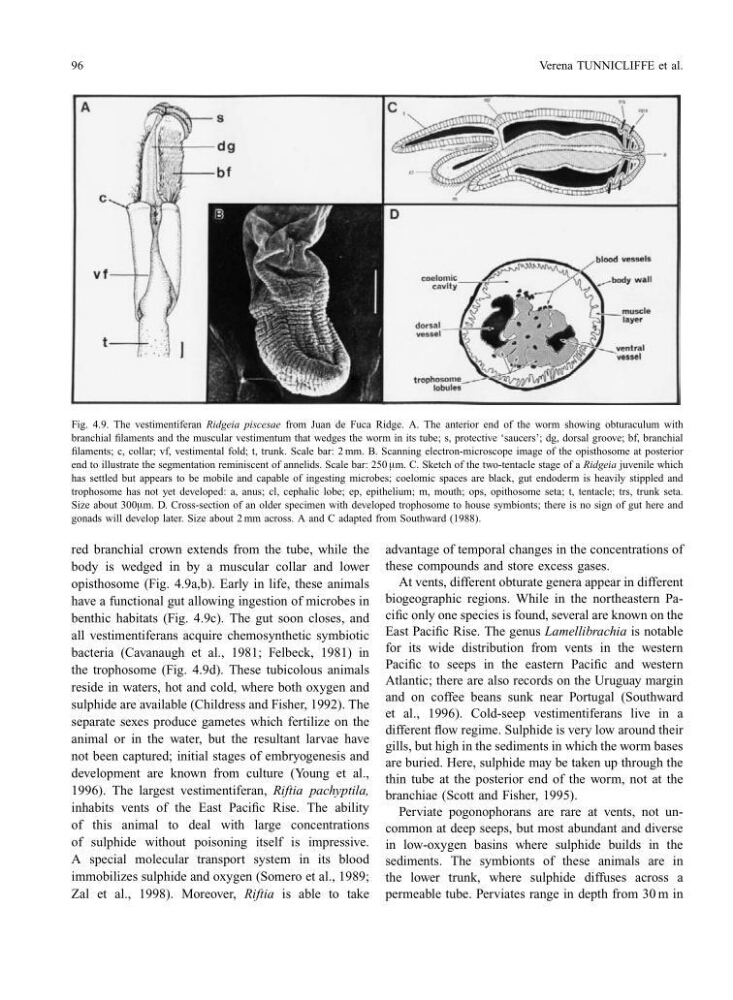
Fig. 4.9. The vestimentiferan Ridgeia piscesae from Juan de Fuca Ridge. A. The anterior end of the worm showing obturaculum with
branchial filaments and the muscular vestimentum that wedges the worm in its tube; s, protective ‘saucers’; dg, dorsal groove; bf, branchial
filaments; c, collar; vf, vestimental fold; t, trunk. Scale bar: 2 mm. B. Scanning electron-microscope image of the opisthosome at posterior
end to illustrate the segmentation reminiscent of annelids. Scale bar: 250 mm. C. Sketch of the two-tentacle stage of a Ridgeia juvenile which
has settled but appears to be mobile and capable of ingesting microbes; coelomic spaces are black, gut endoderm is heavily stippled and
trophosome has not yet developed: a, anus; cl, cephalic lobe; ep, epithelium; m, mouth; ops, opithosome seta; t, tentacle; trs, trunk seta.
Size about 300mm. D. Cross-section of an older specimen with developed trophosome to house symbionts; there is no sign of gut here and
gonads will develop later. Size about 2 mm across. A and C adapted from Southward (1988).
red branchial crown extends from the tube, while the
body is wedged in by a muscular collar and lower
opisthosome (Fig. 4.9a,b). Early in life, these animals
have a functional gut allowing ingestion of microbes in
benthic habitats (Fig. 4.9c). The gut soon closes, and
all vestimentiferans acquire chemosynthetic symbiotic
bacteria (Cavanaugh et al., 1981; Felbeck, 1981) in
the trophosome (Fig. 4.9d). These tubicolous animals
reside in waters, hot and cold, where both oxygen and
sulphide are available (Childress and Fisher, 1992). The
separate sexes produce gametes which fertilize on the
animal or in the water, but the resultant larvae have
not been captured; initial stages of embryogenesis and
development are known from culture (Young et al.,
1996). The largest vestimentiferan, Riftia pachyptila,
inhabits vents of the East Pacific Rise. The ability
of this animal to deal with large concentrations
of sulphide without poisoning itself is impressive.
A special molecular transport system in its blood
immobilizes sulphide and oxygen (Somero et al., 1989;
Zal et al., 1998). Moreover, Riftia is able to take
advantage of temporal changes in the concentrations of
these compounds and store excess gases.
At vents, different obturate genera appear in different
biogeographic regions. While in the northeastern Pacific only one species is found, several are known on the
East Pacific Rise. The genus Lamellibrachia is notable
for its wide distribution from vents in the western
Pacific to seeps in the eastern Pacific and western
Atlantic; there are also records on the Uruguay margin
and on coffee beans sunk near Portugal (Southward
et al., 1996). Cold-seep vestimentiferans live in a
different flow regime. Sulphide is very low around their
gills, but high in the sediments in which the worm bases
are buried. Here, sulphide may be taken up through the
thin tube at the posterior end of the worm, not at the
branchiae (Scott and Fisher, 1995).
Perviate pogonophorans are rare at vents, not uncommon at deep seeps, but most abundant and diverse
in low-oxygen basins where sulphide builds in the
sediments. The symbionts of these animals are in
the lower trunk, where sulphide diffuses across a
permeable tube. Perviates range in depth from 30 m in
Verena TUNNICLIFFE et al.
Fig. 4.9. The vestimentiferan Ridgeia piscesae from Juan de Fuca Ridge. A. The anterior end of the worm showing obturaculum with
branchial filaments and the muscular vestimentum that wedges the worm in its tube; s, protective ‘saucers’; dg, dorsal groove; bf, branchial
filaments; c, collar; vf, vestimental fold; t, trunk. Scale bar: 2 mm. B. Scanning electron-microscope image of the opisthosome at posterior
end to illustrate the segmentation reminiscent of annelids. Scale bar: 250 mm. C. Sketch of the two-tentacle stage of a Ridgeia juvenile which
has settled but appears to be mobile and capable of ingesting microbes; coelomic spaces are black, gut endoderm is heavily stippled and
trophosome has not yet developed: a, anus; cl, cephalic lobe; ep, epithelium; m, mouth; ops, opithosome seta; t, tentacle; trs, trunk seta.
Size about 300mm. D. Cross-section of an older specimen with developed trophosome to house symbionts; there is no sign of gut here and
gonads will develop later. Size about 2 mm across. A and C adapted from Southward (1988).
red branchial crown extends from the tube, while the
body is wedged in by a muscular collar and lower
opisthosome (Fig. 4.9a,b). Early in life, these animals
have a functional gut allowing ingestion of microbes in
benthic habitats (Fig. 4.9c). The gut soon closes, and
all vestimentiferans acquire chemosynthetic symbiotic
bacteria (Cavanaugh et al., 1981; Felbeck, 1981) in
the trophosome (Fig. 4.9d). These tubicolous animals
reside in waters, hot and cold, where both oxygen and
sulphide are available (Childress and Fisher, 1992). The
separate sexes produce gametes which fertilize on the
animal or in the water, but the resultant larvae have
not been captured; initial stages of embryogenesis and
development are known from culture (Young et al.,
1996). The largest vestimentiferan, Riftia pachyptila,
inhabits vents of the East Pacific Rise. The ability
of this animal to deal with large concentrations
of sulphide without poisoning itself is impressive.
A special molecular transport system in its blood
immobilizes sulphide and oxygen (Somero et al., 1989;
Zal et al., 1998). Moreover, Riftia is able to take
advantage of temporal changes in the concentrations of
these compounds and store excess gases.
At vents, different obturate genera appear in different
biogeographic regions. While in the northeastern Pacific only one species is found, several are known on the
East Pacific Rise. The genus Lamellibrachia is notable
for its wide distribution from vents in the western
Pacific to seeps in the eastern Pacific and western
Atlantic; there are also records on the Uruguay margin
and on coffee beans sunk near Portugal (Southward
et al., 1996). Cold-seep vestimentiferans live in a
different flow regime. Sulphide is very low around their
gills, but high in the sediments in which the worm bases
are buried. Here, sulphide may be taken up through the
thin tube at the posterior end of the worm, not at the
branchiae (Scott and Fisher, 1995).
Perviate pogonophorans are rare at vents, not uncommon at deep seeps, but most abundant and diverse
in low-oxygen basins where sulphide builds in the
sediments. The symbionts of these animals are in
the lower trunk, where sulphide diffuses across a
permeable tube. Perviates range in depth from 30 m in