

Glacial erosion
69
(Sweeting, 1966). Not only the rocky substrate shows striations, they are also observed in
fragments in glacial tills. In this way, the existence of striated clasts can help with
determination of genesis, although with reservations in the interpretation of the origin of
problematic deposits (Tricart and Cailleux, 1962). Care must be taken, therefore, because
striations can be produced by other different processes, such as avalanches, mud flows,
subglacial currents, and so forth. Striations are more common in reverse-slope areas, but
they can even appear in vertical walls. Under the microscope, striations consist of
numerous increasing fractures (Iverson, 1995). They indicate direction, but not the
movement of glacial flow; sometimes, several directions or systems of striation
intercrossing occur. The morphologic irregularities of the substrate can explain the
directional variations; they can also indicate several glacial stages or phases of ice
advance. In any case, and mainly through the study of the great glacial ice sheets,
statistical analysis of hundreds of striations is fundamental to obtaining reliable data of the
glacial flow direction for a certain time.
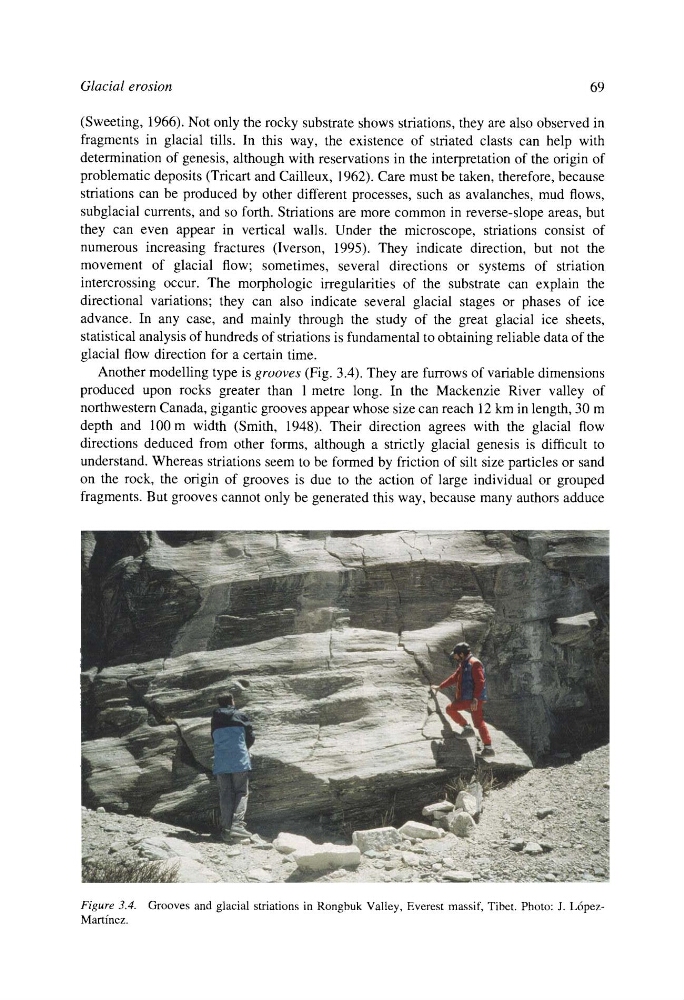
Another modelling type is grooves (Fig. 3.4). They are furrows of variable dimensions
produced upon rocks greater than 1 metre long. In the Mackenzie River valley of
northwestern Canada, gigantic grooves appear whose size can reach 12 km in length, 30 m
depth and 100 m width (Smith, 1948). Their direction agrees with the glacial flow
directions deduced from other forms, although a strictly glacial genesis is difficult to
understand. Whereas striations seem to be formed by friction of silt size particles or sand
on the rock, the origin of grooves is due to the action of large individual or grouped
fragments. But grooves cannot only be generated this way, because many authors adduce
Figure 3.4. Grooves and glacial striations in Rongbuk Valley, Everest massif, Tibet. Photo: J. LrpezMartinez.
69
(Sweeting, 1966). Not only the rocky substrate shows striations, they are also observed in
fragments in glacial tills. In this way, the existence of striated clasts can help with
determination of genesis, although with reservations in the interpretation of the origin of
problematic deposits (Tricart and Cailleux, 1962). Care must be taken, therefore, because
striations can be produced by other different processes, such as avalanches, mud flows,
subglacial currents, and so forth. Striations are more common in reverse-slope areas, but
they can even appear in vertical walls. Under the microscope, striations consist of
numerous increasing fractures (Iverson, 1995). They indicate direction, but not the
movement of glacial flow; sometimes, several directions or systems of striation
intercrossing occur. The morphologic irregularities of the substrate can explain the
directional variations; they can also indicate several glacial stages or phases of ice
advance. In any case, and mainly through the study of the great glacial ice sheets,
statistical analysis of hundreds of striations is fundamental to obtaining reliable data of the
glacial flow direction for a certain time.
Another modelling type is grooves (Fig. 3.4). They are furrows of variable dimensions
produced upon rocks greater than 1 metre long. In the Mackenzie River valley of
northwestern Canada, gigantic grooves appear whose size can reach 12 km in length, 30 m
depth and 100 m width (Smith, 1948). Their direction agrees with the glacial flow
directions deduced from other forms, although a strictly glacial genesis is difficult to
understand. Whereas striations seem to be formed by friction of silt size particles or sand
on the rock, the origin of grooves is due to the action of large individual or grouped
fragments. But grooves cannot only be generated this way, because many authors adduce
Figure 3.4. Grooves and glacial striations in Rongbuk Valley, Everest massif, Tibet. Photo: J. LrpezMartinez.