

Climate change in arid and tropical humid regions
693
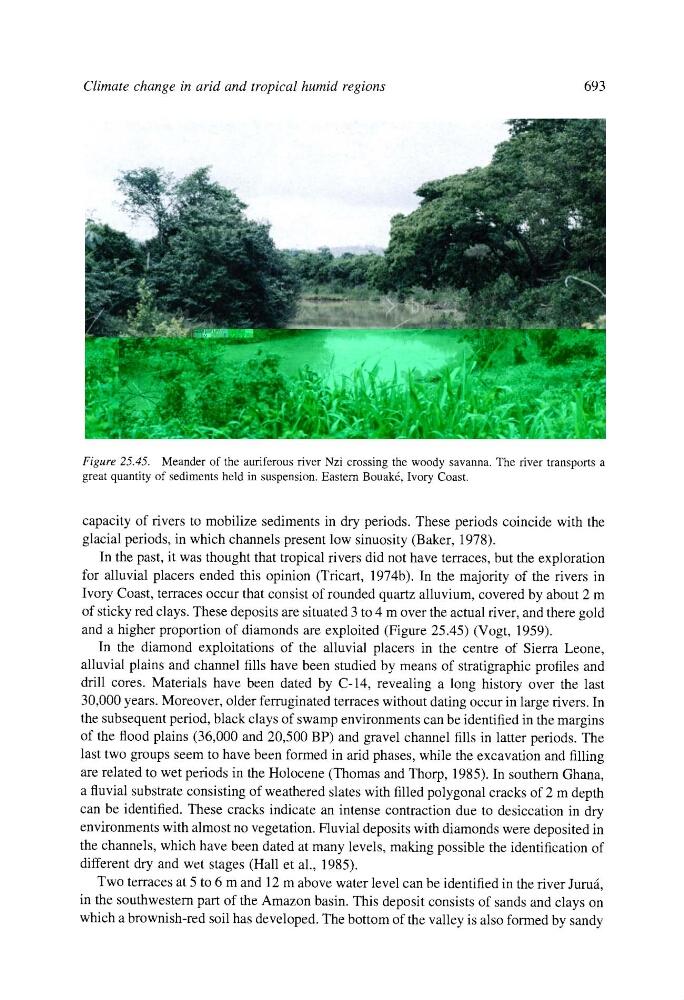
Figure 25.45. Meander of the auriferous river Nzi crossing the woody savanna. The river transports a
great quantity of sediments held in suspension. Eastern Bouak6, Ivory Coast.
capacity of rivers to mobilize sediments in dry periods. These periods coincide with the
glacial periods, in which channels present low sinuosity (Baker, 1978).
In the past, it was thought that tropical rivers did not have terraces, but the exploration
for alluvial placers ended this opinion (Tricart, 1974b). In the majority of the rivers in
Ivory Coast, terraces occur that consist of rounded quartz alluvium, covered by about 2 m
of sticky red clays. These deposits are situated 3 to 4 m over the actual river, and there gold
and a higher proportion of diamonds are exploited (Figure 25.45) (Vogt, 1959).
In the diamond exploitations of the alluvial placers in the centre of Sierra Leone,
alluvial plains and channel fills have been studied by means of stratigraphic profiles and
drill cores. Materials have been dated by C-14, revealing a long history over the last
30,000 years. Moreover, older ferruginated terraces without dating occur in large rivers. In
the subsequent period, black clays of swamp environments can be identified in the margins
of the flood plains (36,000 and 20,500 BP) and gravel channel fills in latter periods. The
last two groups seem to have been formed in arid phases, while the excavation and filling
are related to wet periods in the Holocene (Thomas and Thorp, 1985). In southern Ghana,
a fluvial substrate consisting of weathered slates with filled polygonal cracks of 2 m depth
can be identified. These cracks indicate an intense contraction due to desiccation in dry
environments with almost no vegetation. Fluvial deposits with diamonds were deposited in
the channels, which have been dated at many levels, making possible the identification of
different dry and wet stages (Hall et al., 1985).
Two terraces at 5 to 6 m and 12 m above water level can be identified in the river Juru~i,
in the southwestern part of the Amazon basin. This deposit consists of sands and clays on
which a brownish-red soil has developed. The bottom of the valley is also formed by sandy