

Climate change in arid and tropical humid regions
691
,.;~~.s~
'
(a)
..:. t." ~.-.
Zq ~'c-~'i,:,3~.',.'4~;~ N
~"/4,'~.,~'~i~
Pliocene basalt
t~----~"~ ~
-~
~.-.- ".... th.~ ~m.y.)
~Unalteredgranodiorite
, ~-.
"i.k..~.:..:"...::,..,.f "-"
e III
(b)
~"'" ~ ~"~..~~,~ Zone II
','~ ....T-- ~"-~ "" \....~- ~
~..,~.~
Zone I .__m.~.__
"C1
,
-"
"
'
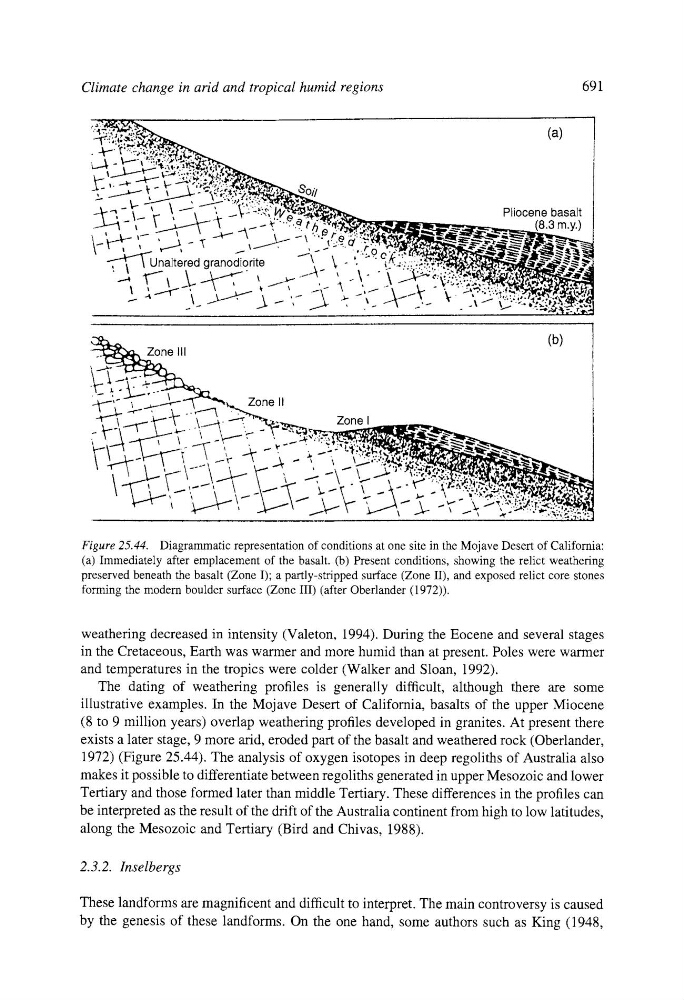
"'""Figure 25.44. Diagrammatic representation of conditions at one site in the Mojave Desert of California:
(a) Immediately after emplacement of the basalt. (b) Present conditions, showing the relict weathering
preserved beneath the basalt (Zone I); a partly-stripped surface (Zone II), and exposed relict core stones
forming the modern boulder surface (Zone III) (after Oberlander (1972)).
weathering decreased in intensity (Valeton, 1994). During the Eocene and several stages
in the Cretaceous, Earth was warmer and more humid than at present. Poles were warmer
and temperatures in the tropics were colder (Walker and Sloan, 1992).
The dating of weathering profiles is generally difficult, although there are some
illustrative examples. In the Mojave Desert of California, basalts of the upper Miocene
(8 to 9 million years) overlap weathering profiles developed in granites. At present there
exists a later stage, 9 more arid, eroded part of the basalt and weathered rock (Oberlander,
1972) (Figure 25.44). The analysis of oxygen isotopes in deep regoliths of Australia also
makes it possible to differentiate between regoliths generated in upper Mesozoic and lower
Tertiary and those formed later than middle Tertiary. These differences in the profiles can
be interpreted as the result of the drift of the Australia continent from high to low latitudes,
along the Mesozoic and Tertiary (Bird and Chivas, 1988).
2.3.2. Inselbergs
These landforms are magnificent and difficult to interpret. The main controversy is caused
by the genesis of these landforms. On the one hand, some authors such as King (1948,