

Climate change in arid and tropical humid regions
677
dunes are remains from past drier climates and, therefore, are indicators of paleodeserts
(Figure 25.33). These dune systems are located in areas that nowadays have rainfalls of
250 mm, and even 2000 mm, as in Zaire (Thomas and Goudie, 1984), the Orinoco Basin
(Tricart, 1985), Pantanal of Brazil (Klammer, 1982b), and elsewhere. They consist of
dunes and sand sheets that are stabilized by structured soils. Within these soils, caliches
and ferralites develop due to the precipitation increase (Tricart, 1979; V61kel and Grunert,
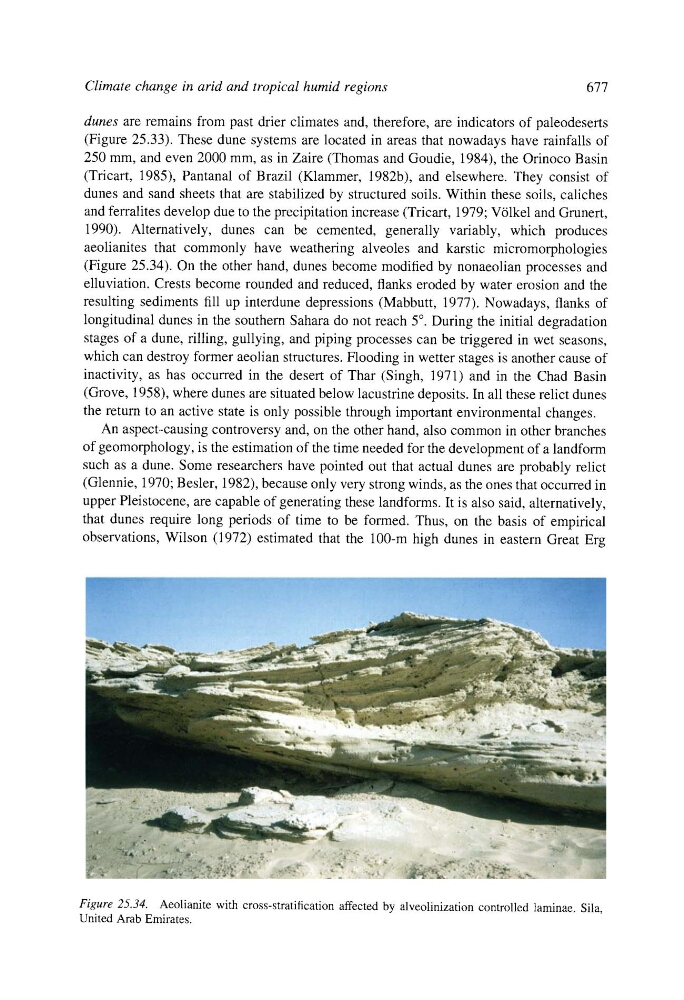
1990). Alternatively, dunes can be cemented, generally variably, which produces
aeolianites that commonly have weathering alveoles and karstic micromorphologies
(Figure 25.34). On the other hand, dunes become modified by nonaeolian processes and
elluviation. Crests become rounded and reduced, flanks eroded by water erosion and the
resulting sediments fill up interdune depressions (Mabbutt, 1977). Nowadays, flanks of
longitudinal dunes in the southern Sahara do not reach 5 ~ . During the initial degradation
stages of a dune, rilling, gullying, and piping processes can be triggered in wet seasons,
which can destroy former aeolian structures. Flooding in wetter stages is another cause of
inactivity, as has occurred in the desert of Thar (Singh, 1971) and in the Chad Basin
(Grove, 1958), where dunes are situated below lacustrine deposits. In all these relict dunes
the return to an active state is only possible through important environmental changes.
An aspect-causing controversy and, on the other hand, also common in other branches
of geomorphology, is the estimation of the time needed for the development of a landform
such as a dune. Some researchers have pointed out that actual dunes are probably relict
(Glennie, 1970; Besler, 1982), because only very strong winds, as the ones that occurred in
upper Pleistocene, are capable of generating these landforms. It is also said, alternatively,
that dunes require long periods of time to be formed. Thus, on the basis of empirical
observations, Wilson (1972) estimated that the 100-m high dunes in eastern Great Erg
Figure 25.34. Aeolianite with cross-stratification affected by alveolinization controlled laminae. Sila,
United Arab Emirates.