

Climate change in arid and tropical humid regions
675
important and durable rainfall occur, the groundwater table appears on the surface
generating marsh deposits in the interdune areas; furthermore, vegetation of large size
settles, stabilising the dunes and generating soils. In the cases in which precipitation is
very intense, dunes can be eroded (Talbot and Williams, 1978). On the other hand, in dry
periods the aquifers are low and, therefore, water availability is virtually zero, hampering
the growth of the vegetation and favouring the aeolian activity during these periods.
1.3.2. Active and inactive dunes
The knowledge of the degree of activity of dunes is problematic and imprecise. From
numerous data, it is estimated that when average precipitation exceeds 100 to 300 mm
(Goudie, 1992), vegetation is effective enough to restrict the movement of the dunes. The
degree of activity can be obtained from climatic indexes collected by Cooke et al. (1993),
and elaborated by Chepil et al. (1962), Wasson (1984), and Lancaster (1988). Climate
indexes are imprecise due to limited meteorological stations and to great year-on-year
variability in semiarid climates (Livingstone and Warren, 1996), in such a way that in
some years the dunes are active and in others with less precipitation, they lose most of the
mobility or even become stable.
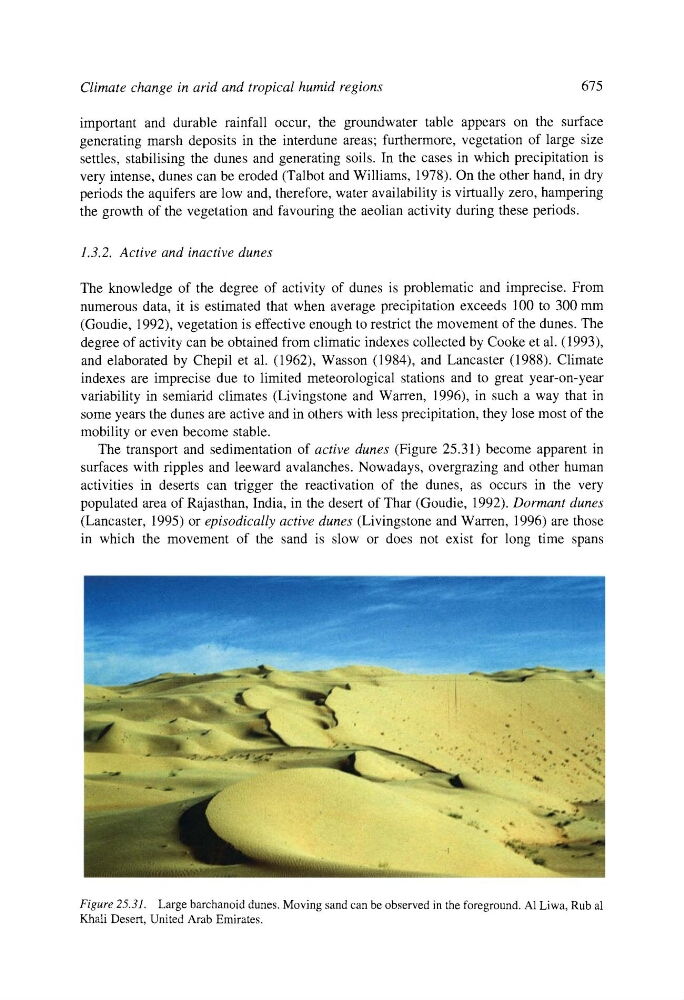
The transport and sedimentation of active dunes (Figure 25.31) become apparent in
surfaces with ripples and leeward avalanches. Nowadays, overgrazing and other human
activities in deserts can trigger the reactivation of the dunes, as occurs in the very
populated area of Rajasthan, India, in the desert of Thar (Goudie, 1992). Dormant dunes
(Lancaster, 1995) or episodically active dunes (Livingstone and Warren, 1996) are those
in which the movement of the sand is slow or does not exist for long time spans
Figure 25.31. Large barchanoid dunes. Moving sand can be observed in the foreground. A1Liwa, Rub al
Khali Desert, United Arab Emirates.