

Climate change in arid and tropical humid regions
673
O _
10v
2530.
f
i
k
g
h
o
=
,...
<
b
e
~
~
~
..::,
.,.,..' -,
:::::.: I; ".:.:v
C
:."74,1
,.,..,
c"
:,'.v
~.", ,' i,:
," .:,
"_~_
,-"
o
~t.','.:
::',...".
" :,_o _..
...:,..:;
....
C
Y':"..!.
..:::-.
._
.. :......
,.-.
~
.;;5'.
....
I....--v...
..-. ,:-v'/..
__
....,.
~..:: ~.
.:v;-.
,~!~!
~
......... :.:' ,~,. ~
..,..,
~-:;:::::
~
~
....... ~::-:.,::: .E: ::;:::;::::
,,,,.,
z
=
....
:::"::, ;::, :. :
~
..=
...-, ,.,,,
: : . : : ~: : . : : : :
..-, ._o ~
"5
..-,
L'~
.-x:: & m
1. 1. 1
E
~
.-9- ~
.-g_
Iii
a: Rognon (1987)
g: Butzer et aL (1978)
b: Talbot (1980), Pachur et al. (1987)
h: Magaritz and Enzel (1990)
c: Michel (1973), Grove (1985)
i: Wasson et aL (1983)
d: Deacon et aL (1984), Lancaster (1989) j: Sung-Chiao (1984)
e: Lancaster (1981 )
k: Bowler and Wasson (1984)
f: Shaw and Cooke (1986)
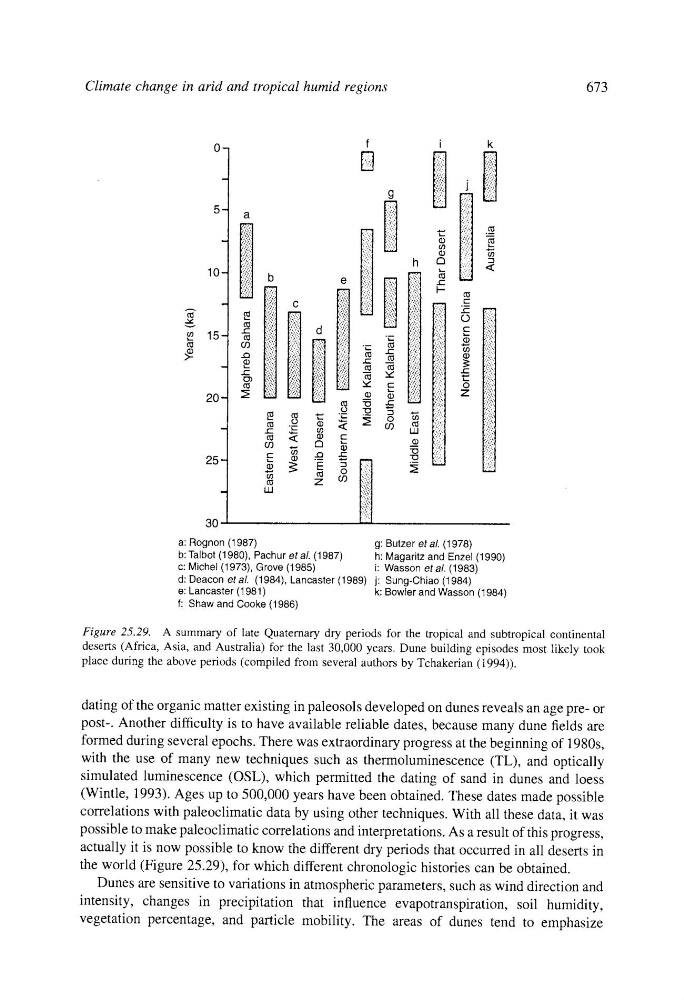
Figure 25.29. A summary of late Quaternary dry periods for the tropical and subtropical continental
deserts (Africa, Asia, and Australia) for the last 30,000 years. Dune building episodes most likely took
place during the above periods (compiled from several authors by Tchakerian (1994)).
dating of the organic matter existing in paleosols developed on dunes reveals an age pre- or
post-. Another difficulty is to have available reliable dates, because many dune fields are
formed during several epochs. There was extraordinary progress at the beginning of 1980s,
with the use of many new techniques such as thermoluminescence (TL), and optically
simulated luminescence (OSL), which permitted the dating of sand in dunes and loess
(Wintle, 1993). Ages up to 500,000 years have been obtained. These dates made possible
correlations with paleoclimatic data by using other techniques. With all these data, it was
possible to make paleoclimatic correlations and interpretations. As a result of this progress,
actually it is now possible to know the different dry periods that occurred in all deserts in
the world (Figure 25.29), for which different chronologic histories can be obtained.
Dunes are sensitive to variations in atmospheric parameters, such as wind direction and
intensity, changes in precipitation that influence evapotranspiration, soil humidity,
vegetation percentage, and particle mobility. The areas of dunes tend to emphasize