

Climate change in glacial and periglacial regions
637
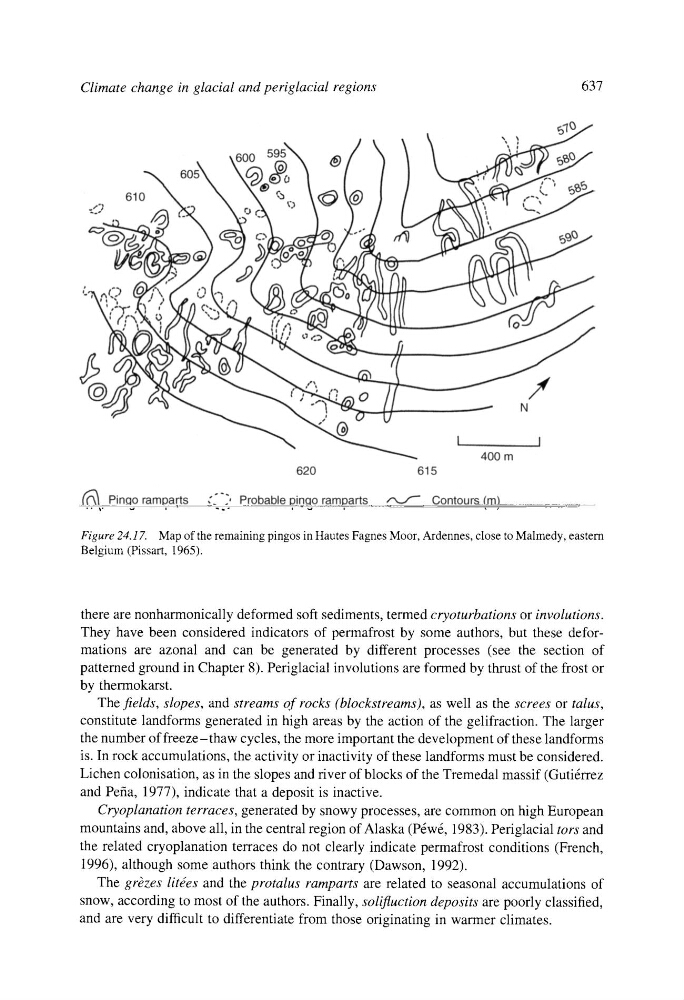
(~ Pingo ramparts ,'.'.'.', Probable pingo ramparts ~
Contours (m)
Figure 24.17. Map of the remaining pingos in Hautes Fagnes Moor, Ardennes, close to Malmedy, eastern
Belgium (Pissart, 1965).
there are nonharmonically deformed soft sediments, termed cryoturbations or involutions.
They have been considered indicators of permafrost by some authors, but these deformations are azonal and can be generated by different processes (see the section of
patterned ground in Chapter 8). Periglacial involutions are formed by thrust of the frost or
by thermokarst.
The fields, slopes, and streams of rocks (blockstreams), as well as the screes or talus,
constitute landforms generated in high areas by the action of the gelifraction. The larger
the number of freeze-thaw cycles, the more important the development of these landforms
is. In rock accumulations, the activity or inactivity of these landforms must be considered.
Lichen colonisation, as in the slopes and river of blocks of the Tremedal massif (Guti6rrez
and Pefia, 1977), indicate that a deposit is inactive.
Cryoplanation terraces, generated by snowy processes, are common on high European
mountains and, above all, in the central region of Alaska (P6w6, 1983). Periglacial tors and
the related cryoplanation terraces do not clearly indicate permafrost conditions (French,
1996), although some authors think the contrary (Dawson, 1992).
The grkzes litdes and the protalus ramparts are related to seasonal accumulations of
snow, according to most of the authors. Finally, solifluction deposits are poorly classified,
and are very difficult to differentiate from those originating in warmer climates.