

Climate change in glacial and periglacial regions
635
100
m
O,
,
, ,
J
I
,
, ,
-80 ...............
-,
18 1000yrBR 0
18
0
18
0
0
....
4
0
5
0
-30
-80
.... ,--~ ...... --, -20
I
-,
..... 1 -5
,
18
0
10
0
10
0
10
0
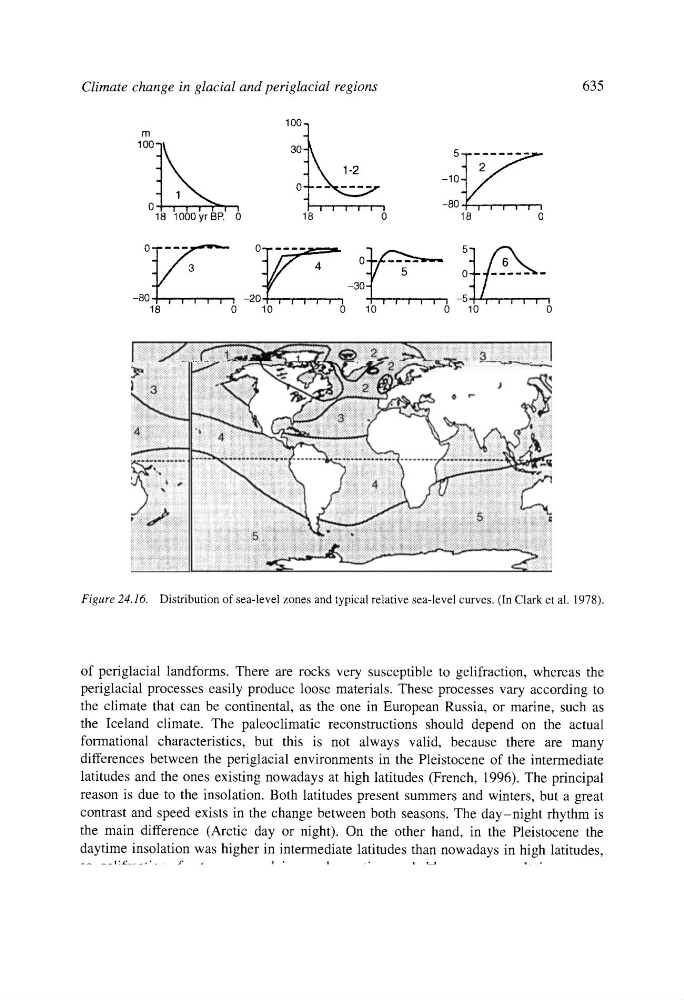
Figure 24.16. Distribution of sea-level zones and typical relative sea-level curves. (In Clark et al. 1978).
of periglacial landforms. There are rocks very susceptible to gelifraction, whereas the
periglacial processes easily produce loose materials. These processes vary according to
the climate that can be continental, as the one in European Russia, or marine, such as
the Iceland climate. The paleoclimatic reconstructions should depend on the actual
formational characteristics, but this is not always valid, because there are many
differences between the periglacial environments in the Pleistocene of the intermediate
latitudes and the ones existing nowadays at high latitudes (French, 1996). The principal
reason is due to the insolation. Both latitudes present summers and winters, but a great
contrast and speed exists in the change between both seasons. The day-night rhythm is
the main difference (Arctic day or night). On the other hand, in the Pleistocene the
daytime insolation was higher in intermediate latitudes than nowadays in high latitudes,
so gelifraction, frost creep, and ice wedge action probably were several times more
intense than in the actual latitudes. Also, in the intermediate latitudes, the effect of the
orientation with regard to the sun is very important, so on slopes facing the sun many
more ice-thaw cycles occur than on the shaded side. On the other hand, during the