

Glaciers
55
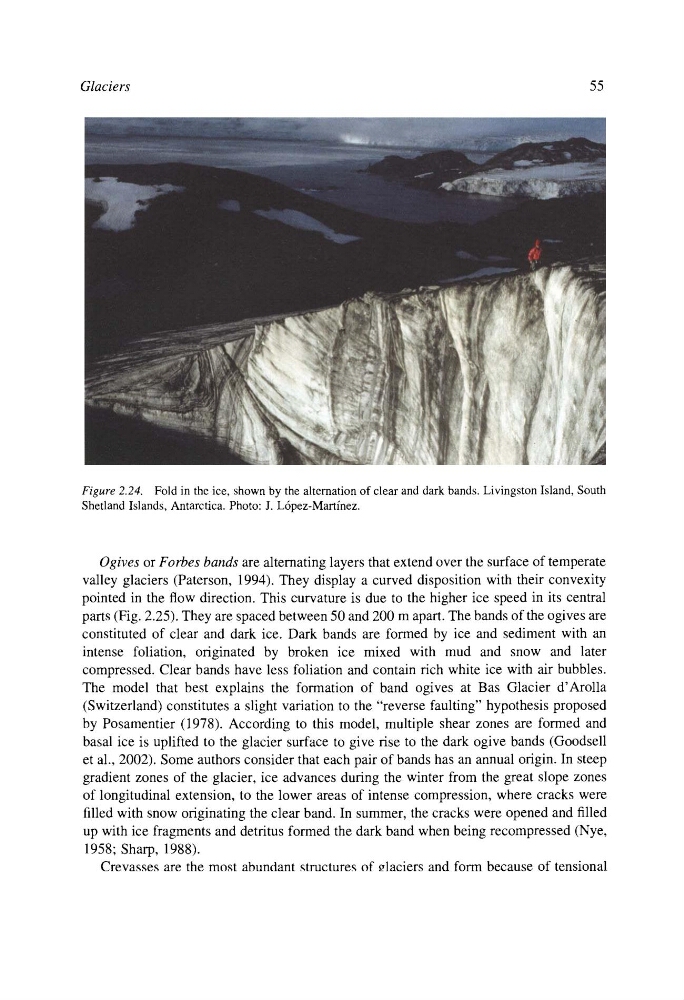
Figure 2.24. Fold in the ice, shown by the alternation of clear and dark bands. Livingston Island, South
Shetland Islands, Antarctica. Photo: J. L6pez-Martfnez.
Ogives or Forbes bands are alternating layers that extend over the surface of temperate
valley glaciers (Paterson, 1994). They display a curved disposition with their convexity
pointed in the flow direction. This curvature is due to the higher ice speed in its central
parts (Fig. 2.25). They are spaced between 50 and 200 m apart. The bands of the ogives are
constituted of clear and dark ice. Dark bands are formed by ice and sediment with an
intense foliation, originated by broken ice mixed with mud and snow and later
compressed. Clear bands have less foliation and contain rich white ice with air bubbles.
The model that best explains the formation of band ogives at Bas Glacier d'Arolla
(Switzerland) constitutes a slight variation to the "reverse faulting" hypothesis proposed
by Posamentier (1978). According to this model, multiple shear zones are formed and
basal ice is uplifted to the glacier surface to give rise to the dark ogive bands (Goodsell
et al., 2002). Some authors consider that each pair of bands has an annual origin. In steep
gradient zones of the glacier, ice advances during the winter from the great slope zones
of longitudinal extension, to the lower areas of intense compression, where cracks were
filled with snow originating the clear band. In summer, the cracks were opened and filled
up with ice fragments and detritus formed the dark band when being recompressed (Nye,
1958; Sharp, 1988).
Crevasses are the most abundant structures of glaciers and form because of tensional
stresses (Menzies, 1995a). Generally, they are straight or weakly bent and subvertical.
Their length is tens to several thousands of metres and their width fluctuates from
millimetres to several metres. The maximal depth is of the order of 35 m, because the ice
55
Figure 2.24. Fold in the ice, shown by the alternation of clear and dark bands. Livingston Island, South
Shetland Islands, Antarctica. Photo: J. L6pez-Martfnez.
Ogives or Forbes bands are alternating layers that extend over the surface of temperate
valley glaciers (Paterson, 1994). They display a curved disposition with their convexity
pointed in the flow direction. This curvature is due to the higher ice speed in its central
parts (Fig. 2.25). They are spaced between 50 and 200 m apart. The bands of the ogives are
constituted of clear and dark ice. Dark bands are formed by ice and sediment with an
intense foliation, originated by broken ice mixed with mud and snow and later
compressed. Clear bands have less foliation and contain rich white ice with air bubbles.
The model that best explains the formation of band ogives at Bas Glacier d'Arolla
(Switzerland) constitutes a slight variation to the "reverse faulting" hypothesis proposed
by Posamentier (1978). According to this model, multiple shear zones are formed and
basal ice is uplifted to the glacier surface to give rise to the dark ogive bands (Goodsell
et al., 2002). Some authors consider that each pair of bands has an annual origin. In steep
gradient zones of the glacier, ice advances during the winter from the great slope zones
of longitudinal extension, to the lower areas of intense compression, where cracks were
filled with snow originating the clear band. In summer, the cracks were opened and filled
up with ice fragments and detritus formed the dark band when being recompressed (Nye,
1958; Sharp, 1988).
Crevasses are the most abundant structures of glaciers and form because of tensional
stresses (Menzies, 1995a). Generally, they are straight or weakly bent and subvertical.
Their length is tens to several thousands of metres and their width fluctuates from
millimetres to several metres. The maximal depth is of the order of 35 m, because the ice