

630
Climatic Geomorphology
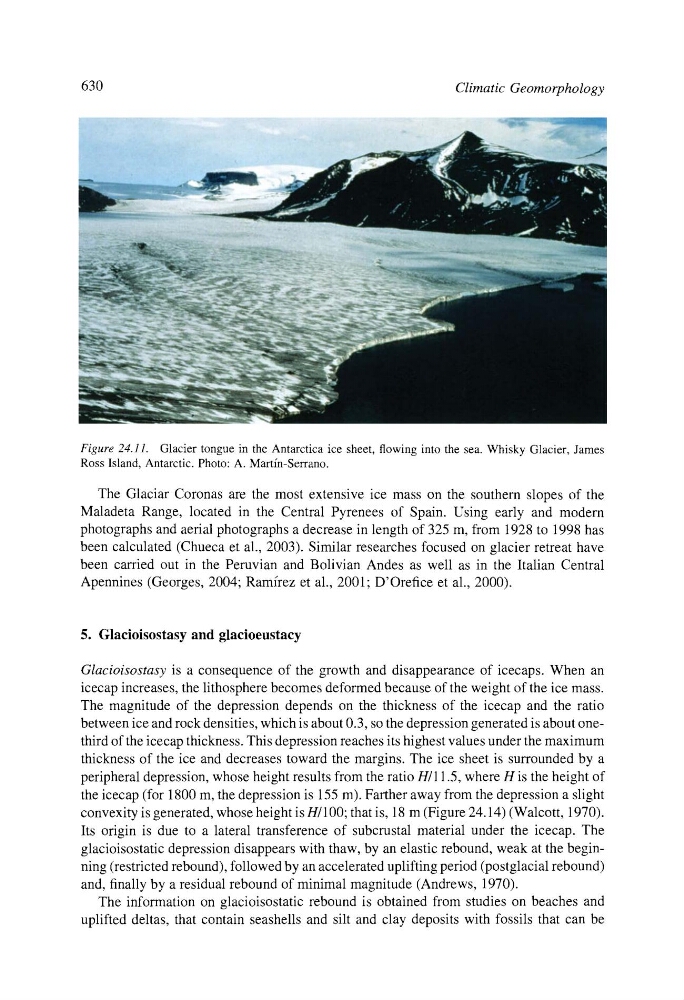
Figure 24.11. Glacier tongue in the Antarctica ice sheet, flowing into the sea. Whisky Glacier, James
Ross Island, Antarctic. Photo: A. Martfn-Serrano.
The Glaciar Coronas are the most extensive ice mass on the southern slopes of the
Maladeta Range, located in the Central Pyrenees of Spain. Using early and modern
photographs and aerial photographs a decrease in length of 325 m, from 1928 to 1998 has
been calculated (Chueca et al., 2003). Similar researches focused on glacier retreat have
been carried out in the Peruvian and Bolivian Andes as well as in the Italian Central
Apennines (Georges, 2004; Ramirez et al., 2001; D'Orefice et al., 2000).
5. Glacioisostasy and glacioeustacy
Glacioisostasy is a consequence of the growth and disappearance of icecaps. When an
icecap increases, the lithosphere becomes deformed because of the weight of the ice mass.
The magnitude of the depression depends on the thickness of the icecap and the ratio
between ice and rock densities, which is about 0.3, so the depression generated is about onethird of the icecap thickness. This depression reaches its highest values under the maximum
thickness of the ice and decreases toward the margins. The ice sheet is surrounded by a
peripheral depression, whose height results from the ratio H/11.5, where H is the height of
the icecap (for 1800 m, the depression is 155 m). Farther away from the depression a slight
convexity is generated, whose height is H/100; that is, 18 m (Figure 24.14) (Walcott, 1970).
Its origin is due to a lateral transference of subcrustal material under the icecap. The
glacioisostatic depression disappears with thaw, by an elastic rebound, weak at the beginning (restricted rebound), followed by an accelerated uplifting period (postglacial rebound)
and, finally by a residual rebound of minimal magnitude (Andrews, 1970).
The information on glacioisostatic rebound is obtained from studies on beaches and
uplifted deltas, that contain seashells and silt and clay deposits with fossils that can be