

Environmental change
611
Pat6-Cornell (1996) pointed out that the models used for the study of the effects of global
climate change are based on a limited knowledge of the main phenomena (for instance, the
role of clouds on oceans). Demangeot (1996) considered that proof of the actual quantity
of warming of the planet is not convincing and asked specialists for more precise data on
icecap melting, the role of deforestation, and so forth. "Since 1940, the Greenland coastal
stations data have undergone predominantly a cooling trend. At the summit of the
Greenland ice sheet the summer average temperature has decreased at the rate of 2.2~ per
decade. This suggests that the Greenland Ice Sheet and coastal regions are not following
the current global warming trend" (Chylek, 2004).
Embleton (1989) indicated that climate changes forecast for the next decades or
centuries is extremely difficult. Obviously, CO2 has significantly increased from 1750,
according to data provided by the analysis of ice cores in Camp Siple in Antarctica and
from air samples taken since 1958 at the observatory of Mauna Loa in Hawaii. There is no
doubt that CO2 produces an increase in temperature. As indicated above, predictions show
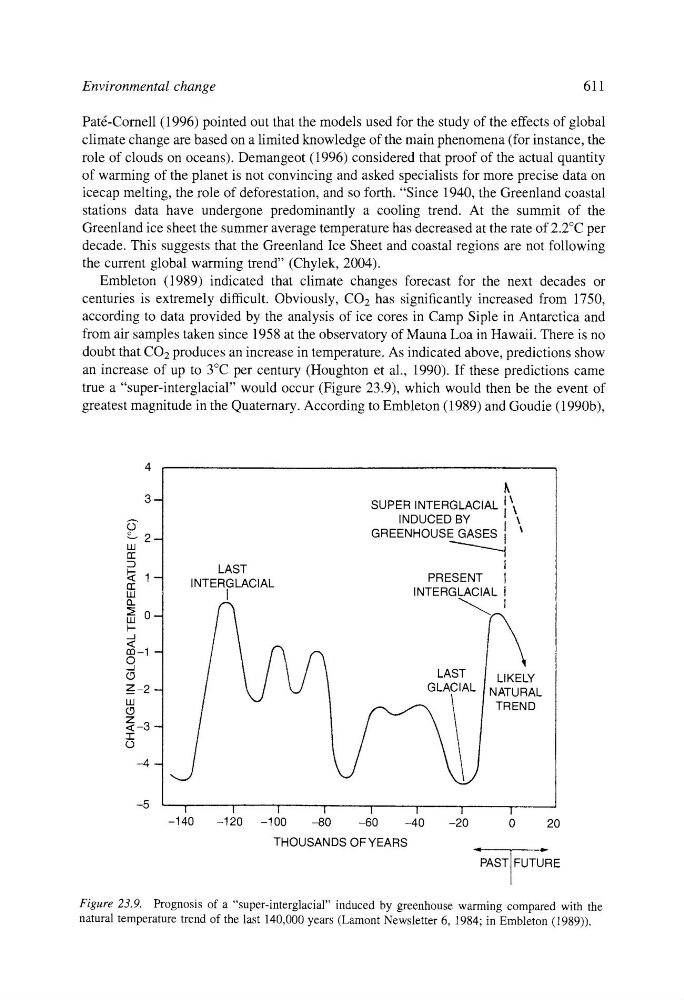
an increase of up to 3~ per century (Houghton et al., 1990). If these predictions came
true a "super-interglacial" would occur (Figure 23.9), which would then be the event of
greatest magnitude in the Quaternary. According to Embleton (1989) and Goudie (1990b),
_
O
o
"~
2 m
i.iJ
rr
cr
ILl
8..
.. 0._1
o-1
_z-2
O
-4
-5
SUPER INTERGLACIAL I\
INDUCED BY
I
z\
GREENHOUSE GASES I
LAST
I
INTERGLACIAL
PRESENT
I
I
INTERGLACIAL I
LAST
/
GLACIAL /NATURAL
D
I
!
I
I
I
1
I
1
-140
-120
-100
-80
-60
-40
-20
0
20
THOUSANDS OF YEARS
;AST l
=
FUTURE
Figure 23.9. Prognosis of a "super-interglacial" induced by greenhouse warming compared with the
natural temperature trend of the last 140,000 years (Lamont Newsletter 6, 1984; in Embleton (1989)).