

Glaciers
53
0
,
,
,
,
5km
t
1963
I
~p'~d ~o~
I
i
1964
~.,
,966 iikes.
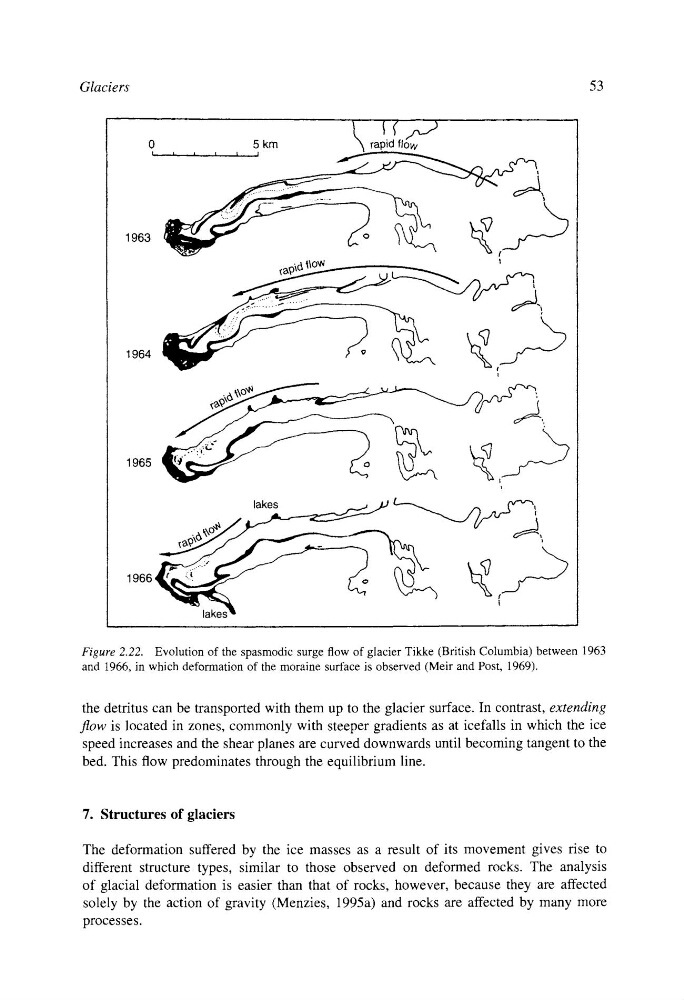
Figure 2.22. Evolution of the spasmodic surge flow of glacier Tikke (British Columbia) between 1963
and 1966, in which deformation of the moraine surface is observed (Meir and Post, 1969).
the detritus can be transported with them up to the glacier surface. In contrast, extending
flow is located in zones, commonly with steeper gradients as at icefalls in which the ice
speed increases and the shear planes are curved downwards until becoming tangent to the
bed. This flow predominates through the equilibrium line.
7. Structures of glaciers
The deformation suffered by the ice masses as a result of its movement gives rise to
different structure types, similar to those observed on deformed rocks. The analysis
of glacial deformation is easier than that of rocks, however, because they are affected
solely by the action of gravity (Menzies, 1995a) and rocks are affected by many more
processes.
53
0
,
,
,
,
5km
t
1963
I
~p'~d ~o~
I
i
1964
~.,
,966 iikes.
Figure 2.22. Evolution of the spasmodic surge flow of glacier Tikke (British Columbia) between 1963
and 1966, in which deformation of the moraine surface is observed (Meir and Post, 1969).
the detritus can be transported with them up to the glacier surface. In contrast, extending
flow is located in zones, commonly with steeper gradients as at icefalls in which the ice
speed increases and the shear planes are curved downwards until becoming tangent to the
bed. This flow predominates through the equilibrium line.
7. Structures of glaciers
The deformation suffered by the ice masses as a result of its movement gives rise to
different structure types, similar to those observed on deformed rocks. The analysis
of glacial deformation is easier than that of rocks, however, because they are affected
solely by the action of gravity (Menzies, 1995a) and rocks are affected by many more
processes.