

584
Climatic Geomorphology
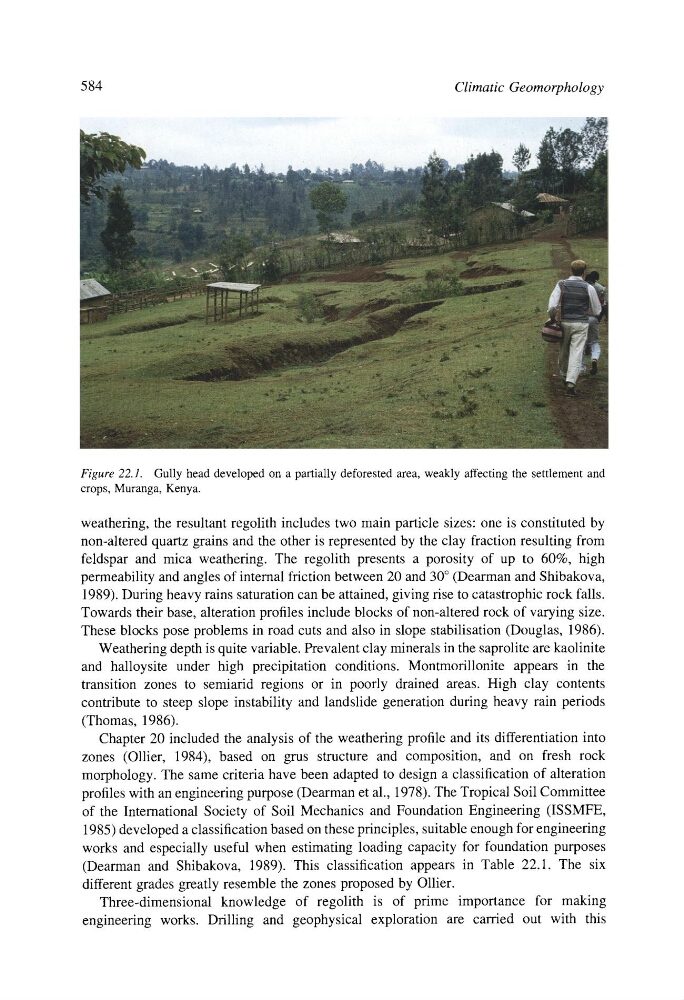
Figure 22.1. Gully head developed on a partially deforested area, weakly affecting the settlement and
crops, Muranga, Kenya.
weathering, the resultant regolith includes two main particle sizes: one is constituted by
non-altered quartz grains and the other is represented by the clay fraction resulting from
feldspar and mica weathering. The regolith presents a porosity of up to 60%, high
permeability and angles of internal friction between 20 and 30 ~ (Dearman and Shibakova,
1989). During heavy rains saturation can be attained, giving rise to catastrophic rock falls.
Towards their base, alteration profiles include blocks of non-altered rock of varying size.
These blocks pose problems in road cuts and also in slope stabilisation (Douglas, 1986).
Weathering depth is quite variable. Prevalent clay minerals in the saprolite are kaolinite
and halloysite under high precipitation conditions. Montmorillonite appears in the
transition zones to semiarid regions or in poorly drained areas. High clay contents
contribute to steep slope instability and landslide generation during heavy rain periods
(Thomas, 1986).
Chapter 20 included the analysis of the weathering profile and its differentiation into
zones (Oilier, 1984), based on grus structure and composition, and on fresh rock
morphology. The same criteria have been adapted to design a classification of alteration
profiles with an engineering purpose (Dearman et al., 1978). The Tropical Soil Committee
of the International Society of Soil Mechanics and Foundation Engineering (ISSMFE,
1985) developed a classification based on these principles, suitable enough for engineering
works and especially useful when estimating loading capacity for foundation purposes
(Dearman and Shibakova, 1989). This classification appears in Table 22.1. The six
different grades greatly resemble the zones proposed by Oilier.
Three-dimensional knowledge of regolith is of prime importance for making
engineering works. Drilling and geophysical exploration are carried out with this