

Tropical landforms
573
At the end of the 19th century inselbergs were interpreted as generated by glacial,
marine and aeolian processes (Twidale, 1982; Vidal Romanf and Twidale, 1998). Later on,
fluvial erosion was considered as the main cause. At present, two main theories explain
bornhardt generation. Several authors (Cotton, 1942; Howard, 1942; Pugh, 1956) have
proposed the scarp retreat hypothesis, although it was King (1942, 1948, 1949, 1953,
1962) who led this idea with the most emphasis. More recently, King' s points of view have
been supported by Kesel (1973, 1977b) after studying deserts of the southwestern USA,
and by Selby (1977) in the Namib Desert. Criticism against King argues that none of his
work was done in humid tropics, zones with a great profusion of bornhardts.
The hypothesis deals with inselbergs of position (fernlinge) that for extended periods of
time have experienced parallel scarp retreat. This process has led to a pediment
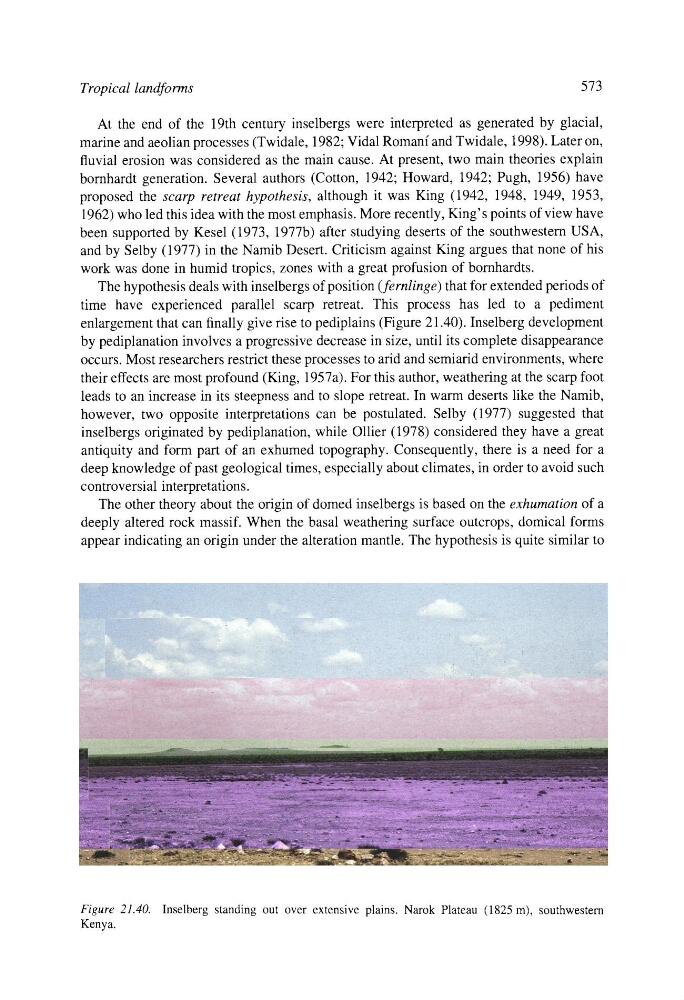
enlargement that can finally give rise to pediplains (Figure 21.40). Inselberg development
by pediplanation involves a progressive decrease in size, until its complete disappearance
occurs. Most researchers restrict these processes to arid and semiarid environments, where
their effects are most profound (King, 1957a). For this author, weathering at the scarp foot
leads to an increase in its steepness and to slope retreat. In warm deserts like the Namib,
however, two opposite interpretations can be postulated. Selby (1977) suggested that
inselbergs originated by pediplanation, while Ollier (1978) considered they have a great
antiquity and form part of an exhumed topography. Consequently, there is a need for a
deep knowledge of past geological times, especially about climates, in order to avoid such
controversial interpretations.
The other theory about the origin of domed inselbergs is based on the exhumation of a
deeply altered rock massif. When the basal weathering surface outcrops, domical forms
appear indicating an origin under the alteration mantle. The hypothesis is quite similar to
Figure 21.40. Inselberg standing out over extensive plains. Narok Plateau (1825 m), southwestern
Kenya.