

566
Climatic Geomorphology
zones with moderate relief. This author distinguishes several types: mesas on horizontal
strata or laterites, hills with rectilinear slopes (typical of arid zones), and convex-concave
slopes covered by regolith, rock domes, and boulders (tors) or castellated forms (castle
koppies). Thomas (1976, 1978, 1994) made similar differentiations. The German authors
distinguished between inselbergs of position (fernlinge) and inselbergs of resistance
(hartlinge). The former have been preserved because of their situation on water divide
zones, where there is little erosion, whereas the latter originate because of the great
resistance to erosion of the rocks. Nevertheless, two main types of inselbergs can be
differentiated: boulder inselbergs or tors and domed inselbergs or bornhardts.
5.1. Boulder inselbergs (tors)
The morphology of boulder inselbergs is varied and controlled by fracture systems. They
develop on gneisses, schists, quartzites, diabases, sandstones, and arkoses, although they
are more abundant on granites (Gerrard, 1988). The boulders (spheroidally weathered
corestones) occur in diverse topographical positions and their size and form depend on the
fracture type and spacing. In Australia they vary in size from 0.25 to 33 m, although the
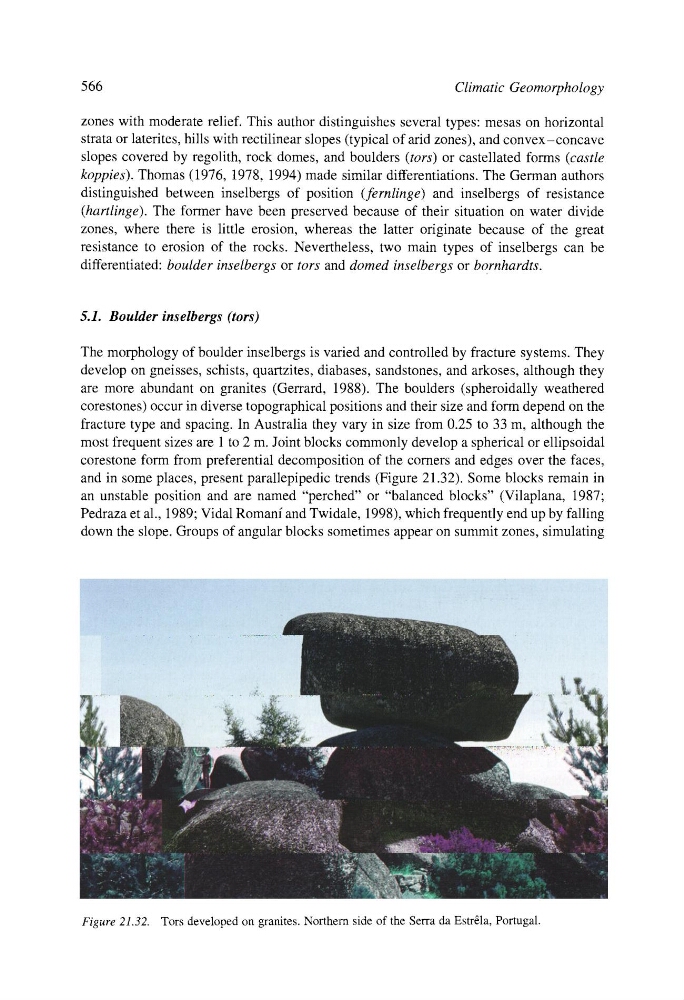
most frequent sizes are 1 to 2 m. Joint blocks commonly develop a spherical or ellipsoidal
corestone form from preferential decomposition of the comers and edges over the faces,
and in some places, present parallepipedic trends (Figure 21.32). Some blocks remain in
an unstable position and are named "perched" or "balanced blocks" (Vilaplana, 1987;
Pedraza et al., 1989; Vidal Romanf and Twidale, 1998), which frequently end up by falling
down the slope. Groups of angular blocks sometimes appear on summit zones, simulating
Figure 21.32. Tors developed on granites. Northern side of the Serra da Estr~la, Portugal.