

558
Climatic Geomorphology
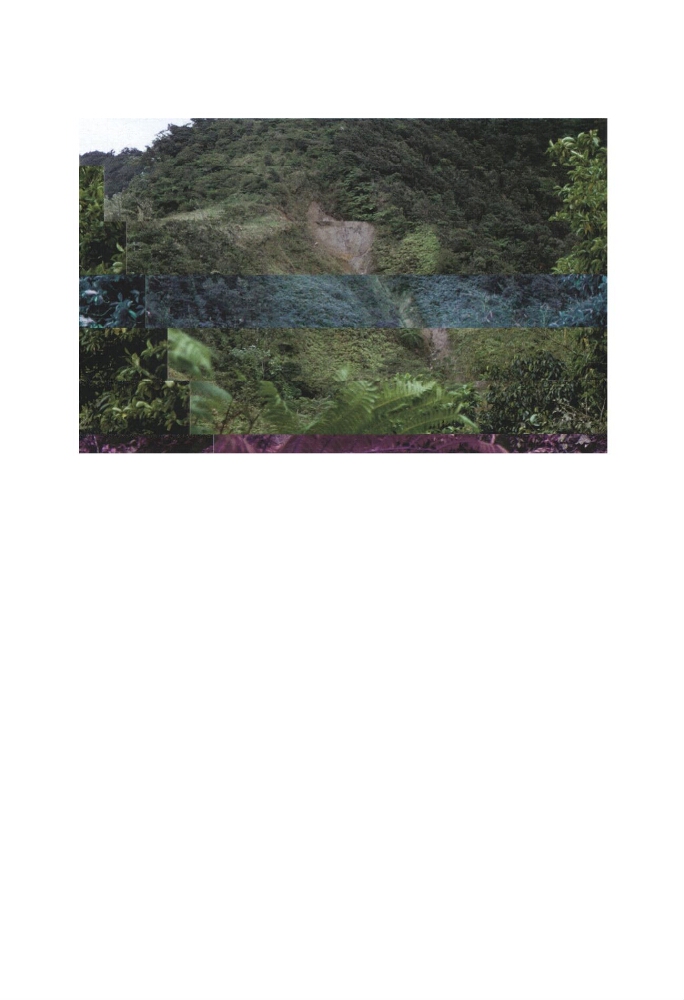
Figure 21.25. Slide on a steep slope with rainforest (pluvisilva) vegetation. Pitones del Corbert,
Martinica Island, Lesser Antilles.
development. This author indicated that 35% of the 700 slides produced in June 1966 in
Hong Kong developed on forested areas, which occupied 8.4% of the region affected by
mass movements.
3. Landforms developed on laterites
Landforms related to laterites appear in the humid tropics and also in semiarid zones
adjacent to savanna regions. Landforms mostly result from fluvial incision of lateritic
deposits, which produce tabular forms capped by laterites. These can last for long periods
of time due to the high resistance of laterites to erosion.
Tabular forms are platforms or mesas of limited dimensions, standing out in the
landscape and with angles lower than 0.5 ~ . Their borders are formed by steep scarps that
retreat basically by weathering processes, leading to a reduction of the platform extension.
Many examples exist in the literature about these tabular landscapes (Figure 21.26)
(Maignien, 1966; Thomas, 1974, 1994; McFarlane, 1976). Fluvial incision in a weathered
zone can produce a new valley. Fe 2+ flowing to the valley gives rise to an iron enrichment
that leads to the generation of a new laterite level. Successive fluvial incisions generate a
terrace or bench morphology (Figure 21.27). Destruction of the laterite scarp supplies
fragments to the lower parts, forming slopes with loose laterite rubble (Figure 21.28) and
newly cemented colluvial deposits that can connect with pediments (Figure 20.22).
In general, laterites harden as a consequence of fluvial incision. When dried they become
very resistant to external agents and after long erosional periods they occupy dominant