

The humid tropics: weathering and laterites
511
BOWEN REACTION SERIES
(Early crystals, largely removed as formed)
Olivine
Pyroxine~
Anorthite-rich)agioclase
Amphibole
Intermediate plagioclase
/
Albite-rich plagioclase
Biotite
/
\
Potassium feldspar
1
Quartz
(Late crystals formed from residual magma)
Olivine
Augite
Homblende
GOLDICH WEATHERING SERIES
Calcic plagioclase
Calcic - alkalic plagioclase
Alkali - calcic plagioclase
Alkalic plagioclase
;r
Biotite
Potash feldspar
Muscovite
~1
Quartz
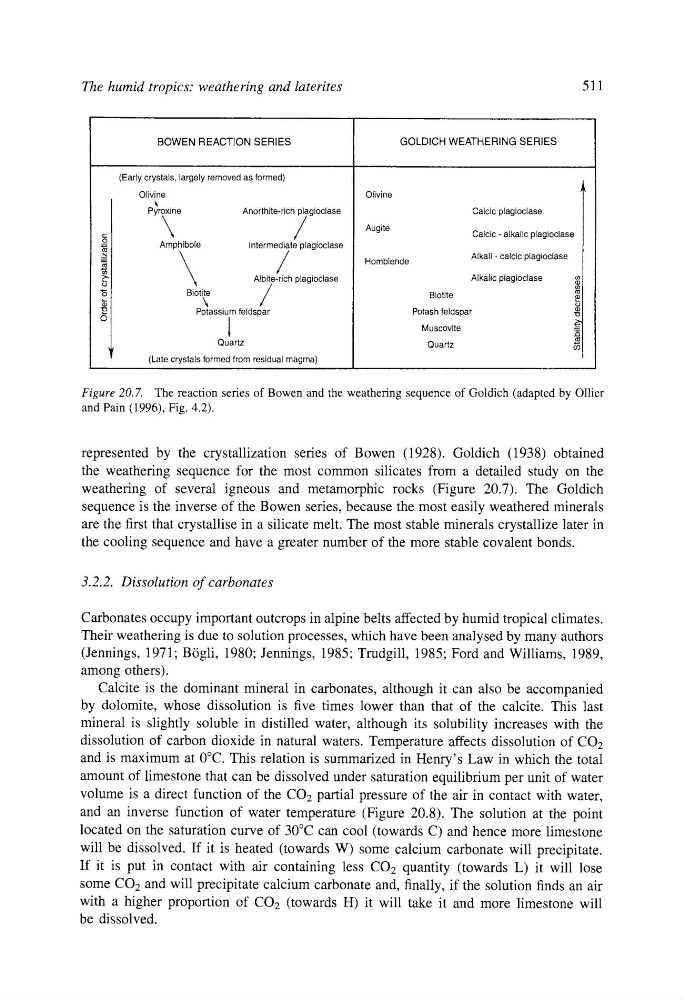
Figure 20.7. The reaction series of Bowen and the weathering sequence of Goldich (adapted by Oilier
and Pain (1996), Fig. 4.2).
represented by the crystallization series of Bowen (1928). Goldich (1938) obtained
the weathering sequence for the most common silicates from a detailed study on the
weathering of several igneous and metamorphic rocks (Figure 20.7). The Goldich
sequence is the inverse of the Bowen series, because the most easily weathered minerals
are the first that crystallise in a silicate melt. The most stable minerals crystallize later in
the cooling sequence and have a greater number of the more stable covalent bonds.
3.2.2. Dissolution of carbonates
Carbonates occupy important outcrops in alpine belts affected by humid tropical climates.
Their weathering is due to solution processes, which have been analysed by many authors
(Jennings, 1971; B6gli, 1980; Jennings, 1985; Trudgill, 1985; Ford and Williams, 1989,
among others).
Calcite is the dominant mineral in carbonates, although it can also be accompanied
by dolomite, whose dissolution is five times lower than that of the calcite. This last
mineral is slightly soluble in distilled water, although its solubility increases with the
dissolution of carbon dioxide in natural waters. Temperature affects dissolution of CO2
and is maximum at 0~ This relation is summarized in Henry's Law in which the total
amount of limestone that can be dissolved under saturation equilibrium per unit of water
volume is a direct function of the CO2 partial pressure of the air in contact with water,
and an inverse function of water temperature (Figure 20.8). The solution at the point
located on the saturation curve of 30~ can cool (towards C) and hence more limestone
will be dissolved. If it is heated (towards W) some calcium carbonate will precipitate.
If it is put in contact with air containing less CO2 quantity (towards L) it will lose
some CO2 and will precipitate calcium carbonate and, finally, if the solution finds an air
with a higher proportion of CO2 (towards H) it will take it and more limestone will
be dissolved.
511
BOWEN REACTION SERIES
(Early crystals, largely removed as formed)
Olivine
Pyroxine~
Anorthite-rich)agioclase
Amphibole
Intermediate plagioclase
/
Albite-rich plagioclase
Biotite
/
\
Potassium feldspar
1
Quartz
(Late crystals formed from residual magma)
Olivine
Augite
Homblende
GOLDICH WEATHERING SERIES
Calcic plagioclase
Calcic - alkalic plagioclase
Alkali - calcic plagioclase
Alkalic plagioclase
;r
Biotite
Potash feldspar
Muscovite
~1
Quartz
Figure 20.7. The reaction series of Bowen and the weathering sequence of Goldich (adapted by Oilier
and Pain (1996), Fig. 4.2).
represented by the crystallization series of Bowen (1928). Goldich (1938) obtained
the weathering sequence for the most common silicates from a detailed study on the
weathering of several igneous and metamorphic rocks (Figure 20.7). The Goldich
sequence is the inverse of the Bowen series, because the most easily weathered minerals
are the first that crystallise in a silicate melt. The most stable minerals crystallize later in
the cooling sequence and have a greater number of the more stable covalent bonds.
3.2.2. Dissolution of carbonates
Carbonates occupy important outcrops in alpine belts affected by humid tropical climates.
Their weathering is due to solution processes, which have been analysed by many authors
(Jennings, 1971; B6gli, 1980; Jennings, 1985; Trudgill, 1985; Ford and Williams, 1989,
among others).
Calcite is the dominant mineral in carbonates, although it can also be accompanied
by dolomite, whose dissolution is five times lower than that of the calcite. This last
mineral is slightly soluble in distilled water, although its solubility increases with the
dissolution of carbon dioxide in natural waters. Temperature affects dissolution of CO2
and is maximum at 0~ This relation is summarized in Henry's Law in which the total
amount of limestone that can be dissolved under saturation equilibrium per unit of water
volume is a direct function of the CO2 partial pressure of the air in contact with water,
and an inverse function of water temperature (Figure 20.8). The solution at the point
located on the saturation curve of 30~ can cool (towards C) and hence more limestone
will be dissolved. If it is heated (towards W) some calcium carbonate will precipitate.
If it is put in contact with air containing less CO2 quantity (towards L) it will lose
some CO2 and will precipitate calcium carbonate and, finally, if the solution finds an air
with a higher proportion of CO2 (towards H) it will take it and more limestone will
be dissolved.