

The humid tropics: weathering and laterites
509
a brief discussion is presented on these factors and their incidence on the mobility and
precipitation of the most frequent ions in silicates.
Following geochemical studies, fresh water pH fluctuates between 4 and 9 (Mason,
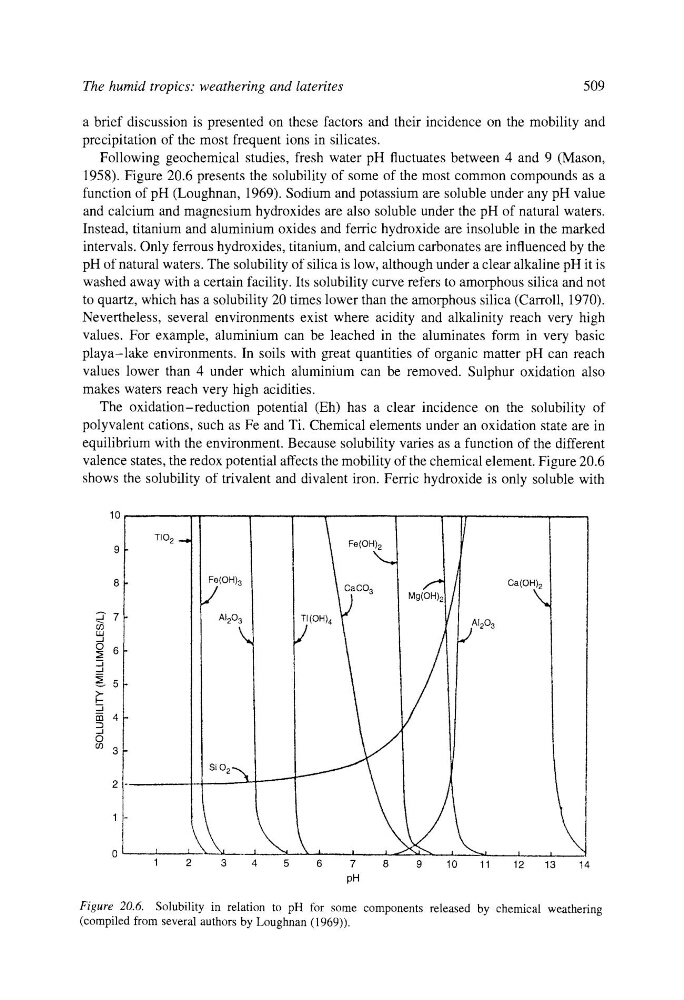
1958). Figure 20.6 presents the solubility of some of the most common compounds as a
function of pH (Loughnan, 1969). Sodium and potassium are soluble under any pH value
and calcium and magnesium hydroxides are also soluble under the pH of natural waters.
Instead, titanium and aluminium oxides and ferric hydroxide are insoluble in the marked
intervals. Only ferrous hydroxides, titanium, and calcium carbonates are influenced by the
pH of natural waters. The solubility of silica is low, although under a clear alkaline pH it is
washed away with a certain facility. Its solubility curve refers to amorphous silica and not
to quartz, which has a solubility 20 times lower than the amorphous silica (Carroll, 1970).
Nevertheless, several environments exist where acidity and alkalinity reach very high
values. For example, aluminium can be leached in the aluminates form in very basic
playa-lake environments. In soils with great quantities of organic matter pH can reach
values lower than 4 under which aluminium can be removed. Sulphur oxidation also
makes waters reach very high acidities.
The oxidation-reduction potential (Eh) has a clear incidence on the solubility of
polyvalent cations, such as Fe and Ti. Chemical elements under an oxidation state are in
equilibrium with the environment. Because solubility varies as a function of the different
valence states, the redox potential affects the mobility of the chemical element. Figure 20.6
shows the solubility of trivalent and divalent iron. Ferric hydroxide is only soluble with
10
~" 7
00
IJJ
._J
o 6
._1
._.1
I-._1
ca 4
23
._1
o
oo 3
TIO2
2 ......
1 -
0 -1
1
. , ,!
Fe(OH) 3
J
AI20 3
f
Fe(OH) 2
Mg(OH)~
/
Ca
1
l
1 .....
i
~
.1
.
1
2
3
4
5
6
7
8
9
10
11
12
13
14
pH
Figure 20.6. Solubility in relation to pH for some components released by chemical weathering
(compiled from several authors by Loughnan (1969)).
509
a brief discussion is presented on these factors and their incidence on the mobility and
precipitation of the most frequent ions in silicates.
Following geochemical studies, fresh water pH fluctuates between 4 and 9 (Mason,
1958). Figure 20.6 presents the solubility of some of the most common compounds as a
function of pH (Loughnan, 1969). Sodium and potassium are soluble under any pH value
and calcium and magnesium hydroxides are also soluble under the pH of natural waters.
Instead, titanium and aluminium oxides and ferric hydroxide are insoluble in the marked
intervals. Only ferrous hydroxides, titanium, and calcium carbonates are influenced by the
pH of natural waters. The solubility of silica is low, although under a clear alkaline pH it is
washed away with a certain facility. Its solubility curve refers to amorphous silica and not
to quartz, which has a solubility 20 times lower than the amorphous silica (Carroll, 1970).
Nevertheless, several environments exist where acidity and alkalinity reach very high
values. For example, aluminium can be leached in the aluminates form in very basic
playa-lake environments. In soils with great quantities of organic matter pH can reach
values lower than 4 under which aluminium can be removed. Sulphur oxidation also
makes waters reach very high acidities.
The oxidation-reduction potential (Eh) has a clear incidence on the solubility of
polyvalent cations, such as Fe and Ti. Chemical elements under an oxidation state are in
equilibrium with the environment. Because solubility varies as a function of the different
valence states, the redox potential affects the mobility of the chemical element. Figure 20.6
shows the solubility of trivalent and divalent iron. Ferric hydroxide is only soluble with
10
~" 7
00
IJJ
._J
o 6
._1
._.1
I-._1
ca 4
23
._1
o
oo 3
TIO2
2 ......
1 -
0 -1
1
. , ,!
Fe(OH) 3
J
AI20 3
f
Fe(OH) 2
Mg(OH)~
/
Ca
1
l
1 .....
i
~
.1
.
1
2
3
4
5
6
7
8
9
10
11
12
13
14
pH
Figure 20.6. Solubility in relation to pH for some components released by chemical weathering
(compiled from several authors by Loughnan (1969)).