

The humid tropics: weathering and laterites
507
intensity in the high parts of stratovolcanoes, which interrupt the extended plains of
western central Africa, like mounts Kenya and Kilimanjaro. It also acts on the high
Andean peaks of Peru, Equador and the Nevados of Columbia.
Rock disintegration is controlled by the rupture of materials, due to the pressure exerted
by growing roots. The carbon dioxide supply to the solutions is also very important, which
results from the gas exchange or respiration of the flora and fauna existing in the soil and
from decomposition of organic matter. The fauna plays an important role in transferring
and mixing materials, moving the regolith to other areas. In the humid tropics this last
work is carried out by termites and worms and can be responsible for the sorting of the
upper part of the soil. There exist several thousand socially organized termite species.
They carry clay size particles to build termitaria, which they construct with segregated
saliva. The number of termites reaches values of 9 million~a in the Ivory Coast and their
amount decreases with latitude and altitude (Goudie, 1988). Termitaria appear as small
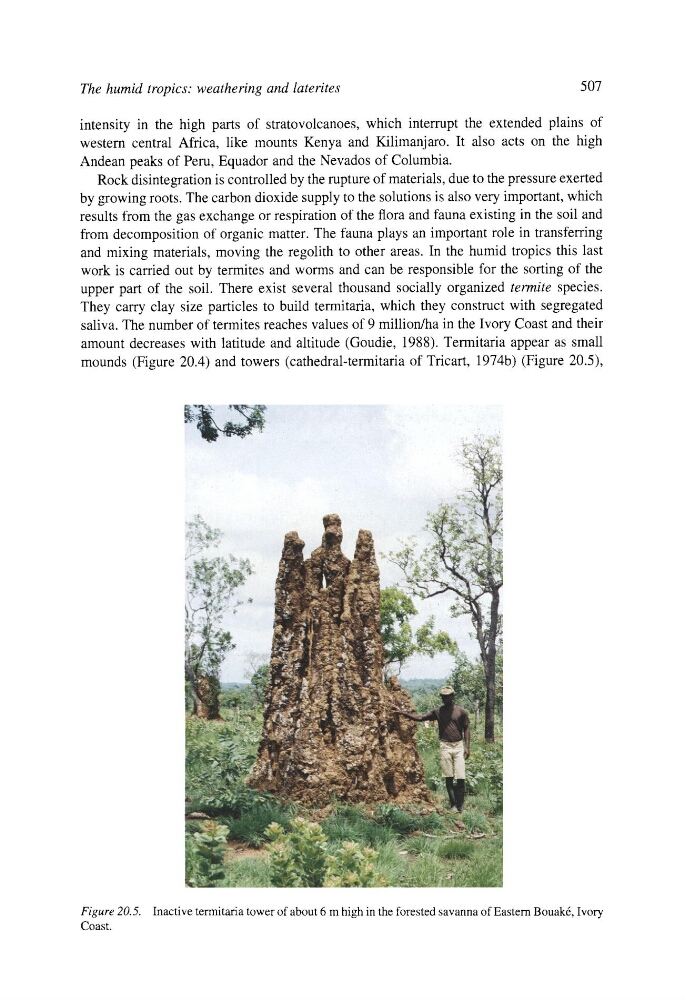
mounds (Figure 20.4) and towers (cathedral-termitaria of Tricart, 1974b) (Figure 20.5),
Figure 20.5. Inactive termitaria tower of about 6 m high in the forested savanna of Eastern Bouak6, Ivory
Coast.
507
intensity in the high parts of stratovolcanoes, which interrupt the extended plains of
western central Africa, like mounts Kenya and Kilimanjaro. It also acts on the high
Andean peaks of Peru, Equador and the Nevados of Columbia.
Rock disintegration is controlled by the rupture of materials, due to the pressure exerted
by growing roots. The carbon dioxide supply to the solutions is also very important, which
results from the gas exchange or respiration of the flora and fauna existing in the soil and
from decomposition of organic matter. The fauna plays an important role in transferring
and mixing materials, moving the regolith to other areas. In the humid tropics this last
work is carried out by termites and worms and can be responsible for the sorting of the
upper part of the soil. There exist several thousand socially organized termite species.
They carry clay size particles to build termitaria, which they construct with segregated
saliva. The number of termites reaches values of 9 million~a in the Ivory Coast and their
amount decreases with latitude and altitude (Goudie, 1988). Termitaria appear as small
mounds (Figure 20.4) and towers (cathedral-termitaria of Tricart, 1974b) (Figure 20.5),
Figure 20.5. Inactive termitaria tower of about 6 m high in the forested savanna of Eastern Bouak6, Ivory
Coast.