

480
Climatic Geomorphology
flood recurrence interval is 70 years. Disasters only occur, therefore, from time to time,
and only the really important ones become the object of public note (Burton et al., 1978).
Pediments have high drainage densities, but in contrast to alluvial fans they have no
radial network. Pediments can be very problematical areas for human activity because
they are at risk of flooding, channel instability and sedimentation (Rhoads, 1986). Because
of their many small channels, linear constructions are often flooded and eroded. To solve
this problem, dams are constructed on the upper ramp of the pediment to deviate water for
flood control. The sediments transported also influence human activity by blocking drains,
sewers - even narrow bridges - and thus hold water back and increase the flow. The small
channels can overflow into one another. All this makes it more difficult for engineers to
stabilize the channels. Where there are pediments, the best solution is to stabilize the
largest channels and to be prepared for rising water (Graf, 1988).
4.4. Floods
On alluvial fans, flood waters are mainly sheet flows running across the fan surface.
Floodwater poses important risks to human activity, and on occasion can be the cause
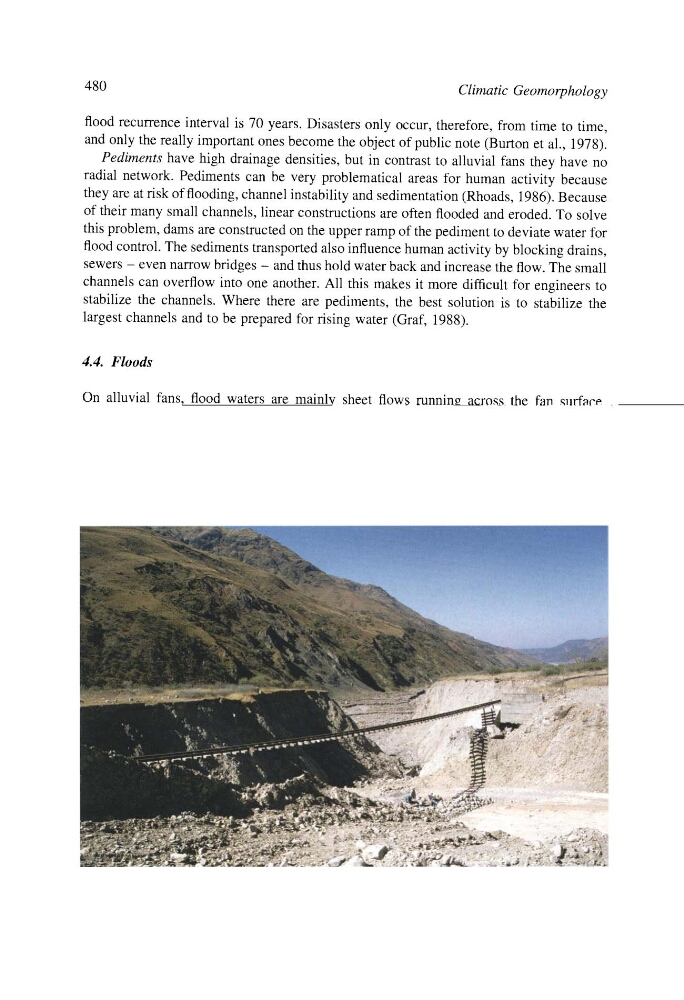
of catastrophe. Buildings can be damaged or destroyed, and railways (Fig. 19.16), roads
(Fig. 19.17), canals, bridges (Fig. 19.18) and agricultural land damaged by erosion or the
accretion of the solids carried by the water.
Figure 19.16. The Arroyo del Medio fan, over which a railway passes, has been cut by the Rfo Grande.
The tracks have been disturbed and left hanging in the air. Cordillera de los Andes, Province of Jujuy,
Argentina. Photo: J.L. Pefia.
Climatic Geomorphology
flood recurrence interval is 70 years. Disasters only occur, therefore, from time to time,
and only the really important ones become the object of public note (Burton et al., 1978).
Pediments have high drainage densities, but in contrast to alluvial fans they have no
radial network. Pediments can be very problematical areas for human activity because
they are at risk of flooding, channel instability and sedimentation (Rhoads, 1986). Because
of their many small channels, linear constructions are often flooded and eroded. To solve
this problem, dams are constructed on the upper ramp of the pediment to deviate water for
flood control. The sediments transported also influence human activity by blocking drains,
sewers - even narrow bridges - and thus hold water back and increase the flow. The small
channels can overflow into one another. All this makes it more difficult for engineers to
stabilize the channels. Where there are pediments, the best solution is to stabilize the
largest channels and to be prepared for rising water (Graf, 1988).
4.4. Floods
On alluvial fans, flood waters are mainly sheet flows running across the fan surface.
Floodwater poses important risks to human activity, and on occasion can be the cause
of catastrophe. Buildings can be damaged or destroyed, and railways (Fig. 19.16), roads
(Fig. 19.17), canals, bridges (Fig. 19.18) and agricultural land damaged by erosion or the
accretion of the solids carried by the water.
Figure 19.16. The Arroyo del Medio fan, over which a railway passes, has been cut by the Rfo Grande.
The tracks have been disturbed and left hanging in the air. Cordillera de los Andes, Province of Jujuy,
Argentina. Photo: J.L. Pefia.